The 'fiddly and frustrating' work removing 10,000 coins from Giant's Causeway columns

 National Trust
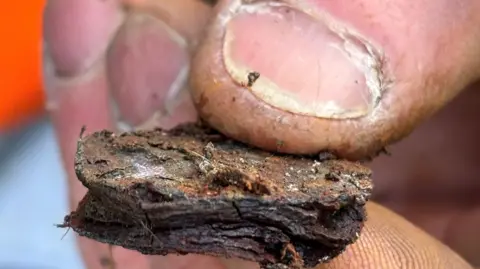
The equivalent of 10,000 coins have been painstakingly removed from the Giant's Causeway following years of visitors jamming them between the columns.
Conservationists working to protect Northern Ireland's iconic World Heritage Site have removed more than 20kg (44.1 lb) of unwanted coins from between its basalt pillars.
Work to remove the coins got under way in May last year following concerns the coins were damaging the causeway's rocks.
"It is a relief, the coins were doing a significant amount of damage ," Dr Cliff Henry, nature engagement officer with the National Trust said.
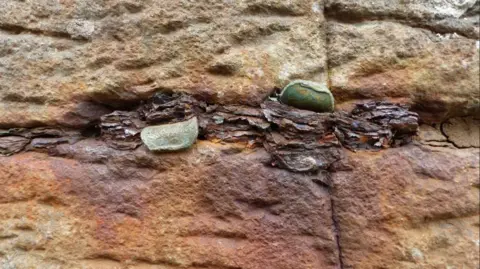
"These coins were rusting and expanding and were capable of pressing the whole column of rock above them, pushing them up," he told BBC Radio Foyle's North West Today programme.
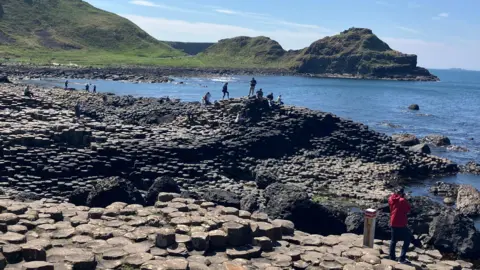
The National Trust said the practice of jamming a coin into the causeway had started years ago but had become problematic as it increased in scale over the last decade.
It is thought visitors were leaving them behind for luck or for love.
A report from the Geological Survey of Northern Ireland had previously recommended the removal of the coins in order to stop the physical and chemical impact of the metal on the rocks.
 National Trust
Henry added: "All that rust, that staining, was coming down the front of the columns.
"It looked terrible and it was causing physical damage to the causeway. We are very glad to get them all out."
 National Trust
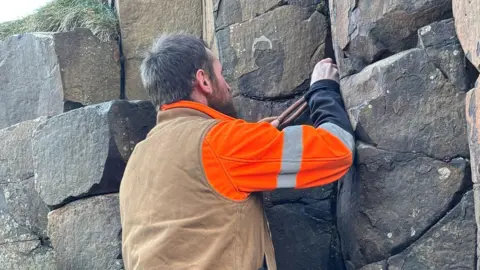
Specialist stonemason Nathan Morrow was brought on board to help with their removal.
"He found it satisfying but frustrating at the same time. It was fiddly work, and frustrating work," Dr Henry said.
"Some coins were quite well stuck. He found if he got them to move at all, if he worked them forward and back, eventually he would be able to get them out. "
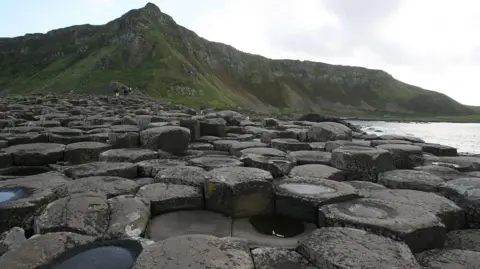 Press Association
Pliers were used to extract coins near the rock's edge, a grouting tool required for some of the more deeply wedged coins.
There were some coins that took upwards of 20 minutes to remove, he said, adding others "popped out very quickly".
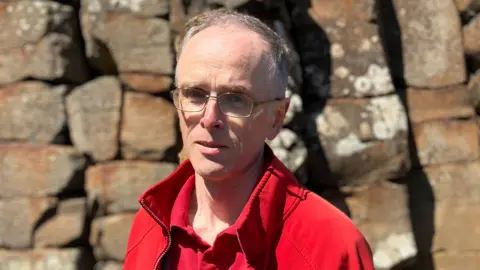
New signage has been erected at the site encouraging people not to wedge any coins into the causeway.
That message, Dr Henry said is being shared too on the Trust's social media presence.
"Please don't put these coins in, if you want to do something with your coin stick it in the charity box and we can use that money for good purposes," he said.
The National Trust said it is now looking at ways to turn the coins into an exhibition piece to raise awareness of their potential damage.
Why is the Giant's Causeway so famous?
 Getty Images
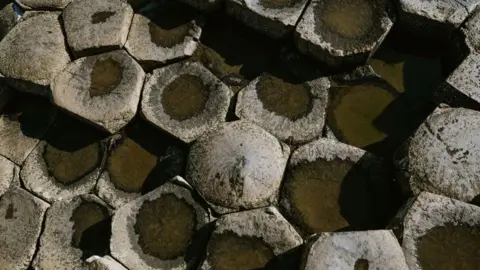
The Giant's Causeway is located in Country Antrim, and was formed by intense volcanic activity which forced molten rock up through cracks in the earth.
This lava flowed and then cooled, contracted and cracked, creating around eight-sided basalt columns.
These are also part of a famous legend about a giant called Finn McCool (Fionn mac Cumhaill in Irish).
It's said that he built the causeway as a bridge to Scotland, in order to fight another giant who was taunting him.
According to a different legend, in another fight with a giant, Finn threw some earth which missed, landed in the sea, and became what we now know to be the Isle of Man.