US and Iran agree deal to end war as Trump says Strait of Hormuz to reopen

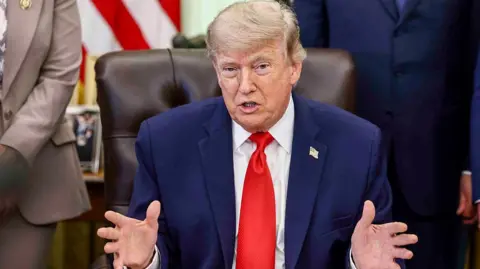 Jim Lo Scalzo/EPA/Bloomberg via Getty Images
The US and Iran have agreed to strike a deal to end their conflict, with US President Donald Trump saying the Strait of Hormuz oil shipping channel would also reopen.
Pakistan's Prime Minister Shehbaz Sharif, whose country has been mediating, announced the deal on Sunday evening.
He said both sides had declared "the immediate and permanent termination of military operations on all fronts, including in Lebanon", where Israel and the Iran-backed group Hezbollah have been fighting, although Israeli politicians criticised the deal.
Trump said he had ordered the immediate removal of a US naval blockade of Iranian ports and said the Strait of Hormuz would be opened when the initial agreement was signed in Switzerland on Friday.
"Ships of the World, start your engines. Let the oil flow!" Trump wrote on Truth Social.
In another post, he said the deal "will bring Peace and Security to the whole Region".
Iran's deputy foreign minister Kazem Gharibabadi confirmed the end of military operations in a phone call on Iranian state TV, which portrayed the framework deal as a victory for Iran.
Iran's top military command, Khatam al-Anbiya Central Headquarters, said that Iranians, together with the country's armed forces and Tehran's proxies and allies in the region, had shown the US and Israel that they had "no option but to accept defeat and surrender".
Israeli politicians pushed back on the deal on Monday.
Defence Minister Israel Katz said Israel opposed a withdrawal from the roughly 5% of Lebanese territory that it has occupied and pledged that if Iran attacked Israel due to events in Lebanon, it would strike "with full force".
Far-right National Security Minister Itamar Ben Gvir wrote on X that "Trump's agreement does not bind us" and vowed to dismantle Hezbollah.
Opposition figure Yair Golan said the deal had been "made over Israel's head".
Gharibabadi told Iranian state media that Qatari mediators held "nearly 14 to 15 hours of lengthy talks" in Tehran to reach the initial agreement.
The deal will extend a ceasefire agreed on 8 April for another 60 days, during which the two sides will sort out the details of a final deal.
Key past sticking points have included Iran's nuclear enrichment and Western insistence that the country not possess a nuclear weapon, and Iran's desire for comprehensive sanctions relief and access to tens of billions of dollars in frozen oil revenues.
US Vice-President JD Vance told Fox News on Sunday that Iran never possessing a nuclear weapon was "built into this agreement" and that the US will be able to verify compliance.
In a congratulatory joint statement, the leaders of the UK, France, Germany and Italy said Iran "must never acquire a nuclear weapon" and that they were "prepared to lift relevant sanctions in response to clear, verifiable steps by Iran on its nuclear programme".
UK Prime Minister Sir Keir Starmer called the announcement "a hugely important step forward in ending the war, ensuring regional stability and re-opening the Strait of Hormuz".
Trump also said that upon the signing of the deal on Friday, "oil will flow on both ends again for the Region, and the World" through the Strait of Hormuz.
The shipping channel, through which 20% of the world's oil and natural gas travels, has been effectively closed by Iran since the war began on 28 February, driving up fuel prices worldwide.
The conflict started when Israel and the US launched strikes on Iran, killing the country's supreme leader. Iran responded by firing missiles at Israel and targeting US bases and assets in Gulf countries.
Lebanon was pulled into the conflict days later, when Iran-backed group Hezbollah fired rockets from Lebanese territory at northern Israel.
Lebanon and Israel agreed to a ceasefire on 16 April. Within days, Israel had continued regular deadly air strikes, accusing Hezbollah of violations, and Hezbollah had returned to its attacks.
Israel has occupied around 5% of Lebanon's territory and flattened entire villages with air strikes and demolitions.
Israel and Hezbollah had agreed to a previous ceasefire in 2024, although Israel had continued near-daily attacks on targets and people it says were linked to Hezbollah.
Additional reporting by Ghoncheh Habibiazad