Plans to stop paying Coastguard volunteers dropped

 Getty Images
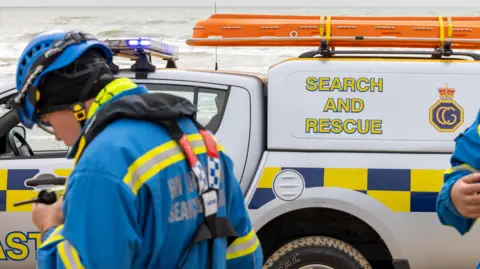
Plans to stop paying volunteer coastguards have been dropped by the government over fears officers would quit or reduce their hours.
The proposed change followed a Court of Appeal judgment which classed responders as workers, due to them receiving hourly remuneration for attending incidents and training exercises.
The Maritime and Coastguard Agency (MCA) said it therefore needed to "change how the service operates" and planned to move to an expenses-only model.
However, transport minister Keir Mather said he had listened to the views of Coastguard rescue officers (CROs) and the change would not go ahead on 1 September.
The Selby MP added: "I visited a Coastguard station in Southampton, met officers from Hill Head and Portsmouth teams, and heard first-hand the impact that changes could have on CROs and their families.
"Given these concerns, my department has undertaken further work to scrutinise the information that was provided to inform decision making.
"Having done so, it has become clear that parts of the information gathering process to inform MCA operational decisions, in particular, the two surveys undertaken, were not sufficiently detailed to properly reflect the impact of these changes."
Although CROs are officially classed as volunteers, they can claim about £11 per hour for responding to callouts or undertaking training exercises.
A minimum payment equivalent to three hours – about £33 – can be claimed even if an incident is resolved before that.
 BBC/Jim Scott
The government was previously warned a survey carried out by the MCA had shown HM Coastguard would be devastated if moving to a sole-volunteer model went ahead.
It showed that at least a quarter of all volunteers would quit or reduce their hours across the UK, rising to as high as 56% in the South East and southern England regions.
HM Coastguard is mainly made up of volunteers, consisting of about 3,000 voluntary responders compared with 400 paid members of staff.
After the expenses-only model was announced in June, it was also met with criticism from the families of victims.
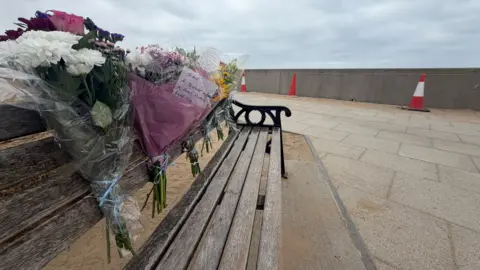
Wayne Taylor and Ian Pascoe were recovered from the water at Seaton Carew beach in Hartlepool on Sunday after helping two children in difficulty in the sea, but they were pronounced dead a short time later.
Pascoe's son Dan said: "The Coastguard is an emergency service in its own right.
"England is an island with over 7,000 miles of coastline - who is making these ridiculous decisions?
"How have we, as a country, gotten to a point where if something like this happens in future, you ring 999 and no-one is coming?"
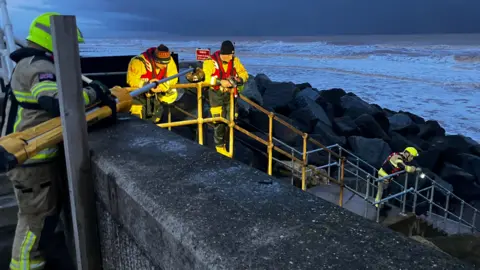
In Withernsea in East Yorkshire, CROs played an integral part in a rescue operation in which three people died.
Grace Keeling, 15, and her friend were taking pictures on the steps leading down to the beach on 2 January, before Grace was engulfed by a large wave.
Her mother Sarah Keeling, 45, and passer-by Mark Ratcliffe, 67, died after going into the water to try to save her.
 BBC/Jessica Lane
MP for Beverley and Holderness, Graham Stuart, said: "The response to the tragedy off Withernsea on 2 January showed the very best of our Coastguard, RNLI volunteers, Hornsea Inshore Rescue and emergency services.
"They went out in terrible conditions and did everything they could to save lives.
"I am pleased the minister listened to CROs, MPs and coastal communities and stopped the September change.
"The government must now work properly with Coastguard rescue officers on a long-term model which respects their service, rewards the hours they give and keeps our coastal communities safe."
Scarborough and Whitby MP Alison Hume added that she had met with Coastguard volunteers in Ravenscar and had worked alongside other coastal MPs to get the government's plans scrapped.
"Following the evidence session I co-chaired in Parliament yesterday, minister Keir Mather has just announced that the proposed changes for September will now not go ahead," she said.
"I have been humbled by the stories I have heard and want to thank the CROs who keep our coastal communities for your service."
'Service is vital'
An MCA spokesperson said it had listened to CROs and "heard the strength of feeling on how changes would affect them".
"We have agreed with ministers to pause plans to move to a revised volunteer model," they added.
"The work of the service is vital to keeping people safe, and this pause gives us the time to engage extensively with our hard-working officers, understand more deeply the potential impact of any changes, and ensure their views help inform the decisions we take on how to shape the service going forward."
Mather said trade unions would also be consulted on future decisions.
"In the longer term, the Department for Transport will explore options for how Coastguard rescue officers can continue to be rightfully recognised and rewarded and have the flexibility to continue to serve their communities," he said.
Additional reporting by PA Media.
Listen to highlights from North Yorkshire on BBC Sounds, catch up with the latest episode of Look North.