Too hot to work? What Channel Island laws say

 BBC
BBCA union representing Channel Island workers says it supports the introduction of maximum temperature limits in workplaces to protect staff, as the islands experience their third heatwave of 2026.
There is no law in Guernsey, Jersey or the UK that says a given temperature is too hot to work, although each place refers to guidance from the UK's Health and Safety Executive (HSE).
Citing this, the States of Guernsey said no meaningful upper limit could be imposed "because in many indoor workplaces high temperatures are not seasonal but created by work activity".
The Government of Jersey said it encouraged all employers to work closely with staff to manage the risks associated with extreme heat.
Temperatures were forecast by Jersey Met to reach up to 34°C (93F) on Friday, a fortnight after Jersey experienced "the hottest day on record for the island", when the temperature soared to a record-breaking 39.3°C (102.7F).
Unite the Union in Jersey's James Turner said it supported any proposed maximum workplace temperature limits "in the interests of workplace safety."
He added: "All employers must ensure under current legislation that the workplace temperature is 'reasonable' to ensure they are following their 'duty of care' to all its employees."
He said he would welcome "mitigation" measures like blinds on windows, open doors and windows for airflow, fresh drinking water and extra breaks for workers as well as fans and air-conditioning where applicable.
"It is vital that if anyone feels unwell or unsafe in such conditions, they report it immediately to colleagues and management as a formal safety concern."
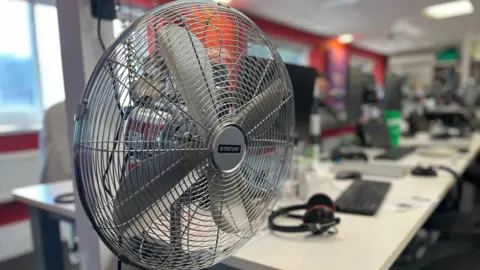
On its Facebook page, Unite the Union Guernsey said that it was "campaigning for a legal maximum working temperature because no one should risk their health just to earn a living".
It said that there was "ambiguity around what is 'reasonable'" and added that it was "time for stronger protections to keep workers safe on the job".
The union said that its health and safety representatives could inspect workplaces, challenge unsafe conditions, demand risk assessments and negotiate agreements to protect workers during extreme weather.
"Remember, employers still have a duty to protect your health and safety so it's important you know your rights," it continued.
'Cultural change' needed
The States of Guernsey said that heat was classed as a hazard, and that it came "with legal obligations like any other hazard".
It said that under Guernsey law, the minimum temperature in an indoor workplace should normally be at least 16°C, or 13°C if work involved rigorous physical effort.
But Robin Gonard, the States of Guernsey's Chief Health and Safety Officer, said: "Before we just apply a blanket maximum temperature, we probably want to be thinking about the built environment much more, and also thinking about how working patterns may need to be changed or how we can adapt already the way that we work, so that we don't just look at temperature as the only marker."
Gonard added that in countries in southern Europe, workers were accustomed to taking breaks during the hottest hours of the day, before again starting work in the late afternoon.
"That's why there's a cultural change that's needed in relation to heat," he said.
"We're just not used to doing anything which is not our typical 09:00 - 17:00 or 08:00 - 16:00, standard working hours.
"But breaking the day halfway through so that we avoid working at the hottest hours - that's a perfectly reasonable way to work."

A Government of Jersey spokesperson said that under the Health & Safety at Work (Jersey) Law 1989, all employers should assess risks to their staff, and ensure that they put necessary controls in place to protect them.
The spokesperson said that best practices included encouraging regular hydration, providing access to cooler environments where possible, adjusting working arrangements where operationally appropriate, and reminding employees to take regular breaks and report any concerns.
"Guidance relating to workplace temperature is available for all Island businesses online, via the Health & Safety Executive, and we encourage employers to review Jersey's Approved Code of Practice for health and safety at work," the spokesperson added.
Follow BBC Guernsey on X and Facebook. Follow BBC Jersey on X and Facebook. Send your story ideas to channel.islands@bbc.co.uk.