'It was a relief to be offered ultrasound treatment'

 BBC
BBCWhen Estella Devaney Fenn found out she had a mass growing in her uterus she was told her options were limited.
She had uterine fibroids - non-cancerous growths in her uterus - that were causing her debilitating pain.
Originally she was given two choices, induced menopause or open-abdominal surgery, which both came with risks and side effects.
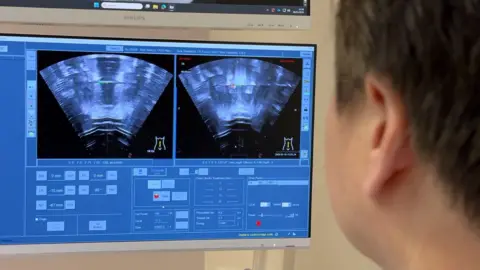
But the high-intensity focused ultrasound (HIFU) facilities at Oxford's Churchill Hospital gave her a third option.
"I was able to advocate for myself against the two extremes offered to me," she said. "And then was offered this HIFU treatment."
The non-invasive procedure uses ultrasound to heat and destroy targeted tumour cells while sparing healthy tissue.
Estella said it was "almost painless, simple and I came home the next day".
She said she had since experienced a few symptoms, but has been told that is to be expected while her body heals.
HIFU turns up the power of ultrasound by a factor of 10,000, according to clinical director Prof David Cranston, and works like a magnifying glass focusing sunlight.
Its high-energy focused sound waves do not leave a wound, with some patients returning home the same day as the procedure.
Prof Cranston said the fact HIFU was non-invasive had many benefits for cancer patients, as well as women with uterine fibroids.
"It avoids the need for surgery and it allows some people even to become pregnant after treatment," he said.
In 2023, Oxford was designated the fifth Centre of Excellence in Europe by the Focused Ultrasound Foundation, and the eleventh worldwide.
The trust said a newly donated state-of-the-art machine, manufactured by Haifu Technology Ltd, would allow it to expand its clinical work treating non-cancerous tumours.
Dr Paul Lyon, a consultant radiologist and clinical director of the programme, said it was an "exciting time" for the technology.
"What we need now is to drive this forward clinically, not just in research, but actually develop services and open up new centres in the UK with this technology," he said.
You can follow BBC Oxfordshire on Facebook, X (Twitter), or Instagram.