The specialist who gave a woman her confidence back with a prosthetic nose

 BBC
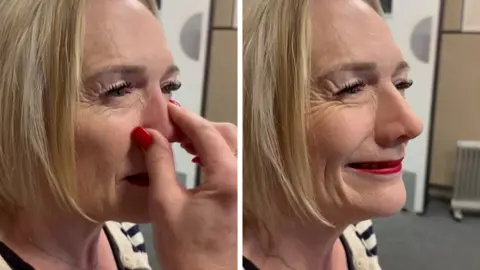
BBCA specialist who helped a woman rebuild her life after she lost her nose to a rare medical condition said her patient went from crying on the hospital floor to inspiring others with her facial prosthetics.
Kelly Hood, a consultant maxillofacial prosthetist at Birmingham's Queen Elizabeth Hospital, first met Jayne Hardman, from Redditch, Worcestershire, about nine years ago.
At the time, Hardman's nose had collapsed as a result of a rare autoimmune condition and she had barely left her home for 18 months.
"I could see that she was so uncomfortable," Hood said.
"She was really quiet and really shy, she wouldn't have anyone looking at her."
Hood recalled how Hardman became so distressed during their first meeting that she did not want to sit in a chair.
"She was actually on the floor crying because she was so affected," she said.
"I sat on the floor with her as she didn't want to sit in the seat and be the centre of attention."
Maxillofacial specialist Hood said she asked her senior colleague to let her help, despite the difficulties involved in reconstructing Hardman's nose.
"She hadn't been out the house for 18 months, and wasn't enjoying life at all," she said.
The pair initially began with adhesive prosthetic noses which could be placed over the area.
But as Hardman's nose collapsed further, it widened, meaning a prosthesis had to be designed around the changes to her face.
"There were going to be compromises and she knew that but she didn't mind and she absolutely embraced it," Hood said.
She said the change in Hardman's confidence was striking.
"All of a sudden Jayne's true character came out," she said.
"I didn't know her before this but I was told she was a firecracker then and she certainly is now.
"She's one of my favourite patients."
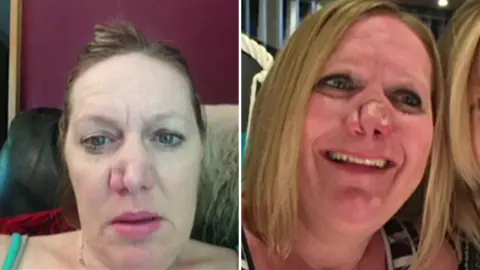 Jayne Hardman
Hardman now uses magnetic prosthetic noses and has more than 10 versions to match different skin tones and situations.
She has also become an advocate for people living with facial prosthetics, sharing videos online about her condition and her life with a prosthetic nose.
Hood said she was proud to see how her patient had used her experience to help others.
"She's an absolute advocate for anyone living with a facial prosthetic," she said.
"She's normalising this for everyone and it's really wonderful to be able to show the world that life after huge major surgery, like Jayne has had, there is a good quality of life."
How does a magnetic nose work?
Hardman's prosthetic is attached using implants placed into the bones of her face.
"They're actually a type of dental implant and they're screwed into the bone," Hood explained.
Before operations, surgeons assessed CT scans to determine the quality and quantity of bone available in the centre of her face in order to support the implants.
"They're essentially screwed in at the right angles we need, in order to put little magnets on the top," she said.
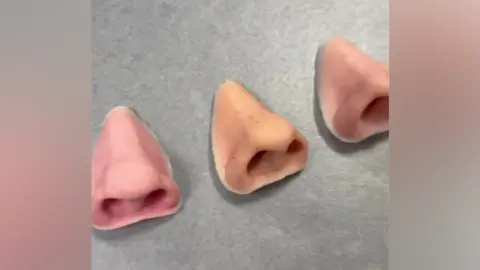
Those magnets allow a prosthesis to be manufactured which can then be put on and removed by the patient.
For Hood, the case is an example of why she loves her job.
"It's so rewarding and I always, always say, if I won the lottery I still would do it," she said.
"I wouldn't want to do it anywhere else other than the Queen Elizabeth.
"We're one of the best teams in the world."
Follow BBC Hereford & Worcester on BBC Sounds, Facebook, X and Instagram.