New Tata boss to face formidable challenges
 NurPhoto via Getty Images
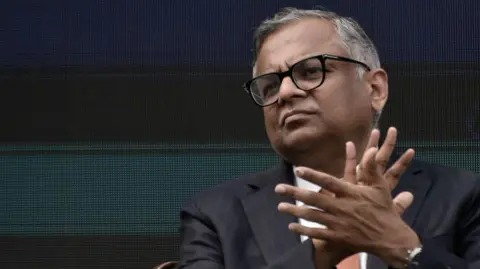
The shock resignation of Tata Sons chairman N Chandrasekaran earlier this month has left corporate India's top job vacant. But finding his successor will be no easy task for the country's most revered conglomerate, whose sprawling $300bn empire spans Jaguar Land Rover and Air India as well as manufacturing iPhones for Apple.
Chandrasekaran resigned amid a deadlock over his reappointment and a widening rift with Tata Trusts - the charity arm which owns controlling shares of the unlisted commercial holding company.
The disagreements are said to have centred over a public listing of Tata Sons as well as capital allocation for the group's various new unlisted businesses, including semiconductors, e-commerce and aviation, all of which are bleeding money.
The group has been in the middle of the largest ever capital investment cycle, with tens of billions of dollars being deployed on everything from building India's first chip fabrication plant to manufacturing EV batteries and turning around Air India, which the Tatas bought from the government in 2022.
The new person at the helm will need to have an ability to assess and absorb the risks that have come with this breakneck expansion as well as rise up to numerous other challenges, Hetal Dalal from Institutional Investor Advisor Services (IiAS), a governance advisory firm, told the BBC.
"It is an incredibly difficult role not just for the individual who will get it but also for the selection committee to find someone. It requires a multitude of skillsets and experience from managing the Tata Trusts to the Tata Sons board, understanding various new businesses and being able to also have strong relationships with regulators and the government," Dalal said.
"There aren't many people running such large, diversified conglomerates. And will they leave their current roles to join the Tata Group?"
 LightRocket via Getty Images
The complexity of the role has risen in recent years as the "collective losses of the new businesses are more than the cashflow generated by older companies like TCS, the group's software arm whose business model has been challenged by AI”, Nirmalya Kumar, who previously headed strategy at Tata Sons, told the BBC.
TCS has been the group's cash cow, contributing to some 85% of cash flows, but is no longer the pillar of support it once was.
According to Dalal, even though losses at privately held companies have mounted, the performance of publicly traded, CEO-run Tata companies has been strong.
The group has a good bench strength of internal candidates who could throw their hats in the ring. Yet, finding a candidate who's a straight "plug and play fit" will be difficult, she says.
"I think any person who comes in will have a set of skills and experience, but must be also groomed for the role."
Kumar, on the other hand, isn't convinced the internal names doing the rounds will fit the bill.
"The people internally are good executors of existing business models. Companies like Tata Steel and Tata Motors are almost running on auto-pilot with a CEO in charge. The new chairman will have to understand new business models of the four unlisted businesses that are losing money," he said.
For investors, the resignation is likely to usher in a period of prolonged uncertainty.
New leadership will bring a change in strategic direction at the group in terms of how a new chairman approaches the ambitious expansion Chandrasekharan undertook, say experts.
"Some of the bleeding businesses will need a strategic plan to be made profitable. [The new person] will need to decide whether to scale back or exit some investments," says Dalal.
Kumar says they will also need to communicate a clear plan to the market on how much further investment is needed and when a break-even is expected on these ambitious bets.
But most importantly, he adds, the focus will have to be on "driving alignment between the Trusts [the dominant shareholder] and Tata Sons".
The group's most successful run was under JRD Tata and Ratan Tata, when the relationship between the biggest shareholder and the operating company was frictionless as they were at the helm of both entities.
It broke down under Cyrus Mistry when there was a separation of the roles. Chandrasekharan's exit is the second instance where the chairman has resigned because of the rocky relationship with the Trusts.
The fact that the principal shareholder was not aligned on business strategy was perhaps a fundamental problem in the relationship breaking down, Mukund Rajan, former brand custodian at Tata Sons, told India Today news channel.
"You cannot have companies being run where the majority shareholder is either feeling ignored or not aligned with the way the company will be run going forward," Rajan said.
Repairing this relationship will have to be a key priority for whoever is next in the driving seat.
 AFP via Getty Images
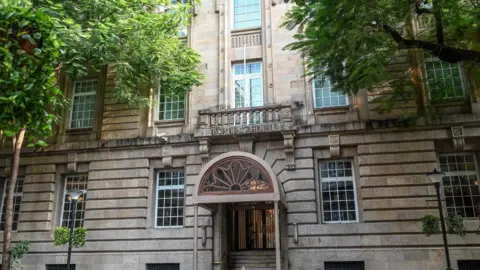
For now, the ongoing turmoil has dented the group's brand image, say experts.
Clear communication has been a major challenge with the Tatas, which does not bode well for the public markets, according to Dalal. While the holding company can argue that it is not publicly traded, what happens there has a direct impact on shareholders of the listed Tata universe, she adds.
"The priority should not be the volume of communication but about reducing uncertainty," Minari Shah, a communications advisor who previously worked with Tata Motors, told the BBC.
"That means demonstrating that governance mechanisms are working, reassuring stakeholders that business continuity is unaffected and providing clarity around the process for leadership transition. It is okay not to have all the answers immediately, as long as stakeholders have confidence that the disagreeing parties are in dialogue."
As of now, nearly two weeks after Chandrasekharan's resignation there have been no detailed public statements on either a succession roadmap, or the way ahead from either Tata Sons or Tata Trusts.
The former's annual general meeting also had to be adjourned because of a lack of quorum, leaving several governance and succession related decisions under a cloud at exactly the moment when shareholders of India's most iconic company will be looking for the greatest clarity.