How rare US Declaration of Independence copy was saved

 Family photo
It was an unexpected discovery that had historians scratching their heads.
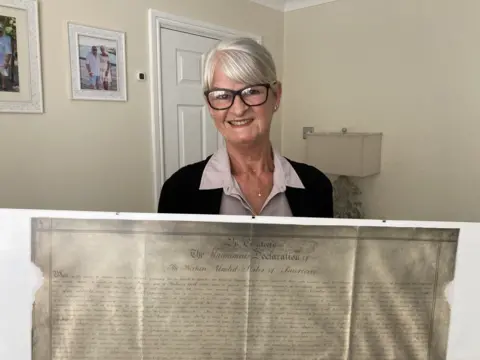
How did an 18th Century, handwritten parchment copy of the American Declaration of Independence end up in the West Sussex Records Office in Chichester?
Even more remarkable was the fact it was the only copy of its kind known to exist other than the original, kept in the US National Archives in Washington.
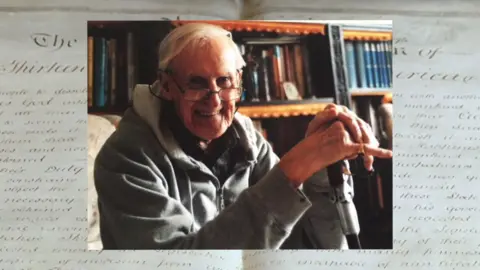
It transpired the document had been entrusted to the Records Office in 1956 by a local history buff, Leslie Holden. But its rarity and significance was not realised until decades later, after his death.
Holden's daughter, Noeline Buitenhuis, said: "He would have just been blown away. It would have been the highlight of his life.
"He'd have been delighted that he saved it."
Holden had been an avid collector of historical artefacts which filled every spare corner of his home.
"On Saturday mornings he would look through the Chichester Observer, see where the local jumble sales were and get there early to see what he could find," recalled Buitenhuis.
"Papers, books, paintings, anything relating to Chichester he would buy."
It was during the Second World War, while Holden was working as a clerk at Rapers solicitors in Chichester, that he was believed to have saved the Declaration from destruction.
The government had launched a campaign for homes and businesses to salvage items to be recycled for the war effort, including paper.
"He was asked to go down into the cellar and retrieve all this paperwork for salvage," said Buitenhuis.
"He found numerous items there he didn't feel should be destroyed and asked his boss if he could keep them."
Holden later gave all the documents he'd amassed over the years to the Records Office, including the Declaration.
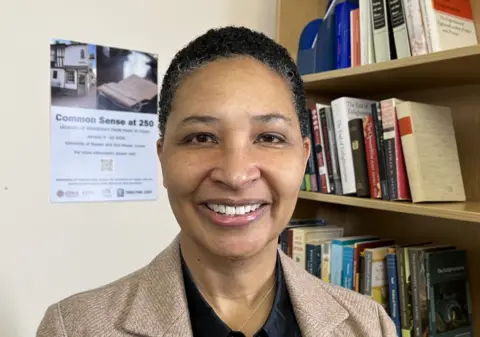
But it was only in 2016, when Harvard University started a project to catalogue every early copy of the Declaration produced, that the document's true significance came to light.
Its listing in the West Sussex online archive intrigued lead researcher Professor Danielle Allen, who asked for an image to be sent.
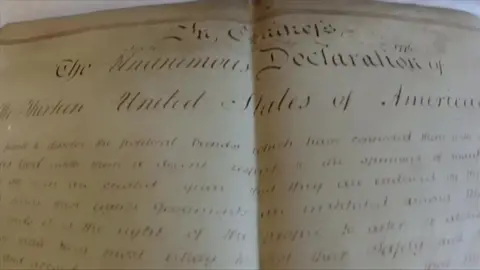
"We opened it and wow! There was this incredible image of a ceremonial scale parchment of the Declaration of Independence," said Allen.
"Our jaws dropped. This wasn't supposed to exist. It's beautiful, it's completely legible. You just felt time collapse."
Scientific tests on the sheepskin parchment and type of ink used proved it was authentic and probably produced in Philadelphia in the 1780s, a few years after the original Declaration was signed.
 Getty Images
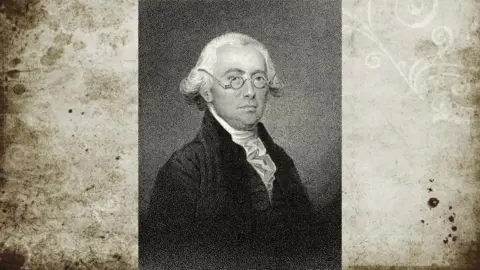
Wendy Walker, the county archivist for West Sussex, said: "The theory is it was made around 1787 at the instigation of James Wilson, who was one of the original Founding Fathers of America.
"He drew up the U.S. Constitution so would have needed a copy of the Declaration to refer to and maybe this was it - or one of them."
Now dubbed the 'Sussex Declaration', the next challenge for researchers was to work out how the document had got from Philadelphia in 1787 to the cellar of Rapers solicitors.
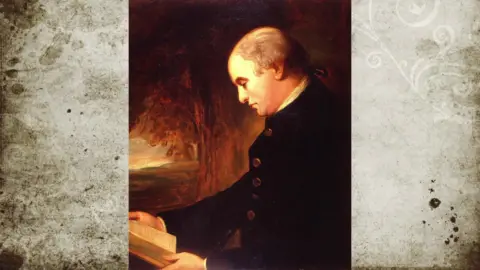
It transpired Rapers had looked after the legal affairs of Goodwood House in West Sussex, which 250 years ago was home to the Third Duke of Richmond, known as the Radical Duke.
 Goodwood Collection
Clemmie de la Poer Beresford, curator of the Goodwood Collection at Goodwood House, said: "The Duke had this wonderful sense of rebellion.
"When he saw the bloodshed that was happening in America, that was when he really decided to become an advocate for American independence.
"He wasn't worried about putting his neck out in Parliament and speaking against King George III".
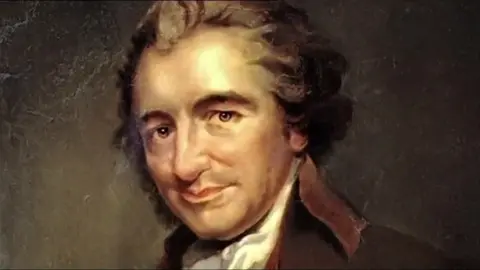
Behind the scenes, it seemed the Duke was supporting even more radical campaigners, including Thomas Paine, a tax collector from Lewes.
 Getty Images
Paine later travelled to America and in 1776 wrote the pamphlet Common Sense, urging the colonists to declare their independence from Britain. It was a big factor in swaying public opinion.
Paine and the Third Duke of Richmond were not previously thought to have had a close connection. But Allen had a hunch she has spent the last ten years trying to prove.
"Our hypothesis was that when Paine came back from America to Britain in 1787, he brought that copy of the Declaration with him as a gift for the Duke," she said.
Allen spent several summers poring over the Duke's papers and books in the library of Goodwood House before finding the evidence to support her theory.
 Goodwood Collection
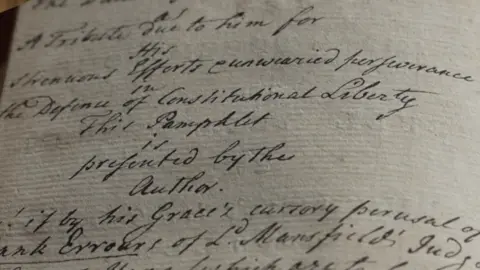
In a pamphlet called The Juryman's Touchstone, there was a handwritten dedication to the Duke "as a tribute for his strenuous efforts and unwearied perseverance in the defence of constitutional liberty".
Although the author was anonymous, Danielle recognised the handwriting as Thomas Paine's.
"I got goosebumps, the hair rose on the back of my neck," she said.
"It was just incredible."
Many historians have accepted Allen's theory, which appears to solve the mystery around the Sussex Declaration, just in time for the 250th anniversary of the Declaration of Independence on 4th July.
 West Sussex Records Office
This summer, the West Sussex Records Office is holding special public viewings of the unique document, which can be booked via its website.
"The more you learn, the more intriguing this story becomes," said Walker, who has previously hosted viewings by President Trump and the Duke and Duchess of Sussex.
"It's just been a fascinating journey and it's a journey that's still going on."
Follow BBC Sussex on Facebook, on X, and on Instagram. Send your story ideas to southeasttoday@bbc.co.uk or WhatsApp us on 08081 002250.