'It was like a family': Three generations worked at bank

 Kate Bradbrook/BBC
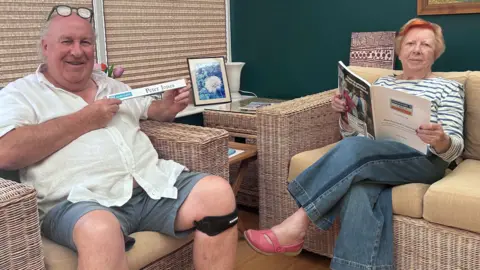
A mother, son and grandson who all worked for the same bank say the company was "a family" which connected people across their hometown.
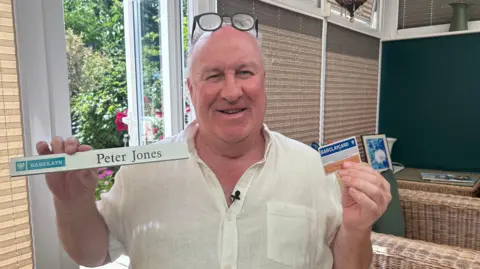
"I think I was indoctrinated at the Christmas party for children in 1967," jokes Peter Jones, now 66, who spent his entire working life at Barclaycard in Northampton.
The firm launched the UK's first credit card at a former shoe factory 60 years ago, but the Jones family say the hard work was matched by an amazing social scene.
His mother Pat Jones, 91, says: "I worked in fraud and credit review, and I played hockey and football for them at one stage through the social network.
"Barclays were a good supporter of social work. Male and female, you could do anything.
"I travelled the world for them. It just opened a new life for me, as it did for many female workers in Northampton," she said.
 Barclays
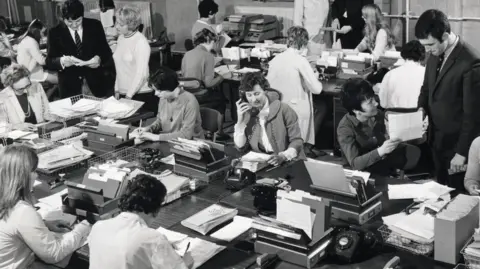
Peter, who joined Barclaycard at the age of 20, recalls a very different kind of workplace to today's computer-lined offices: both more restrictive and permissive.
"You could smoke at your desk - there was smoke just lingering in the air," he recalls.
"You could not go to the toilet unless you put your hand up. It was like being back at school. We sat in rows, everybody in their suits and ties - predominantly male.
"The chief clerk sat at the front, and if he looked at you, it was like laser eyes into your body because you knew you'd either done something wrong or well."
However, "that fear disappeared really through social events, sporting events," Peter says.
"The social side underpinned the business side, and they looked after the people," he continues.
"When you've got a happy workforce, you're very productive, you work as a team, you help each other out through thick and thin."
 Kate Bradbrook/BBC
He says Barclaycard has been "fantastic" to Northampton's economy and social network.
"The economy has really flourished. There's lots of families in Northampton who are intergenerational through Barclaycard," he says.
"You can't go into town now without either knowing someone who worked at Barclaycard, or they know of someone who worked there."
Peter's son is now continuing the family tradition, working at the Northampton HQ.
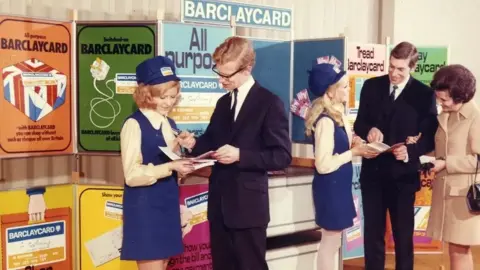
Paul Faulkner, Barclays' vice chairman for the Midlands, agrees that the impact on the area is considerable.
"We started in an old shoe factory with under 200 employees, and now here we are in the relatively new office in Northampton, with nearly 5,000 members of staff."
 Barclaycard
Pat says it is "mind-blowing" to see how banking has changed in recent decades.
"Youngsters have no idea of the concept of the beginning, when everything was paper-based," she says.
"The shops would ring in to a department called authorisation, and they would have great big manual sheets that were printed overnight from the previous day's transactions.
"The staff would then go through these papers looking for the card number and either approving or declining the transaction depending on the circumstances."
Pat has "very fun memories" of "very happy times" but says "things have changed - it's totally different now".
She continues: "I hear the odd word from my grandson. A lot of them work from home now, which means they miss that community spirit we had when I worked there."
Do you have a story suggestion for Northamptonshire? Contact us below.
Follow Northamptonshire news on BBC Sounds, Facebook, Instagram and X.