'Surrender or face full force' of state, Nigerian president warns armed groups

 Bloomberg via Getty Images
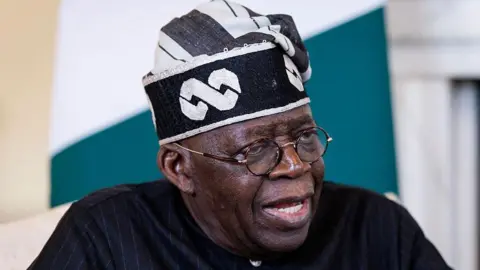
Armed groups operating in Nigeria must "surrender or face the full force" of the state, the country's President Bola Ahmed Tinubu has warned.
Speaking during a national broadcast marking Nigeria's Democracy Day, he said that although the year's celebrations had been "dampened" by the recent kidnappings of school children, security remained at the heart of the government.
Nigeria has long battled with an economic crisis and insecurity.
Public fear has been reignited as attacks on schools and villages as well as mass abductions for ransom have increased, largely in the country's northern and central regions.
Referring specifically to the abduction of children in Oyo and Borno states, Tinubu said the authorities "remain hopeful for their safe return".
"Democracy without security is not solid enough", he explained, as he announced more than 50,000 new police officers and allocated record 5.41tn naira ($4bn; £3bn) to defence and security in the yearly budget.
Thousands of new military recruits have also been approved.
Defending his government's security record since coming into office in May 2023, he said that the military had killed 13,000 "terrorists" in the past year, while civilian deaths as a result of insurgents were down by 81% since 2015.
Tinubu added that more than 124,000 fighters and their dependants had also laid down their arms under a government initiative called Operation Safe Corridor.
But security analysts have said attacks are continuing to affect communities across several states, and are now spreading to southern parts of the country.
Civil society groups have mobilised peaceful marches across Nigeria's major state capitals, calling for action against insecurity and economic hardship.
Millions of Nigerians are left struggling as Africa's most populous nation is hard-hit by rising food and transportation costs.
Labour unions and civil society groups have repeatedly expressed concerns over the impact of inflation on ordinary citizens.
The president said the economic reforms - ending the fuel subsidy and allowing the exchange rate to move freely - implemented by his administration were necessary to stabilise public finances and restore investor confidence.
Marking 27 years of civilian rule in Nigeria, Tinubu also used his address to pay tribute to national heroes for their efforts in the pro-democracy fight.
He paid special attention to those connected to the country's annulled presidential election in June 1993, including the late presumed winner, MKO Abiola.
 Getty Images/BBC
Go to BBCAfrica.com for more news from the African continent.
Follow us on Twitter @BBCAfrica, on Facebook at BBC Africa or on Instagram at bbcafrica