Why Andy Burnham will find it so tricky to unite Britain


 BBC
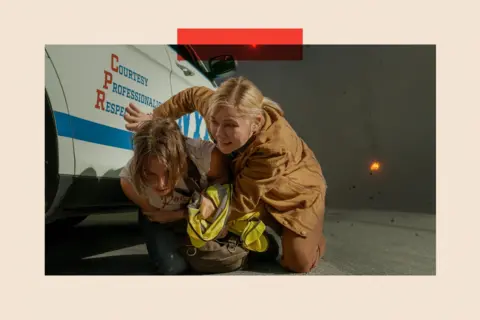
BBCDid you get to see the 2024 film Civil War, with its dystopian depiction of a present day USA in the midst of a violent meltdown?
What made it such an effective thriller was that it all seemed so frighteningly real. Although the two sides in that civil war were fictitious, it hit a raw nerve precisely because of the very obvious divides that scar modern day America.
But interestingly it was actually written and directed by a British film-maker, Alex Garland, and he expressed worries about his home country, as well as the US. In both countries, he told the Guardian, "there's a lot to be very concerned about".
He's not alone. If you are an avid user of social media, you could almost believe that we are a nation disunited enough to have a full-on civil war of our own. And even away from the exaggerated adversarialism online, there are plenty of people worried that Britain is gripped by uncontrollable rage.
 A24
A24It's a sense of discord that Britain's new prime minister, Andy Burnham, seems to recognise. Since announcing his run for the Makerfield seat in May, he's repeatedly urged Britons to forget about party labels or factional identities and instead unite around pride in their local area. "Place first, not party first", is how he puts it.
And as he entered Downing Street on Monday, he called for a "new national sense of unity, of common purpose and positivity".
But it's worth asking: just how divided really is Britain?
Some talk as though the population is ready to wield the pitchforks; that we are close to social breakdown; that a small spark could lead to a serious fire.
Last year, a commission co-chaired by the former Home Secretary, Sir Sajid Javid, warned in a report: "The bonds that hold society together - civic participation, and a shared sense of belonging - are under growing pressure."
Well, I have just had the privilege of spending a month journeying - literally and figuratively - through some of the divisions that define modern Britain, for a Radio 4 series.
Is there any common ground left in the country that Burnham has now inherited - or are we polarised to the point of no-repair?
A defining split
For a long time, Britain had a clear, defining split: social class. What kind of job you had, how you spoke, what time you had your evening meal, what you watched on TV, how you voted… it was all pre-determined by your working or middle class background.
Today, that has got a lot more complicated with a decline in the number of jobs that would have been regarded as "working class", and a big rise in the number of young people going to university from those backgrounds. That's not to say it isn't still there.
But probably the most obvious faultline in Britain and other western countries now is in values, with a marked difference between two sides: progressives on one side, and social conservatives on the other. If we have a civil war any time soon, it'll be the Allied Readers of the Guardian versus the United League of GB News Viewers. That schism is more clearly driven by age and education than it is by class.
This clash defines politics at the moment, and manifests in rows about "woke" values, patriotism, and immigration. And what makes it so intense is a feeling, held by some on both sides, that the other side is some kind of existential threat to their vision of what society should be.
Because this is such a clear schism, we commissioned polling from the More in Common research institute (covering Great Britain, not Northern Ireland).
We asked respondents if they prefer living in communities "where more people come from different cultural backgrounds", or "where most people come from the same cultural background". We found a population split down the middle: 53% prefer a diverse community, 47% said they preferred a more homogenous one.
It poses a challenge for Burnham: it's much harder to settle a national argument where there is a 50-50 divide, than where one side dominates completely.
On the specific question of immigration, however, the country looks more united. Our poll found that about three-quarters of Britons thought immigration was too high. Burnham himself has said that net migration was "way too high" under the Conservative government, and said he'll try to "find the right balance" on the issue.
Faultlines
But that's not the only faultline cutting across British society. From my conversations around the country, I heard a list of other, quite distinct concerns. These are often bound up under one general heading of "polarisation", but it's been illuminating to unpack them.
One specific worry - most keenly felt on the right - is about social integration. It is whether in some cities, there are communities of different culture, ethnicity and even language, residing right next to each other but living totally separate lives. We saw that voiced in Leicester, the city with the highest share of people who speak a main language that's not English.
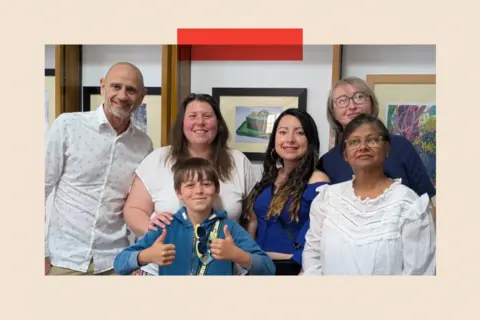
Jason, a 54-year-old window installer, has watched the city undergo this change, and has made Hindu and Sikh friends. But Jason, who is white British, also has his complaints, and says that Muslim families in the area tend to turn down his services. "They do stick to their own."
He says there's one part of the city he now stays away from, after he was racially abused last year by a group of men in a car "calling me a white so-and-so". And he finds the language barrier particularly difficult. "Sometimes it's very hard to take an inquiry on the phone. You're doing a quote on the windows and you just really can't communicate."
And then there's another worry - perhaps felt more keenly on the left - about what some see as rising levels of racism and violence. From Southport to Southampton, racial tensions have erupted on the streets in the last few years.
 SOPA Images/LightRocket via Getty Images
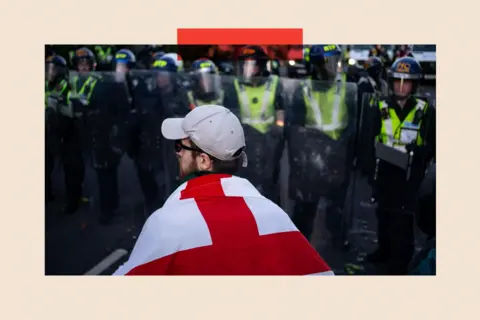
Hannah Henderson, who runs a dog-friendly coffee shop in Southampton, says she was recently driving with her daughter when they passed a hotel that houses asylum seekers. "There was a protest happening… people with the St George's flags around their shoulders… police lining up. She felt really unsafe. She's twelve. She didn't really understand, why would people be so cross?".
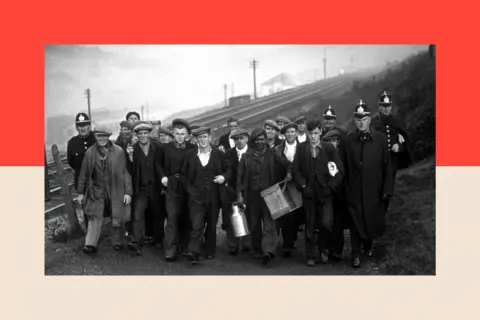
And then there's the divide between different places. Some residents of deprived, post-industrial towns - areas that have suffered from the disappearance of manufacturing and mining - feel a quiet frustration towards larger, economically flourishing cities. Those smaller towns tend not to have a university, and they tend to have a run down high street, giving a visual sense of decline. Places like Wigan - in Greater Manchester, Burnham's stronghold - often languish next to the bigger cities in whose shadow they sit.
 Topical Press Agency/Getty Images
This is a point made by Fiona Hill, the daughter of a coal miner from Bishop Auckland who later moved to Washington DC to become a senior White House adviser. Her book, There's Nothing For You Here, is named after the advice her father gave when she left school in 1984.
"The reason it's called 'left behind' is because you look at health outcomes, education, transport, access to amenities… and all of the [towns] that we're talking about are left behind," says Hill, who is now chancellor of Durham University. "Certainly they're not on the same level as… the flourishing city centres in Manchester, Liverpool, and absolutely not at the same level as London."
Sharing too little
Another, related concern is that we simply share too little these days: we do things at home alone; we don't go to church together each Sunday; we barely go out to the pub like we used to.
And on the national level - in England at least - there's only a vague sense of identity. Yes, most of us might enjoy watching the national football teams. But is that all our sense of nationhood consists of now? Even the flag - and its place on lampposts and signs - has become divisive.
Playwright James Graham thinks that a nation is largely defined via "the story it tells itself" - and parts of England, he says, feel excluded from the national story.
"Some people get bigger roles than others in that story, historically," he says. "If you see yourself on screen or stage, or in film or books or newspapers, if you feel like you're being seen and you're being heard and you feel part of a story, that does temper some of the natural bitterness and resentment that you feel when your economic situation isn't quite so good."
It all suggests Britain is a nation not quite at ease with itself and with a lot to fix.
Common ground
That being said, we found a lot of common ground talking to people around Britain; reasonable folks dispirited by the problems they observe, but ready to navigate their way through them constructively. For every riot, there are volunteers who'll come out the next day to clean up the mess.
Often there's a sports team or community centre that becomes a focal point for neighbourly spirit. At Grimsby Town Football Club, we heard from Christine Green, who started volunteering for the club during a difficult period in her life. "I was going through a divorce and… needed something to occupy my time and my mind so I'm not focusing on negative stuff", she remembers.
She lives in the deprived East Marsh area of Grimsby, a neighbourhood she says is often derided as a place of crime and unemployment. It is an image she doesn't recognise. "I know the person next door and I know the person across the road. My mum lives the next block up and my daughter can take the dogs for a walk. That's nice to me - not living in a secluded house where you've got no idea who anybody is around you."
Lord Stockwood, the Grimsby-born entrepreneur who bought the football club in 2021, says: "In an increasingly complex and crazy world, this is a place of permanence and love and memory for me and for many others."
Indeed, in our poll, it was encouraging that most respondents didn't seem to want to burn their locality down. We asked respondents if the city, town, or village they lived in was a good place to live and work. A full 70% thought their location was "very good" or "somewhat good" as a place to live. (It was less than that, only about half, who thought it was a good place to work.)
But is 70% good enough? You can take a glass two-thirds full or a third empty view of that figure.
Place is a unifying force
I do wonder if one way of finding common ground will be a renewed focus on the idea of "place". Increasingly, there's a push - from politicians and academics - to help people forge (or re-forge) connections to their local areas.
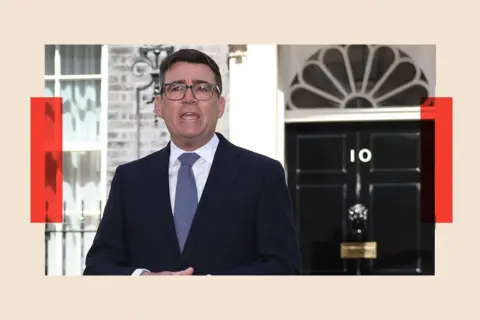
Certainly, Burnham seems to agree. When we embarked upon this journey, we didn't know he would be entering No 10. What fortuitous timing. He must have spent more time outside London in the years running up to his premiership than any other modern prime minister - and it's fascinating to see where that's landed him.
 Getty Images
Last year, he told the Institute for Government think tank: "Place is a unifying force. However people vote, they are united by a desire to see the place where they live move forward."
From the capital, the thinking goes, it's easy to think that if we can make Britain work, then each community will flourish. It might be that we really need to do it the other way round - if we can make each community flourish, then the country will work.
That's not straightforward by the way. As Burnham knows, it has been easier to revitalise Manchester than the many towns spread around it. But creating social cohesion where it is lacking, is surely a defining mission of Burnham's premiership.
Top picture credit: Getty Images

BBC InDepth is the home on the website and app for the best analysis, with fresh perspectives that challenge assumptions and deep reporting on the biggest issues of the day. Emma Barnett and John Simpson bring their pick of the most thought-provoking deep reads and analysis, every Saturday. Sign up for the newsletter here