Hidden moth population found after 70 years

 Charlotte Rankin
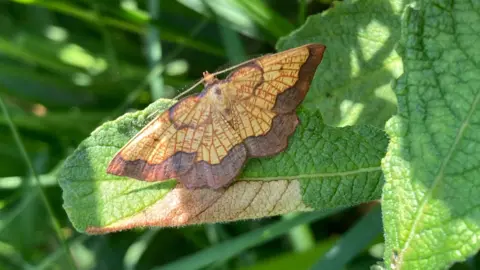
A hidden population of one of England's rarest moths has been found at a site where it had not been seen for more than 70 years.
Head of conservation at Butterfly Conservation Dr Dave Wainwright has spent his career searching for the dark bordered beauty and said he felt an "overwhelming feeling of relief" when they were found at Wallington estate, in Northumberland.
For decades, the only site where the moth was found in England was at Strensall Common, in Yorkshire, but the population there has been in decline due to climate change and a wildfire.
The discovery has given conservationists new hope for the species and opened up the possibilities of where more can be found.
Once widespread across northern England and Scotland, habitat loss has caused significant decline in the dark bordered beauty.
The custard-and-chocolate-coloured moth was found at the National Trust site previously but had not been seen since 1952.
 Charlotte Rankin
Wainwright has been searching for new English colonies since he started working for Butterfly Conservation in 2004.
He even visited the Wallington estate that year but found none.
But on his most recent visit, Wainwright said they found one "within a few minutes".
"I was hopeful - I'm always hopeful- but I definitely didn't expect it because I've been to so many sites to look for this species over the years, so my heart and head were in two different places," he said.
"It was one of the highlights of my career.
"Overwhelmingly it was just a feeling of relief that we weren't just fighting the fight at one site anymore."
The moth's caterpillars will only eat two plants - aspen and creeping willow - which makes it a challenge to conserve, according to Butterfly Conservation.
Wainwright said Wallington was a different environment to Strensell, which conservationists had previously based their idea of a "good habitat" for the moths, opening up new possibilities.
"The thing that's kept me going all these years is I always felt there was a chance of finding dark bordered beauty on the Northumberland/Cumbria border – now it feels like there could be other colonies out there waiting to be discovered which would be brilliant," he said.
The National Trust, which runs Wallington, said it hoped to expand the potential habitat for the moth.