Toll of looking after parents not spoken about, carers say

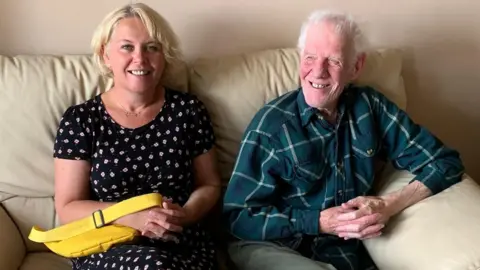 Gemma Lennon
"You don't just walk away from your parent for the day and go to bed thinking that's it. You are constantly thinking about the support you need to give."
Gemma Lennon, 54, drives from her home in Huddersfield to her father's house in Wakefield almost every day, to cook, clean, sort out his bills and keep him company.
Her father Richard, 85, is housebound and spends most of his day in his living room chair, using a stairlift to get to bed.
Gemma and her sister Jane both work full-time, and split his care between them, supported by paid carers for less than two hours a week.
"It is a real struggle, it is juggling," Gemma says.
The sisters are not alone - a 2023 King's Fund report suggested about 57% of unpaid carers were looking after a parent or grandparent.
For Gemma, it is not just about the financial implications of caring for a loved one, but the mental and physical toll it can take.
She was recently diagnosed with high blood pressure, which she thinks could be due to stress.
"I have a supportive husband which I'm really lucky for, but I come home and then it's thinking about what needs to be done here," she says.
"Then you just sit down and collapse, exhausted by everything."
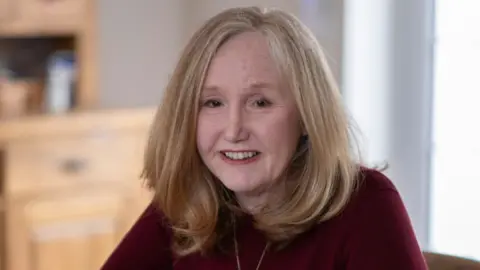 The Carents Room
Carents Room, a community interest company providing online support for those who support their parents, published a report this week into the emotional toll of caring.
It found 96% of 4,293 survey respondents said they were "always on alert" as a carer, even when not physically with the person they cared for.
It said 81% felt society treated caring for a parent as "just what you do".
Founder Dr Jackie Gray, a retired GP and public health consultant, describes the impact that caring can have as "absolutely profound".
"So many are living in this state of hyper vigilance," she says.
"I think we need to shift from considering this as a private family matter that people should just get on with, to giving them permission to seek and accept support."
Gemma says caring for an older person can "feel exactly the same as being a new parent, but you have to do it silently because of the lack of understanding".
Her father worries about putting a strain on his daughters which can lead to him being reluctant to ask for help, she explains.
His electricity went off for five hours on one occasion, preventing him from using the stairlift.
"I went to bed and then I got a message from dad saying 'when you come in the morning, I might still be sat in the chair'.
"He didn't want to tell us, but that broke our hearts. So it's making sure he doesn't feel like he's being a burden in any way."
 Getty Images
Currina Nembhard, 63, from Sheffield, moved closer to her 83-year-old parents so she could better care for them as they both have health conditions.
She works three days a week as a social worker alongside helping her parents with appointments, bills and online tasks.
"You're juggling two households," she says. "Now I'm semi-retired I thought, it's my time now, I'll be able to go on holiday for long periods of time."
She says she believes carers do have to take breaks, but adds: "You do feel guilty when you go away."
It is not about being reluctant to support a loved one, Currina says, but instead acknowledging it can be difficult, and speaking openly about the pressure.
"You know your parents are going to get older, but you don't think about it, and I suppose you think they'll be okay forever," she says.
"I don't want to take away their independence [but] it's as if they lose the ability to think and organise things."
'Fragmented' services
More needs to be done to support carers overall wellbeing, according to Gray, especially when faced with an ageing population in the UK.
In 2022, there were around 12.7 million people aged 65 or over in the UK, making up 19% of the population, according to the Office of National Statistics.
This is projected to rise to 27% by 2072.
"Ageing is not a marginal activity. It's something that many of us hope will happen," Gray says. "You cannot be a great carer or a great relative if you're in a difficult state mentally or physically."
Expanding "very fragmented" services and tackling taboos around openly discussing pressures on carers would be a step in the right direction, she adds.
A Department of Health and Social Care spokesperson says the government is "committed to building a system that properly recognises and supports unpaid carers" as part of plans for a National Care Service."
They say unpaid carers provided an "invaluable service" and often put the "needs of others before their own".
The amount unpaid carers can earn has increased by £2,750 in two years, they add, and an independent commission into adult social care is also under way.
For now, Gemma says she is happy to have met others in the same position, through a Carents Room support group, and urges others to speak up when they need help.
"It's somewhere to offload when you're at your lowest," she says. "Complete strangers supporting you really gives you that bit of strength to carry on."
- If you have been affected by the issues raised in this story, information and support is available via the BBC Action Line
If you have been affected by any of the issues mentioned in this article please visit BBC Action Line.
Listen to highlights from West Yorkshire on BBC Sounds, catch up with the latest episode of Look North.