House of Mercy: Victorian refuge for 'fallen women'

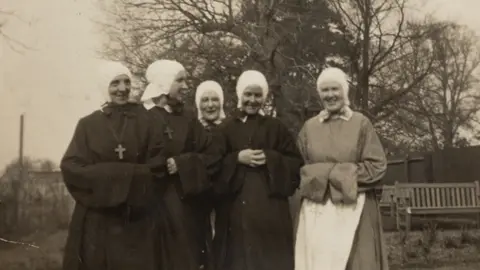 Royal Berkshire Archives
In 1848, a widow welcomed into her Berkshire home a young woman, who was the victim of familial sexual abuse.
Over the next four years, she was joined by more young women seeking refuge from prostitution and sexual exploitation.
The House of Mercy in Windsor went on to become one of the leading institutions of its kind in Victorian England, set up as refuges for "fallen women" - a blanket term for unmarried mothers and victims of sexual exploitation and abuse.
Radio Berkshire's Lorin Bozkurt has been finding out more about what life was like inside its walls and some of the women who passed through.
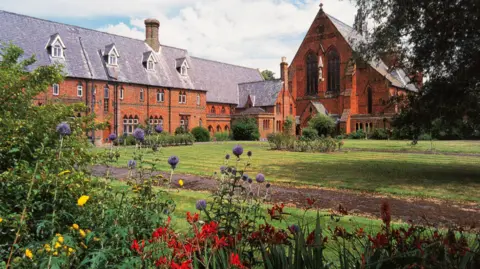
The original buildings have long since been converted into residential homes but, nearly 200 years ago, the Victorian convent and refuge provided shelter, rehabilitation and trade training for vulnerable and marginalised women.
"In the 19th Century, it was a farm on one side and an enormous site containing a number of different buildings... run by the Community of St John Baptist, ranging from children's homes to hospitals but, most importantly, the House of Mercy itself," said Lisa Spurrier, from Royal Berkshire Archives.
When Spanish widow Mariquita Tennant took that first young woman in to her home next to parish church St Andrews Clewer, it laid the foundations of the refuge, she said.
"The following year, she started taking in a few other young women who had been living in what sounds very like a brothel in Windsor... and the numbers basically exploded from there."
"Some of them had definitely been prostitutes but probably the majority hadn't," said Spurrier.
She continued: "They were mostly from a working class background. I would say the majority actually came from London, which was obviously sort of the place where there was the greatest amount of deprivation and the greatest need.
"The second-largest group came from Oxford and then, within Berkshire, the largest number came from Reading. There were certainly some from from the Windsor area as well.
"Most of them had been servants of some kind and they'd fallen into a desperation of one kind or another."
Almost all had been "sexually active in some way, which wasn't really approved of if you weren't married in the 19th Century", said Spurrier.
The idea was for them to spend a few years at the House of Mercy before rebuilding their lives in society.
 Royal Berkshire Archives
The women residing at the refuge were referred to as penitents, with a sister personally assigned to each of them. Their days would be filled with prayer, bible study and work.
"People expected to work so it wasn't regarded as being a punishment in any way but they were put to work, mostly doing either laundry or needlework," said Spurrier.
The laundry took in washing from Eton College and other local businesses and families.
Women in poor physical health would be assigned to needlework, including making clothes for themselves and the other women, as well as church embroidery to be sold.
Some women "couldn't stand the strictness of the regime" and left, said Spurrier.
The personal testimony of one penitent, preserved in the Royal Berkshire Archives, provides an insight into daily life at the house.
"Every evening, the class sister would get the book out, call out our names and we all had to say every time we had spoken unnecessarily during silence time," the woman recalled.
She continued: "In our chapel, the girls never had kneelers to kneel on. Our knees used to get very sore with kneeling on the floor.
"It was a bit hard for my knobbly knees and, one day, I made two lovely soft ones [kneelers].
"I used to put them in my stockings to kneel on and I could kneel in chapel on my knees without them hurting me. The girls used to say to me, 'how is it you could kneel so long in chapel on your knees without them hurting you?'."
From the 1960s onwards, some of the women chose to remain within the refuge as Magdalenes, "separate from the sisters", Spurrier said.
The term derives from St Mary Magdalene, a biblical figure traditionally seen as a repentant sinner.
One penitent, who was allowed to join the sisterhood after 20 years as a Magdalene, was not a "fallen woman" but rather "a bit of a naughty girl who struggled with her family", said the archivist.
In the woman's account, recorded in 1985, she said: "I can now look back on my life from that day when my aunt took me to be with the sisters in the home but I have always known it was not my aunt but God's hand who led me there."
The House of Mercy closed in 1954 but the remaining buildings serve as a "permanent memorial of the way 19th Century women tried to save others," said Spurrier.
"There were clergy involved, supervising and approving, but the day-to-day work was all done by other women and, I think, that's an important thing to remember."