East Bristol traffic scheme to become permanent

 BBC
BBCBristol City Council has voted to make a controversial road traffic management scheme permanent.
The East Bristol Liveable Neighbourhood (EBLN), covering Barton Hill and parts of Redfield and St George, was introduced in late 2024 to reduce through-traffic and encourage more walking, cycling and public transport.
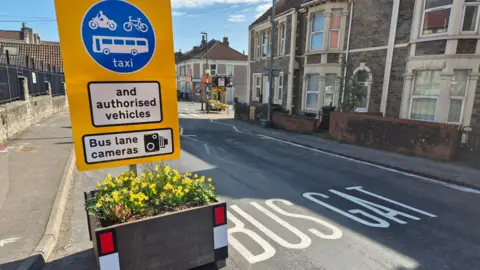
The scheme uses planters and bus gates to restrict vehicle movements and has divided opinion among residents, prompting protests and delays to some work.
Council monitoring reports suggest traffic has fallen significantly on many streets within the scheme area, while supporters say it has made roads safer and quieter. Opponents argue it has made journeys longer and harder for some residents.
What is the East Bristol Liveable Neighbourhood?
The scheme covers Barton Hill and parts of Redfield and St George, south of Church Road and north of the River Avon.
It was introduced as a trial designed to reduce traffic on residential streets by preventing some through-routes being used by drivers.
The council says the aim is to create safer neighbourhoods, improve air quality and encourage people to walk, cycle and use public transport.
Has traffic fallen?
Bristol City Council has produced business case reports and monitoring reports on how traffic has been affected in the area.
The reports would suggest that the scheme has so far done what it intended, with a significant decrease in motorised vehicle traffic across most internal roads - sometimes by as much as 90%.
At the same time, pedestrian volume has increased on most of the roads in the scheme, with one road seeing a 123% increase in foot traffic.
Council papers have noted that the EBLN has become a "polarising topic" among residents.
Chair of the Transport and Connectivity Committee, Councillor Ed Plowden, said: "While we hear the voices of people who have found the EBLN trial challenging, it's allowing children to travel more independently to school, has created quieter streets where people feel more comfortable spending time outside, and is helping to support healthier, more active communities.
"These were the original intentions of the scheme, and I am pleased to report that it is meeting these aims and that we are already delivering against the government's recent policy updates of more people travelling actively."
Some businesses inside the area have noticed the changes. Danny Beament, from A&D Automotive told the BBC: "The customers did notice a change, and people did complain that they had to go all round the houses to get to us now.
"It does affect some customers getting to us."
Why are some residents opposed?
The council paid an independent polling company to do a survey of residents in the area.
When asked, a third supported the scheme, almost half say they opposed, and 18% said they neither opposed nor supported the scheme.
Katie Sullivan from Redfield said the council had "overestimated the ability" of people to function in the city without a car.
"I'm not a rat runner, but I've been barred from the streets in which I live. I am horrified that it might be permanent," she added.
She said her family regularly walked and used bikes to get around but buses were unaffordable, often late or too full to get on.
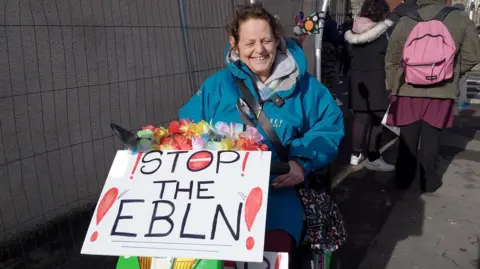
Meanwhile, those with disabilities like Melissa Topping (top picture) said her vehicle is her "independence", and that campaigners have been "ignored."
"As soon as the roadblocks went in, we lost our support networks, and we've become a ghost town.
"I've been working endlessly, 24/7, just fighting for the right to be able to access my own street. This vote decides my future in the area," she said.
The opposition campaign attracted significant attention during the trial, with contractors facing protests and police attending some demonstrations.
Bristol City Council leader Tony Dyer said there were "definitely lessons to be learned" about the process, which saw residents in Barton Hill protesting against council contractors as they closed some side-roads to vehicles.
"Do I personally regret, I think yes I do," he said last year.
 Alex Seabrook
Some opponents voiced concerns that the measures could affect response times for emergency vehicles.
Avon Fire & Rescue Service said it was consulted during the EBLN scheme's development and continues to work closely with the council.
"We recognise that changes to road layouts and traffic management measures may influence the routes available to emergency vehicles in some circumstances," a spokesperson said.
"However, our ongoing monitoring indicates that our response performance within the area continues to remain in line with our operational standards."
Crews have access to up-to-date mapping of traffic management measures through the mobile data terminals fitted in all frontline vehicles.
They also have the necessary access arrangements, including codes for traffic restrictions such as bollards and bus gates, to help maintain emergency access where required, the service added.
Why do supporters back the scheme?
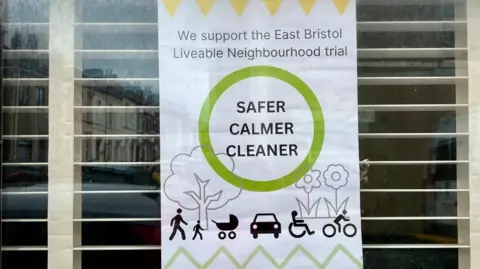
Supporters say the changes have made streets safer and more pleasant to use.
Sam Gunner, who lives inside the scheme, said he now feels "a hundred times safer" cycling his children to school.
Gunner added: "The scheme has also enabled us to cycle into town more easily, opening up parts of the city that before would have been very dangerous to get to by bicycle."
Another resident, Liz Read, said: "I look after my three-year-old grandson and we're now able to go for walks pretty safely along Beaufort Road and go to the park without having to put him in a buggy in case he runs into the traffic."
Lyndsey Melling from St George said the scheme has been a "dream come true" for her and her neighbours.
"I now feel it's easier and safer to walk and cycle because there's less traffic. I've had near misses and road rage incidents before which made me feel unsafe."
Her husband is a painter and decorator, and drives every day, and said the traffic levels were the same before and after the scheme, "but it's important to recognise that traffic was terrible before, and that's only going to get worse," she added.
Could similar schemes come to South Bristol?
The outcome of the vote will be closely watched because Bristol City Council is also developing a South Bristol Liveable Neighbourhood covering Totterdown, Southville and parts of Bedminster.
Already, some businesses in the area have told the BBC they are worried about losing trade as a result.
A survey of the area revealed that more than 70% of residents were against the proposals, and Labour MP Karin Smyth, whose Bristol South constituency covers part of the area, told BBC Politics West it was "a scheme in search of a problem".
The south Bristol scheme will be rolled out later this year.
Follow BBC Bristol on Facebook, X and Instagram. Send your story ideas to us on email or via WhatsApp on 0800 313 4630.