Why are diggers reshaping Douglas beach?

 BBC
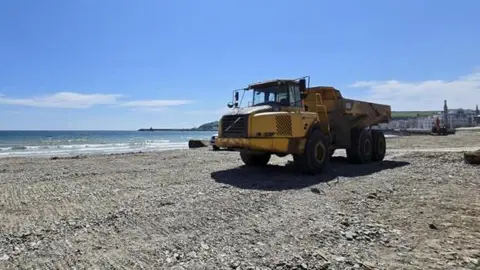
BBCVisitors to Douglas Beach may have noticed excavators and trucks moving sand along the shoreline.
But why is this being done, and what difference does it make?
The machinery is being used as part of work to 're-profile' the two-mile stretch of sandy beach along the capital's coastline.
Douglas City Council said the programme, which began on 7 July and is expected to finish on 17 July, involves moving sand that has accumulated against the seawall, and applying it as a new layer on eroded sections elsewhere.
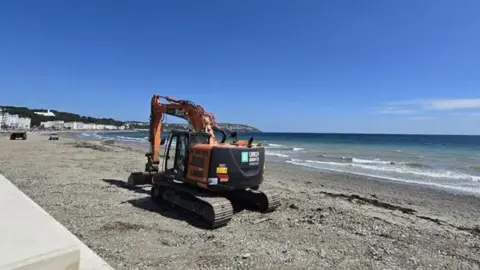
Beach re-profiling is the process of moving naturally accumulated sand from one area of a beach to another to restore a more even profile.
Along Douglas Promenade, tides, prevailing winds and wave action continually shift sand, a council spokesperson said.
Over time, this can leave some sections with large build-ups while other areas become lower or more exposed.
Rather than bringing in new material, the council said workers have been told to redistribute sand already on the beach.
Maintaining an even beach profile can help reduce erosion in lower areas, improve drainage and create a more consistent surface for beach users. It can also help prevent excessive build-ups of sand against the promenade seawall.
The works are also designed to absorb wave energy and prevent flooding.
Groyne removal
Groynes are structures built at right angles to the shoreline to trap sand and reduce the movement of sediment along the coast.
In the 1920s and 1930s, these wooden structures were put into Douglas beach to trap sand and prevent erosion.
By holding sand in place, they can help maintain a wider beach and provide a buffer between the sea and coastal defences. When groynes are removed, sand is able to move more naturally along the shoreline, rapidly increasing the rate of erosion.
The existing groynes were removed in 2020 after being considered 'ineffective and no longer serving their original purpose.' No new groynes were installed due to the high costs.
This means sand movement is now managed via these re-profiling works.
It is seen as the best course of action, as previously, the cost of re-installing these groynes was described by a former Douglas councillor as 'astronomical.'
The work is considered a form of routine coastal management and has been agreed with the Department of Environment, Food and Agriculture (DEFA) to minimise environmental impacts.
While the work is underway, members of the public have been asked to stay clear of the working area because of the heavy machinery operating on the beach. Dog walkers are also being asked to keep pets under close control and away from the site.
The council has apologised for any temporary disruption while the work is completed.
Read more stories from the Isle of Man on the BBC, watch BBC North West Tonight on BBC iPlayer and follow BBC Isle of Man on Facebook and X.