The cannabis-laced gummies with fake packaging

 Wiltshire Police
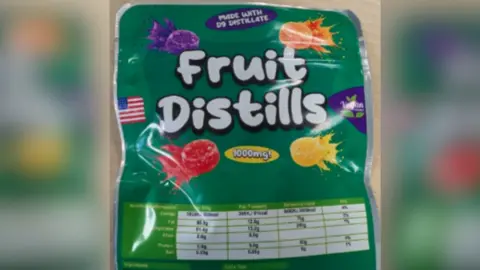
On first glance, the bag looks like an innocent packet of Fruit Pastilles. A busy parent may not notice anything amiss.
But upon closer inspection, it can be seen that the name of the sweets is spelled wrong, and there is a note on the packet claiming that it is "made with D9 distillate", a highly-potent cannabis extract, and "contains 1,000mg".
The bag was seized from an 18-year-old by police in Swindon, Wiltshire, last week and is part of a growing movement of cannabis-laced gummies targeted at young people.
Parents have been urged to warn their children of the dangers of these kinds of sweets and the potentially fatal impact they could have.
What are cannabis gummies and why are they dangerous?
Cannabis edibles, which include gummies, contain tetrahydrocannabinol (THC) and are illegal in the UK.
They can also come in the form of chocolates, cakes or cookies.
The familiar and colourful packaging of cannabis gummies, which are marketed online, makes them attractive to children.
Meanwhile, the innocent appearance of the contraband can throw parents or teachers off the scent and make the drugs easier to hide.
How can parents spot fake sweet packaging?
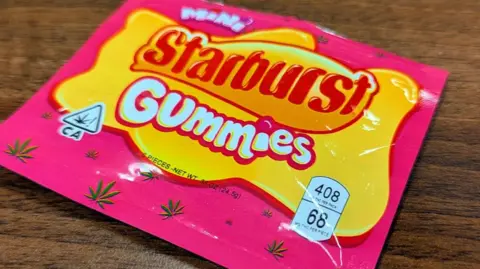
Tell-tale signs that sweets are not all they seem can be if popular names - such as Haribo or Starbursts - are spelled wrong or if there are strange symbols, such as a cannabis leaf, on the packaging.
In Swindon, the cannabis gummies seized last week were labelled that they contained 1,000mg.
This means the packet contains that measurement of THC, an extremely high quantity of cannabis which could be harmful if consumed, particularly by children.
Swindon Neighbourhood Inspector Joe Senior, of Wiltshire Police, said: "These cannabis-laced gummies are designed to look like ordinary sweets, disguising them to parents and making them particularly appealing and dangerous to children and young people."
Why are experts worried about them?
"We do know that young people don't view cannabis use as particularly risky," said Prof Christopher Pudney, an academic at the University of Bath who researches synthetic drugs and the detection of them.
"They also don't like smoking, they view it as bad for their health," he added.
"We start to wonder if that's the reason for the rise of cannabis, THC vapes and now cannabis edibles."
The professor says cannabis-laced gummies pose a risk of being laced with Spice - a synthetic cannabinoid which can cause some people to have extreme paranoia or fatal overdoses.
Unlike cannabis, which is grown, synthetic cannabinoids are created in a lab and have a very difficult chemical structure.
Pudney continued: "There is a long history of people selling cannabis edibles which have semi-professional produced packaging, which matches quite close to something which appears to be a normal legitimate product.
"What no-one can tell you is the intention of that. Is that to obfuscate [that] they are illegal – or is it to almost have a bit of a branding on them which is a consistent branding to imply value?"

The drug dealers do not make the packaging themselves, Pudney explained.
Instead they go online and find a provider to produce the packaging.
A breadcrumb trail then emerges on social media where pictures of gummies are posted with links to buy them online.
What happens if a child eats cannabis-laced gummies?
Cannabis gummies can be stronger than smoked cannabis and it can take hours to feel their effect. This can lead to overconsumption as young people chase a quick high.
Paul Carruthers, a substance misuse service manager for The Children's Society, which works with young people, added: "Someone can take far more than they realise and there's often no way to tell how strong they are.
"A child who eats one might become drowsy, dizzy or sick, or occasionally unwell enough to need medical help."
He said: "The best thing parents and carers can do is to talk openly and early.
"Help children understand that some sweets or gummies aren't what they seem, that it's always okay to say no, and to come to you or a trusted adult if they're unsure or feel pressured."
 Hope UK
How can parents talk to children about the risks of edibles?
Charities and experts have urged parents to have serious conversations with their children about the impact of these seemingly innocent looking sweets and report any concerns to police.
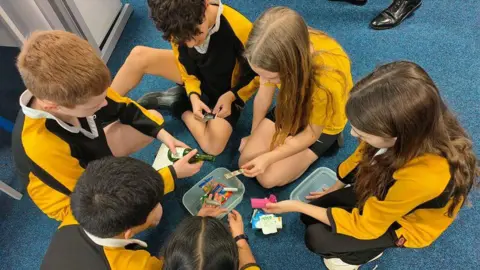
"The picture for this incident in Swindon is interesting," said Mary Deller from drug and alcohol education charity Hope UK, which discussed drug use with 20,000 Year 6 pupils last year.
"As a parent, if you're busy and glance at the packaging, your brain adjusts for the error in the spelling. If you don't look at it carefully, you wouldn't necessarily know what it is unless you examined it more closely."
Deller pointed to previous examples of when cannabis-laced gummies have had severe consequences - such as in 2025 when eight children in Sheffield were taken to hospital after they ate sweets laced with cannabis.
"Education is the best way of preventing tragic incidents," Deller continued. "A lot of the harm comes about because children aren't aware and parents aren't aware."
Follow BBC Wiltshire on Facebook, X and Instagram. Send your story ideas to us on email or via WhatsApp on 0800 313 4630.