Poo, parking and poor pitching - the Lake District's summer battles

 United Utilities
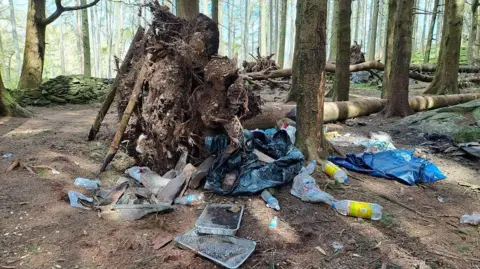
Millions of people visit the Lake District every year, but not all of them abide by the Countryside Code's plea to "leave no trace". It means for enforcement officers and volunteers, summer is often marked by irresponsible parking, inconsiderate camping and even human waste - which doesn't quite have the same ring to it as the Summer of Love.
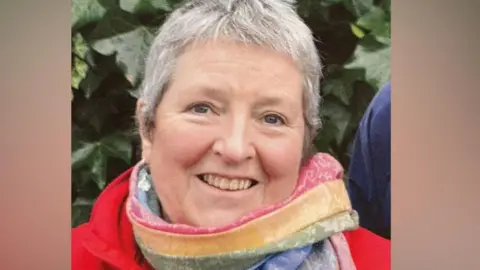
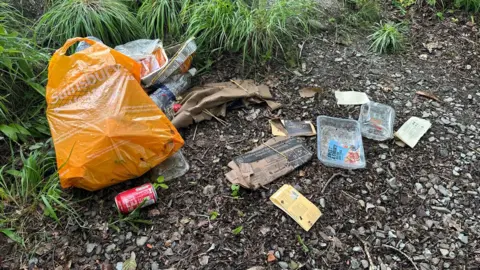
"Fifty-plus members of the public engaged with, 10 overnight campers spoken to, eight bags of rubbish collected and they had the joy of seeing one man using a bush as his toilet," reads out Judith Derbyshire, a Westmorland and Furness councillor.
It is an extract from a report by patrol officers responsible for tackling anti-social behaviour, who were out in the Coniston area one weekend in July.
"I'm going to lower the standard of the conversation here but the issue is to do with human poo," says Derbyshire, although she might have used slightly more colourful language.
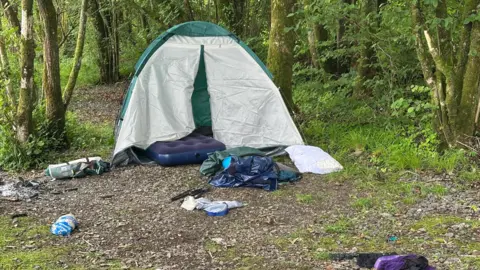
She is responsible for community safety at the Liberal Democrat-led council and says since Covid there has been a surge in visitors who arrive without plans for accommodation, meaning fly-camping is rife.
Fly-camping takes place away from designated camp sites and without landowners' permission.
"Don't feel you can just come up, park up on a lay-by and then go and put a tent up down by the lake shore - you shouldn't be doing that," she says.
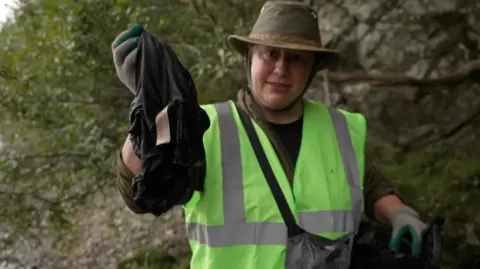
It is not just about the litter.
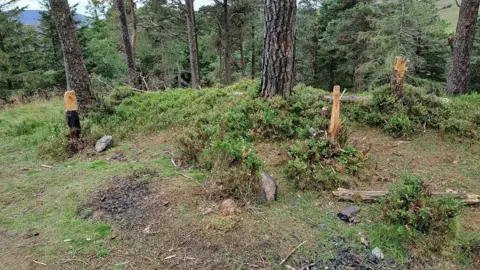
Derbyshire says people are also chopping down branches and trees to light fires, causing damage to the environment.
"There's a tree down at Ullswater, as you're driving down the A592.
"It's a very large oak tree and somebody fairly recently has put a bonfire up the hollow inside it and, sorry, it's a lovely, big, old oak tree and I want it to be there in a long time to come."
 United Utilities
Westmorland and Furness Council and Cumberland Council are responsible for looking after parts of the Unesco World Heritage Site.
Together with Cumbria Police, they can enforce Public Spaces Protection Orders (PSPOs), which help tackle anti-social behaviour.
It means in areas covered by a PSPO they have extra powers, such as making someone leave the site or issuing a fine.
Derbyshire says Westmorland and Furness officers have only issued eight tickets so far this summer, as enforcement is seen as a last resort.
Instead, the authority tries to "engage, educate and encourage".
"If we've perhaps gone out and seen a group in the evening and then gone back in the morning and they're not tidying up, they've done damage and they've said they weren't going to have a bonfire and they obviously have and it's still burning, then that gets to the enforcement stage," she says.
 Westmorland and Furness Council
Enforcement is made difficult by the fact the council has "very few" officers and there is no round-the-clock response service, Derbyshire says.
"Putting it bluntly, we are going to have strong cutbacks from our funding as a local authority, we're not going to have the staff to be able to put that sort of thing in place."
Fines for breaching a PSPO are currently at £100, but Derbyshire says the government is expected to issue new guidance which could see them raise to £500.
For irresponsible parking, councils can issue a £50 ticket which is reduced if paid within a certain timeframe.
"The problem that we've got now is that a parking ticket is not really a deterrent," says Rob Lewis, a senior manager at Cumberland Council's highways department.
"If there's four or five people in a vehicle, some of them will just share the cost of that ticket and they'll take it as a parking charge - so it's almost part of the expense of the day out."
He says the council are in talks with the British Parking Association and other authorities to see if higher charges would be more beneficial in areas such as the Lake District National Park.
At busy times, he says, buses have had to be cancelled because badly parked cars are not leaving enough room for them to pass.
 Nicola Millner
Local social media pages often show cars parked in front of farm gates, passing places and even private fields.
Were there to be a medical emergency or a fire, the stakes would be even higher, Lewis says.
"We do try and educate the visitors before they come to say where it is appropriate to park and where it isn't appropriate to park."
To try and ease congestion on the narrow country roads, shuttle buses serve the most popular areas including Buttermere and the Wasdale Valley, and many operators offer free travel to under-16s during the summer.
While Cumberland Council has a team of 25 officers issuing parking tickets, they are spread across the whole authority area, from Millom to Carlisle.
Lewis says there is more focus on the Lake District at busy times, but not all bad parking can be enforced by the council.
"It's not that easy, we cannot issue [tickets] unless there's a restriction in place or unless there's a yellow line down there, or it's part of a disc zone, for example."
 Wasdale Action Group/A Wasdale Lad
He says problem areas can be flagged to the council, but restrictions may take up to a year to come into force, due to the length of time it takes to go through the process and consult with affected residents.
The police have powers to deal with certain issues, such as if a vehicle is causing an obstruction.
Derbyshire says people can also contact police if they see anyone behaving in a dangerous way, such as lighting a bonfire that is likely to spread to a large area.
"We're not encouraging people to go and approach people, but more to feed the information back to us," she says.
 Nicola Millner
Descriptions of people involved and any vehicle registrations would help them track offenders down, Derbyshire says.
She believes working together with residents, visitors and bodies such as the National Trust and other landowners is key to getting the situation under control.
"We want people to come to Lake District and it's good that there's a wider range of people coming here, it's just that we need to get them educated so they know what they can do and what they can't do."
Follow BBC Cumbria on X, Facebook, Nextdoor and Instagram and listen to Radio Cumbria on BBC Sounds.