Meet the thrifters turning pre-loved into profit

 Laura Foster/BBC
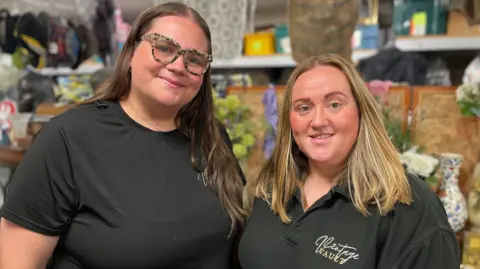
As children, best friends Georgina Nixon and Stacey Almond remember shopping in charity stores with their parents and grandparents.
Today, "thrifting" is a popular and mainstream hobby, but back then it came with something of a stigma.
"It's massively changed... when I was younger, you knew you were going to be made fun of," says Nixon, 32, of Letchworth Garden City, Hertfordshire.
"Now it's such a big thing, and everyone can afford something."
She and Almond, of Luton, are among a growing number of people who have turned their nose for a bargain into a business.
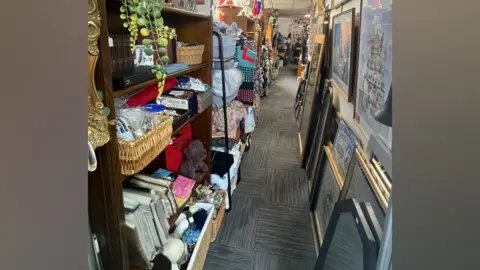
Together they run Vintage Vault in Letchworth, launched by Nixon two years ago after she found her confidence growing in line with her sales.
They say the cost-of-living crisis, alongside the ability to research and sell products online, has enabled a one-time side hustle to flourish into a business with sustainability at its heart.
The phenomenon has even spawned the BBC TV show Shift the Thrift, in which bargain hunters go head-to-head to transform charity shop finds into profits for good causes.
 Laura Foster/BBC
Nixon's father's house clearance business provided her with the chance to sell an array of goods.
Her best find to date has been a rare Wedgwood lamp from a house clearance that sold for £1,500.
"It's fun – that's what started it," she says.
"It's not just about finding something that's a lot of money, it's just finding something you love and you think, 'That would have gone to waste.'
"Saving that item is what keeps us going and when you see someone come in that needs that item and you've sold it to them for low cost, they're getting that thrill, too."
 Laura Foster/BBC
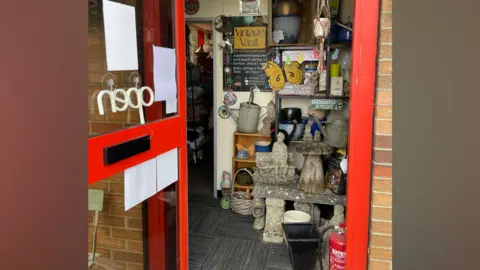
As well as house clearances, she sources stock from private sales, charity shops and even a second-hand seller in Hungary, and estimates about 80% of her items would otherwise end up in landfill.
But Nixon admits she gets a mixed reception from charity shop staff when purchasing items to resell.
However, she believes she is not exploitative because, as well as keeping items out if landfill, she always pays charities over the odds for specific items she has found for customers.
"Not every charity shop does online... we do online, so we've got more of a target audience to get it out of the door," she says.
Nixon, a mother of two, has also found it a family-friendly way to make a living
"I'd go into charity shops to find things I liked, source them and sell for a low profit, but I was able to take my children with me and be at home with them," she says.
 Alex Dunlop/BBC
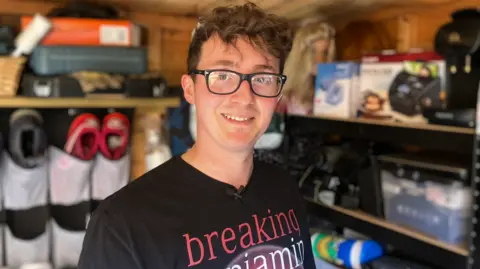
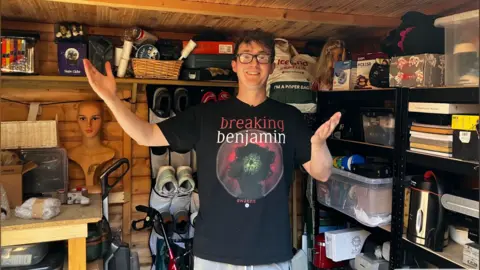
That is a scenario recognised by Matt Leggett, from Norwich, whose hobby of scouring for bargains at car boot sales to then sell online has earned him enough money to stay at home to look after his son.
Leggett was a police officer and then a Royal Mail delivery driver before capitalising on his car boot hauls.
He says it is "helping a lot to bring extra in while I'm not in a full-time, proper job".
Leggett says he makes between £1,500 and £2,200 per month after tax by spending his winters trawling charity shops and his summers at car boot sales.
He picks up everything from cuddly toys to shoes and his speciality, electronics.
"I was still at one of my previous jobs and noticed a snowball effect from working in the shed and realised the money I was making was creeping up," he says.
"I'm a stay-at-home dad now with my boy, so this is helping a lot.
"I love it – I never thought I'd find a job I truly love."
 Alex Dunlop/BBC
He documents his car boot hunts on social media, which he says has become another income stream, feeding into people's interest in the entrepreneurial phenomenon.
"When I first started doing it, it was a very tight-knit community... but the community's growing massively," Leggett says.
He says it is great to see younger people coming through and starting up their own businesses.
Leggett works out of his garden shed, researching items, photographing and writing online sale posts before packaging his goods and sending them out for delivery.
But he has struggled with one issue in particular: where to keep everything.
"You've got to remember, we're in the selling business, not the storage business," he jokes.
But what do charity shops think of people buying items to resell?
Robin Osterley, chief executive of the Charity Retail Association says they "receive valuable income from people buying items to resell, and we don't object to this in principle at all".
But he adds: "However, it would be nice to think that the reseller would consider the shops if they are lucky enough to get a significant windfall from doing this, and possibly make a donation to the charity, who are after all in the business of raising money for very good causes."
Do you have a story suggestion? Contact us below.
Follow East of England news on X, Instagram and Facebook: BBC Beds, Herts & Bucks, BBC Cambridgeshire, BBC Essex, BBC Norfolk, BBC Northamptonshire or BBC Suffolk.