'Worrying' pollution in Cotswolds river - volunteers

 Ruth McDonagh
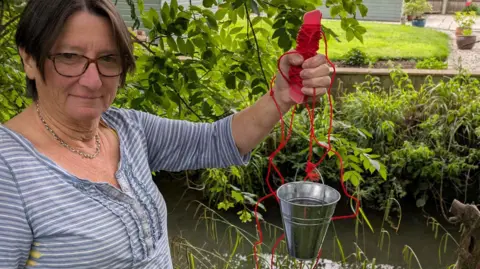
A group of Gloucestershire neighbours testing their local river every week for more than a year say they are concerned by "worryingly high" levels of phosphates and nitrates recorded.
The volunteers from charity Winchcombe Green Town (WGT) have been testing at four sites on their stretch of the 14-mile (22.5km) River Isbourne, which flows northwards from Cleeve Hill to the River Avon.
WGT trustee Stuart Pickles said: "Until now we had no water quality data. Now we have the evidence, we are calling for the Environment Agency to investigate." The agency has been asked for comment.
Meanwhile, Severn Trent Water said it had been reducing storm overflow spills at Winchcombe Sewage Treatment Works.
 Ruth McDonagh
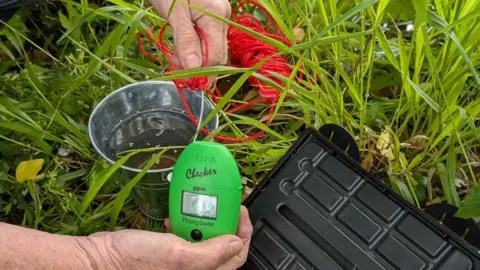
Pickles says 10 volunteers covered four testing sites and test once a week for phosphates and nitrates, as well as for electro-conductivity levels and temperature, which can impact the results.
They have now been testing for more than a year and are continuing until they gather two years' of data.
"The levels of both nitrates, which we believe comes from agricultural fertilisers, and also phosphates, which tends to come more from the sewage outlets, the levels are both high, worryingly high," he said.
"It's come as quite a bit of a shock. I live right by the river and my dog plays in there and so you sort of wonder. We always thought that it was clean enough as Winchcombe is quite close to the source of the river up on Cleeve Hill and it's not as though we're downstream of heavy industry," Pickles added.
'Very disturbing'
The group has been supported by Winchcombe Town Council, which funded the four water-testing kits.
Council chairman Jim Mason said: "The council has a statutory obligation to conserve and enhance biodiversity and this initiative supports that.
"The River Isbourne is an integral and important part of the town and we must do all we can to protect and conserve it and the wildlife and biodiversity in and around it."
Mason said the findings were "very disturbing".
"I've personally noticed a big decline in wildlife, fish and bird life in and along the river and now we know why," he added.
A Severn Trent Water spokesperson said the company had been investing £160m across Gloucestershire to improve river health and that storm overflow spills at Winchcombe Sewage Treatment Works had reduced to almost half from 2024 to 2025.
They added: "Phosphorous emissions from the Winchcombe treatment works in 2025 were less than a third of what is allowed under our Environment Agency permit.
"It's important to note that of the 14 reasons why the River Isbourne isn't categorised as in good health by the Environment Agency, only two are linked to Severn Trent."
Follow BBC Gloucestershire on Facebook, X and Instagram. Send your story ideas to us on email or via WhatsApp on 0800 313 4630.