It was eerie working in the grave of Richard III

 King Richard III Visitor Centre
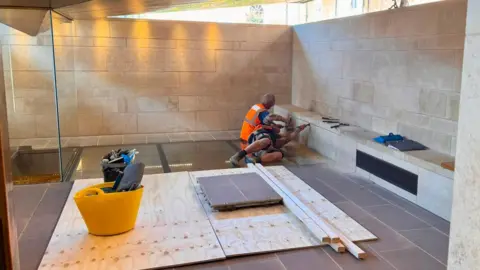
Specialist contractors have said it was an "eerie" experience working inside the grave of King Richard III after completing repairs to cracked glazing over the historic site.
The last Plantagenet king of England's bones were discovered under a council car park in Leicester in 2012, and the burial area is now the centrepiece of a visitor centre.
This week, experts were sent in to fix a large crack in thick glass that allows visitors to walk over the area and view it from above, caused when a visitor accidentally dropped a glass bottle.
Leicester City Council, which runs the centre, said the replacement of the glass was successfully carried out with no impact on the precious archaeology.
The project, costing nearly £30,000, was carried out by Olivetti Group.
"I'm not a spiritual person but [the grave] has a feel to it," said Fran Abell, the firm's head of small works.
"The air is quite fresh down there because there is a live air flow to preserve the site and stop moss and mould growing.
"It is a quite pleasant atmosphere other than the eerie nature of what you are standing next to."
 King Richard III Visitor Centre
The damage was caused in 2024 but the delay on the repair work resulted from the need to find rare reinforced glass to replace the cracked glazing.
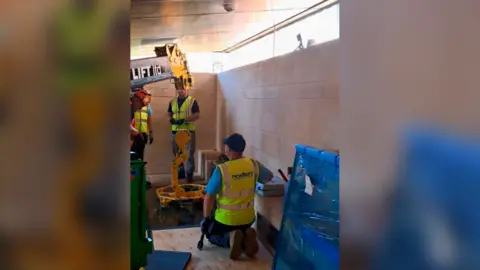
Stonemasons removed benches near the site before a crane was used to lift the heavy glass panel.
A platform was then constructed over the grave site and covered with a tarpaulin to protect the area from falling glass and silicone.
Of the accidental damage, a council spokesperson said: "A visitor sitting next to the grave site stood up, and the glass bottle he had in the thigh pocket of his cargo trousers fell out and shattered on the glazed floor.
"The impact caused a small chip in the top layer of the triple-glazed glass panel, which radiated out as a distinct crack across the panel."
The cost of the repairs was largely covered by an insurance claim, the council added.
Visitor centre manager Phil Hackett told the BBC: "The visitor was mortified by what happened but it was completely accidental - one of those really unfortunate things.
"The crack was very distinct and only the top layer of the triple-glazed panel was damaged.
"Understandably some people were nervous about treading on it although it was very, very safe.
"I'm glad to say it is now looking as good as new and the grave has been unaffected."
The medieval monarch was killed at the Battle of Bosworth in 1485 when Henry Tudor took the English crown.
For centuries it was believed his body had been thrown into the River Soar in Leicester.
However, the Richard III Society and University of Leicester archaeologists decided to investigate suggestions the king had actually been buried in the former Greyfriars friary in the city.
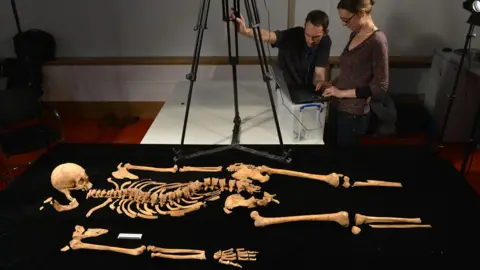
They uncovered his skeleton in 2012 and the remains, with Richard III's famous curved spine, were later interred at Leicester Cathedral.
Listen to BBC Radio Leicester on Sounds and follow BBC Leicester on Facebook, on X, or on Instagram. Send your story ideas to eastmidsnews@bbc.co.uk or via WhatsApp on 0808 100 2210.