Ex-firefighter urges wider access to bleed kits

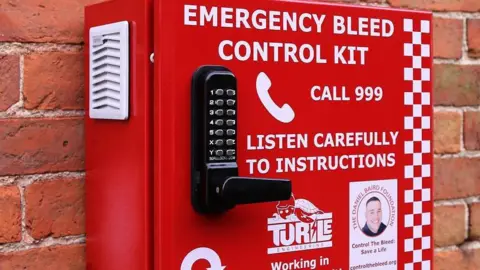 North Yorkshire Council
Life-saving bleed kits should be as "widely available as defibrillators", a former firefighter said, after helping increase their number across North Yorkshire from just four to more than 50.
Tim Taylor, a first aid trainer, began donating specialist bleed kits to communities across the region after more than 1,700 blades were surrendered in a county knife amnesty.
He said he was "shocked" to find only four publicly accessible kits in the county, despite more than 3,500 being available across the UK.
Taylor said his experience of serious incidents motivated him to act. "Quite simply, if people had access to a bleed kit when they needed one, it's life or death," he said.
Taylor began campaigning after discovering there were just three kits in York and one in Selby.
"That felt like a significant gap," he said.
"If we have knife amnesty bins, we should also have the means to treat the injuries those weapons can cause."
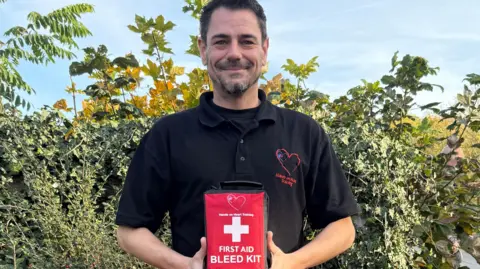 Tim Taylor
Taylor, who was a firefighter for 18 years, said his concerns grew after he saw a knife surrender bin in Stokesley.
He later discovered more than 20 such bins across the county, with about 4,400 blades handed in since the first knife amnesty bin was installed in the county in Harrogate in 2023.
"That was quite alarming," he said. "I wondered where the treatment provision was."
The first aider has since funded the rollout of bleed kits himself, helping increase the number to more than 50 in eight months.
He said the kits, which contain equipment including tourniquets, wound-packing gauze and chest seals, alongside guides to help people use them, were now located in "libraries, hotels and public toilets, from Hinderwell to Helmsley and Harrogate".
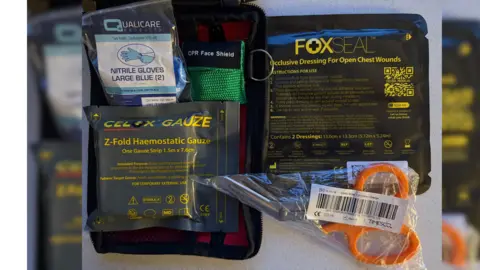 Tim Taylor
The kits are designed specifically for life-threatening blood loss.
"They're not like your typical first aid kit," Taylor said.
"They're designed to deal with life-threatening bleeds."
He added: "In a rural area like ours, it's not always knife crime.
"It could be a farming accident, a road traffic collision or a work-related injury that's resulted in significant bleeding.
"So the response time for the emergency services could be a lot longer than somebody helping with a bleed kit."
He said ideally every defibrillator site should also include a bleed kit.
"It could mean the difference between saving someone or not," he said.
Taylor is urging more communities to install the kits and said people could find out where their nearest bleed kit was by using the national Bleed Map.
Listen to highlights from North Yorkshire on BBC Sounds, catch up with the latest episode of Look North.