Robots are asking for tips. But who actually gets the money?

 BBC/ Serenity Strull
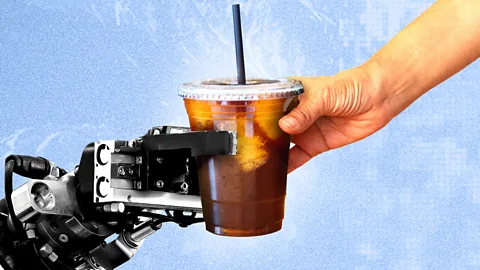
Machines are sticking out their digital palms. Your reaction could help shape the future of the service industry.
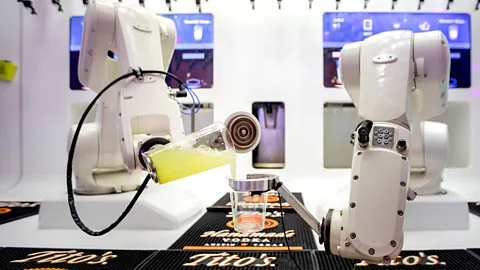
If you're not in the mood for slot machines at Las Vegas's Venetian Hotel, you can find some entertainment at a bar called The Tipsy Robot. It has a kitschy gimmick: two robotic arms that make automated cocktails.
I hit "margarita" on a screen and watched them jerk to life. They mixed tequila with lime and triple sec, spinning needlessly for extra flair and bowing to deliver the glass. It might have thrilled me 20 years ago. Today, it's almost a cliché.
The drink ran $17 (£12.55), but I found an additional charge: a 10% "service fee". Tipsy wanted a tip.
It wasn't the first time I'd encountered this. A similar robot barista asked me for a tip at Artly Coffee in New York. At Newark Liberty International Airport, a self-checkout machine suggested a gratuity on a bottle of water at an unstaffed kiosk. Across the country in Portland, Oregon, a human took my order at the restaurant Top Burmese, but a robot server wheeled out the dinner.
For the human waiter, I happily tipped 20%, but on the other occasions I hesitated. The rules of tipping go out the window when robots stick out their digital palms, and it's often unclear who keeps the money.
But is this the new normal, or just a passing robot fever dream? The answer may hinge on what you decide to do with your wallet.
Representatives for The Tipsy Robot and Artly Coffee say their human staff split all the tips and the companies get nothing. Artly has even turned off tip-prompts since I visited. Yet these may be exceptions. In fact, some experts tell me robo-tipping may part of a broader effort to squeeze more out of workers and customers alike.
"We have every reason to believe that some unscrupulous employers are taking the robot tips for themselves," says Holona Ochs, an associate professor of political science at Lehigh University, US, and co-author of the book Gratuity. "The critical question is who benefits, and who pays the price," says Ochs.
The robot cash grab
Since the pandemic, people are now asked for more tips in more places than ever before, often prompted by digital payment systems. Consumers complain of "emotional blackmail" as suggested tip percentages creep up. And while some scoff at Americans' "out of control" tip culture, it's spreading across the globe.
The changing norms are a flash point in the US, where gratuities let companies pay staff a lower base salary. The US minimum wage is $7.25 (£5.35) an hour, but it drops to just $2.13 (£1.57) for employees who work for tips.
When you tip a worker in the US, the law says companies, owners and supervisors cannot take a cut. But if you're tipping a machine, there may be a loophole.
"A legal standard for who owns robot tips has not been established," says Ochs.
 Getty Images
The Trump administration has made it harder for employees to pursue claims about tip problems, and workers may keep their stories secret for fear of retribution. "So if employers are taking tips given to robots, we have little way of knowing," she says, at least for now.
"A lot of the time you can see people doing work in the kitchen or behind the bar, but the tip may well be going to a corporation. There are no rules."
That doesn't mean automatons are bad for service workers. The novelty of robots is the whole point at places like the Tipsy Robot and Artly Coffee, so the people working alongside machines wouldn't have those jobs otherwise.
Artly says that its decision to turn off tip-prompts and give workers a raise was in part a response to customer complaints about tips. Some locations now have physical tip jars, but 100% of tips still go to human staff, says Abigail Smathers, director of content at Artly. "We don't believe in automating for cost savings at the expense of humans."
There's a labour shortage in the service industry, and robots can help without displacing humans, Smathers says. However, she acknowledges that AI is being deployed in places where it doesn't belong.
"But at the end of the day, that is where the problem lies. This technology is not inherently evil. Its morality lives in intent and execution," she says "But we are doing our best to build with intent, act with integrity, and ensure that the future of this technology benefits the many, not the few."
Katerina Berezina, an associate professor who studies hospitality technology at the University of Mississippi, US, says the industry deserves more credit. "I don't think it's fair to assume this is just companies trying to make money at any cost," she says.
"The tip or the service fee can just be something that covers the necessary labour or updates that the robot needs." Tipping is the norm in this industry, she says, and companies work within market constraints.
On the other hand, some like the advocacy group One Fair Wage argue robots are simply an effort to continue paying low wages, which is the real cause of the restaurant labour shortage.
Whatever the balance of factors at play, experts say the future depends on how you and other customers respond to the experiments we're seeing now.
To tip or not to tip?
"Think of the main motivations for tipping," says Michael Lynn, professor emeritus at Cornell University, US, and author of the book The Psychology of Tipping.
We often tip to reward good service, or for altruistic reasons to make up for low wages. Lynn says. And of course, there's the question of status and approval; "If I don't tip, they're going to hate me," he says. In other words, we feel obligated.
"Almost none of that applies to robots, so clearly there's no reason to tip," Lynn says.
However, people may be doing it anyway. In one study, only about 11% of participants said they would tip a robot bartender. "But people who actually had experience with robot bartenders were much more likely to be willing to tip than other people," says Berezina, the study's co-author.
And even though most people said they wouldn't tip a robot, about 42% changed their mind if the tip was going to human employees.
More like this:
Still, Lynn argues it's a wildly unpopular practice, and it will probably stay that way. Businesses are introducing robot tips because it helps make more money, but if robo-tips drive customers away, that may help kill them.
"There is no god of tipping, no one can make you pay. And the norms come from the bottom up," he says. "I think businesses will come to see this and abandon these expansions."
In other words, Lynn says you and I are just living through a brief and incredibly annoying moment in history.
"I believe that's true," he says. "But hey, anybody who says they can predict the future is lying."
--
For more technology news and insights, sign up to our Tech Decoded newsletter, while The Essential List delivers a handpicked selection of features and insights to your inbox twice a week.