'On shore, their weight becomes lethal': Why it's so hard to help a stranded whale

 Getty Images
The sad fate of a stranded humpback in Germany raises bigger questions about distressed whales – and how to help them.
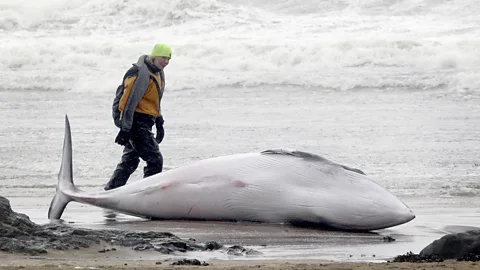
On 14 May 2026, the carcass of a 12-metre-long humpback whale washed up in the shallows of Anholt, a small island near Denmark. It rocked back and forth in the waves, occasionally pecked at by seagulls. Denmark's Environmental Protection Agency confirmed it was Timmy, whose almost two-month-long rescue saga had turned into a viral cautionary tale.
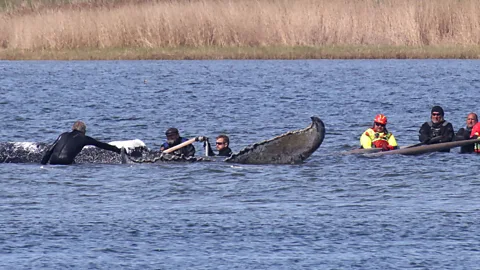
Timmy's name came from Timmendorfer Strand, the German beach with the sandbank where the humpback whale was initially sighted. He was partially entangled in a fishing net but remained submerged enough to survive for over a month. During that time, and through several failed rescue attempts, he amassed millions of avid fans worldwide, rallying for his life.
After assessing Timmy's condition, the International Whaling Commission advised that the most compassionate thing to do was to let the animal die on the beach. Instead, two private donors reportedly paid approximately €1.5m (£1.3m/$1.7m) to refloat Timmy via a water-filled barge. The whale only survived a few days after his release.
Many details of Timmy's story remain unclear, but his ordeal still raises an important, bigger question: how do you best help a stranded whale? With strandings rising in some parts of the world, it's an increasingly important question.
A dramatic rise
Marine mammal strandings are increasing dramatically in areas where coastal water temperatures are rising due to climate change, like the UK. Scotland saw an 800% increase in baleen whale strandings over the 30 years from 1992 to 2022, according to a report by the Scottish Marine Animal Stranding Scheme (SMASS). While there's no singular reason for the spike, the researchers posited that warming waters pushing prey north played a part, along with more plastic and noise pollution from ship traffic.
 Getty Images
Whale strandings can happen for many reasons, but often it's because the animal is sick or injured, experts say.
"The two most common anthropogenic sources of trauma that lead to stranding are collisions with vessels and entanglement in fishing gear," says Andrew Read, professor of marine biology and director of Duke University Marine Laboratory in the US. "But whales may also strand, either alive or dead, if they are sick. Diseased individuals typically exhibit signs of prolonged illness, such as poor body condition."
Stranding response teams from US government agency National Oceanographic and Atmospheric Administration (NOAA) Fisheries see evidence of this in examinations and necropsies. Sometimes it's a combination of factors, including malnutrition, biotoxins, and young calves being separated from their mothers, says Rachel Hager, lead for public affairs at NOAA Fisheries.
Algal blooms, for example, can release biotoxins that sicken whales, causing them to strand. These blooms can also inadvertently lead to strandings by creating "dead zones", pockets of extremely low dissolved oxygen that form when large algal blooms die and break down on the ocean floor. Dead zones can kill off a whale's food supply, forcing them to wander closer to shore, where they get stranded. (Read more about the hidden dead zones spreading across the Baltic Sea floor).
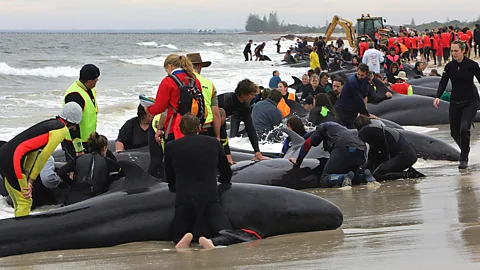
Weather changes can also disorient whales, as is believed to have been the case in a mass false killer whale strandings off Tasmania in 2025. "[Some whales] may have stranded due to making a navigational error, or for social reasons – if one member of a pod strands, we can see the other pod members strand with them as they try to remain together," says Natalie Arrow, a marine veterinarian and director of the Marine Mammal Vet and volunteer with the British Divers Marine Life Rescue (BDMLR), which deals with whale strandings.
It was the worst mass stranding Tasmania had seen in 50 years, and sadly, due to the powerful surf, none of the animals could be saved.
Refloating a whale
It's relatively rare for a large whale to survive a stranding event, according to NOAA Fisheries data. Of the 201 large whales that stranded alive in the US between 2006 and 2025, only 17 were able to unstrand themselves and swim away. Just seven whales were unstranded with human intervention.
 Getty Images
Even if the whale is alive, successful refloating is uncommon. Just 0.8% (15 whales) of the 1,939 whales stranded in the US between 2006 and 2019 were refloated (only 128 were alive upon initial observation), according to another NOAA analysis.
The sheer size of whales is one reason why it's so hard to help them without further distressing them. Smaller cetaceans like dolphins and porpoises may be carried back to the water for refloating, experts say, but the process is much more difficult for whales. "They [typically] cannot be moved in a way that is both safe for humans and doesn't cause the whale undue stress or risk injury," says Arrow. "A humpback whale can reach up to 40,000kg [88,000lb], and blue whales 140,000kg (309,000lb)." That's the equivalent of 30 African elephants. A stranded whale with a 7.5-metre-long tail could unintentionally kill you if you were standing near it as it swooshed back and forth.
Even when a whale that strands was otherwise healthy, its body can rapidly deteriorate. "Cetaceans are not designed to be on land, and their bodies are impacted by what we call 'stranding-related pathologies'," says Arrow. These can include dehydration, injuries from scraping against land, dried-out skin that begins to peel and split, and even hyperthermia because the whale can no longer regulate its body temperature.
What's going on inside a stranded whale's body is even more severe.
Symptoms of shock, such as laboured breathing and blood pooling in the stomach and thorax, develop, and the whale's weight can begin to crush its internal organs, says Read. "These animals live in water where their weight is not a concern. But on shore, their weight becomes lethal."
If you find a stranded whale
If you come upon a stranded whale or any large marine mammal, the first thing you should do is call your local marine mammal stranding network, experts say. In the US, NOAA Fisheries has them listed by region and state. The UK has a few different organisations you can contact based on your location.
When you reach them, they'll ask where you found the stranded animal and whether you can give them any information about its current state (if it's moving, what the skin looks like, and whether there are visible wounds, for example). If the animal appears to be alive, they'll instruct you to stay away from it.
"We would not recommend approaching the whale without direct advice to do so from the response team," says Arrow.
If there are other bystanders around, experts recommend keeping everyone quiet and calm so as not to stress the whale any more. Hager suggests taking pictures of the animal and the scene from different angles and sharing them with the response team so they can keep track of its status. In some instances, if the stranding team deems it safe, bystanders may help keep the animal cool with water.
 Getty Images
Under no circumstances should people attempt to push or pull the animal back into the water, Hager cautions. Handling or pushing stranded marine mammals back into the water, even if well-intentioned, can count as harassing a protected species, which is illegal in the US, says Hager.
When refloating works
Once a response team arrives and assesses the whale, they may attempt to refloat it if it's deemed healthy enough. According to the experts, that's rarely the case with large whales like humpbacks and blue whales.
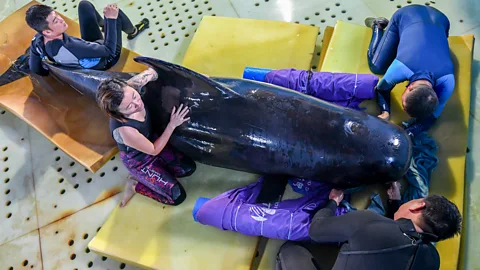
"We can almost never perform a controlled refloat of a whale, as they are too large for us to manually move, even with the use of specialist cetacean rescue pontoons that some organisations possess – they are for small whales only," says Arrow.
A response team may enlist bystanders' help with smaller whales and other marine mammals if it's considered safe and appropriate to refloat them. Every stranding scenario is unique, and only a trained team member should make decisions for the animal's well-being, says Hager.
Euthanising a stranded whale
Deciding to euthanise a stranded whale – meaning, killing it to end its suffering – is never easy, experts say. "Euthanasia is a last resort used to end the suffering of an animal that is deemed unable to survive," says Jim Rice, stranding programme manager at the Marine Mammal Institute, Oregon State University.
However, even if the vets on site believe that it's the most compassionate course of action, it's not always possible. For example, a very large amount of the medication is needed to compassionately euthanise a whale, and it may be difficult to administer it. Killing the animal with a firearm is also difficult given its thick skin – and of course, euthanasia by any means requires special authorisation. In the case of Timmy, German officials said that euthanasia was not a feasible option under the circumstances.
Then there's the matter of the remaining animal carcass. If the whale is euthanised with a chemical agent, its body will need to be disposed of properly, since it can poison nearby scavengers. If it died of natural causes or without dangerous chemical aids, the carcass is often left or buried on the beach where it stranded.
More like this:
Leaving a stranded whale
Given the lack of other options, large whales are often left to die without intervention as it's "the most humane and practical response", says Read. This can take anywhere from several hours to a few days.
For onlookers, it may feel cruel to leave an animal to die without trying to intervene. Marine experts empathise with the overwhelming compassion and desire to save such a magnificent creature.
"Marine mammals bring out very strong emotions in people, most of whom only want what's best for the animal," says Rice. But people may have unrealistic expectations about what is feasible for the animal's survivability, he adds.
By the time rescue operations to relocate Timmy were underway, he was already likely in a severely compromised state of health, and survival chances were extremely low, says Arrow.
"It is not always in the best interest of the animal to return it to the water, given underlying health conditions, as well as the toll and stress of stranding alive," says Hager.
For people who want to help cetaceans threatened by strandings, a more effective point of intervention may be before the stranding: for example, through initiatives that prevent bycatch and entanglement and thus reduce the overall number of strandings. Bycatch and entanglement in fishing gear kill an estimated 300,000 cetaceans a year – including, it appears, Timmy.
--
For essential climate news and hopeful developments to your inbox, sign up to the Future Earth newsletter, while The Essential List delivers a handpicked selection of features and insights twice a week.