'He was tasked with making the body disappear': The macabre kidnapping of Eva Perón's corpse

 Getty Images
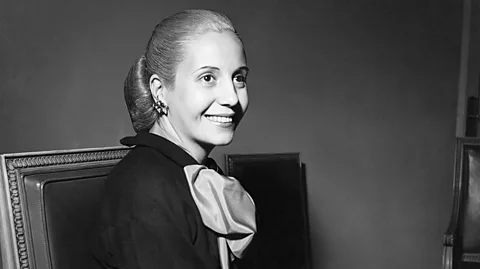
Argentina's iconic first lady died in July 1952. Sixty years on, the BBC looked back at her cadaver's bizarre disappearance – and its 16-year journey around the globe.
A few hours after the death of Eva Perón, on 26 July 1952, Dr Pedro Ara got to work. The renowned Spanish anatomist was tasked with embalming the Argentinian first lady's body in the same way the Russians had preserved the remains of Lenin and Stalin. The corpse of Evita, as she was affectionately known, was kept in the Ministry of Labour building, where a monument to workers was due to be built, with a glass coffin at its base that would be her final resting spot.
Warning: This article contains details that some may find distressing.
Yet three years later, in September 1955, her husband, President Juan Perón, was deposed in a military coup and went into exile. The new regime decided to steal Eva Perón's body – setting off a macabre 16-year odyssey. Her cadaver would be held at the Centre for Military Intelligence, stored in a van, buried in Milan, and transported to Madrid before it was eventually returned to Buenos Aires to be laid to rest in a heavily fortified crypt.
After Eva Perón died of cervical cancer at the age of 33, her husband had political reasons for having her embalmed. Her poor rural background and her charitable works as first lady had won her fervent working-class support. "So he wanted to preserve that, [by] preserving the body," Flavia Fiorucci, a historian of Peronism, told the BBC in 2012. "It also had to do with the importance that Perón and Peronism gave to symbols, and Evita was a symbol."
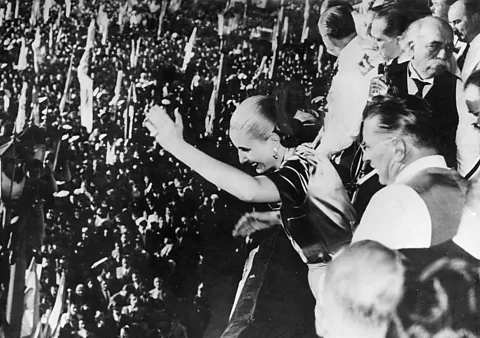
That was clear in the weeks after her death. Dr Ara was able to embalm Evita's body in a lifelike state using a paraffin and glycerine injection technique. Two million people visited her coffin as she lay in state in Congress for 14 days, the devotion she'd inspired while alive continuing after her death.
And the symbolism of Evita's body was the reason for the long meandering journey it took over the next 16 years. When Perón was deposed in 1955, the dictatorship led by Gen Pedro Aramburu aimed to quash all aspects of Peronism – and feared that her corpse could become an emblem of resistance.
Lt Col Carlos Moori Koenig, head of the Army Intelligence Service, moved it around Buenos Aires, paranoid that Peronists might attempt to retrieve it. Evita's cadaver was said to be hidden in a van parked on the streets of the capital, behind a cinema screen, and inside the city's waterworks – and wherever it went, flowers and candles appeared.
 Getty Images
Koenig then moved the body to his office, where he allegedly stood the coffin upright, and showed it off to visitors. He was said to have become obsessed with her corpse. "I knew him from military school. He was completely normal, but after getting his hands on the body, he went mad," said Col Héctor Cabanillas in the 1997 documentary Evita, la tumba sin paz (Evita, the grave with no peace).
Argentine academic Cecilia Macón told the BBC in 2012 that, while it's hard to uncover the truth because "myth and history mingle constantly in stories regarding Evita", one story is that Koenig became infatuated with his charge, before being relieved of his duties in 1957.
Cabanillas was then tasked with making the body of Eva Perón disappear, arranging for it to be shipped to Italy in 1957. Evita was buried under the name María Maggi de Magistris in a cemetery in Milan. She was not forgotten by her supporters, however, with graffiti appearing in Buenos Aires asking, "Where is the body of Eva Perón?" The return of the corpse became a rallying cry for Peronists in Argentina.
The return of the body
Fiorucci believes that the fact it was the military who had made Evita's corpse disappear added to its potency. "The pain inflicted [on] the dead body of Evita was also a symbol of that against the working class."
In 1971, a new regime aimed to return Argentina to democratic rule, easing restrictions against Peronists, and agreed to return Evita's body to Juan Perón. It was delivered in a silver coffin to the villa in suburban Madrid where the former dictator was living in exile, with his third wife Isabel.
In History
In History is a series which uses the BBC's unique audio and video archive to explore historical events that still resonate today. Sign up to the accompanying weekly newsletter.
Carlos Spadoni, then a confidant of Juan Perón, was one of the first to see the body. "Gen Perón, the gardener and I took the body out of the coffin," he told the BBC in 2012. "We laid it on a marble-top table and our hands got all dirty with earth. So the body had to be cleaned. Isabel took care of that… with a cotton cloth and water. Nothing more. Very carefully. Isabel combed the blonde hair. It was long and she cleaned it bit by bit with a comb and then blow-dried it."
Again, myths circulated about what happened next, with stories focused on the occult beliefs of the former government minister José López Rega. According to one tale, the Peronist politician told Isabel to lie beside the body of Eva Perón so that the Evita political magic would rub off on to her. Beliefs like this tapped into the almost religious reverence that Evita's followers felt towards her. The former dance‐hall girl who rose to power with her husband became a spiritual leader to her devotees, her body taking on a sacred importance for them – although she was also reviled by anti-Peronists.
More like this:
Juan Perón returned to power in Argentina in 1973, with Isabel as his vice president. Evita's body remained in Spain, but after Juan died suddenly in 1974, her corpse was returned to Buenos Aires. Domingo Tellechea was sitting in a bar in the capital when he was first approached to repair damage to Evita's body. "Two guys all dressed in black came in," he told the BBC in 2012. "They flung the doors open and looked over at us. This was dangerous, because in those days people were being carried off and 'disappeared' and never seen again."
Tellechea was a restorer of art, antiquities – and human remains. Fearful of government death squads, he was relieved when he found out the two men were drivers. They took him to see Oscar Ivanissevich, Eva Perón's former personal physician. "He said to me, 'We've got a job for you. You've got to restore the body of Eva Perón.'"
Tellechea accepted, despite being aware of the risks. "To do the work was to put myself in opposition to the people who made the body disappear and a lot of people really wished Evita had never turned up again at all. I knew it could bring me problems," he said. "There were threats, phone threats, torching my car." The restorer later went into exile, as state brutality and torture became systematic in Argentina under successive regimes.
Yet Evita was finally laid to rest in October 1976, with only a small group to witness her burial. The crypt was fortified to ensure her remains would never be disturbed again. The marble tomb had a trapdoor in the floor leading down to a hidden room. And that room had a second trapdoor leading to another room which housed her coffin. Even 24 years after her death, the strength of Evita's symbolism meant that her body had to be buried 5m below the ground.
--
For more stories and never-before-published radio scripts to your inbox, sign up to the In History newsletter, while The Essential List delivers a handpicked selection of features and insights twice a week.