How 'heat domes' are causing a marine life shift

 JP Fallaize
Marine heatwaves are causing a shift under the surface with some species suffering as others become more common, experts have warned.
The heatwave has been fuelled by the "heat domes" that brought record-breaking air temperatures in May and June, on top of long-term ocean warming due to climate change.
Sea Fisheries said Guernsey's water temperature earlier in July was 17.7C (63.8F), 2.7C higher than the average for the same week between 1980 and 2019.
Nicky Harris, who leads the marine biology section at La Société Guernesiaise, said: "We have to start thinking ahead in terms of how we can best make our seas more resilient, more healthy, to combat marine heatwaves."
Harris said some species off Guernsey were not benefiting from the temperature rise.
"Certain crustacean species that we really rely on as a fishing industry, they prefer colder waters, so things like chancre crabs, this is going to cause more shifts to deeper, colder waters."
She said seas had experienced a "downward shift" in phytoplankton and plankton which was "concerning" as they were a vital food source for marine life.
Dolphins 'eating jellyfish'
Guernsey diver John Fallaize said he had seen a shift in wildlife present in island waters, such as comber fish, which were usually found in the Mediterranean.
"This small fish is guaranteed on every dive irrespective of the locations around the islands," he said.
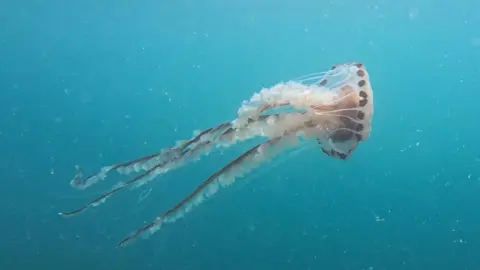
Fallaize said he noticed more jellyfish, including mauve stingers which were also more commonly found in warmer European waters.
"More dolphins [are] being seen and from what I have seen they have been eating the jellyfish as there is no mackerel about either," he said.
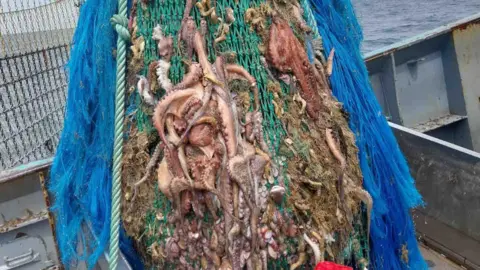
Fallaize added octopus had been "more plentiful and of a slightly smaller size than the last two years".
Harris said the surge in numbers in recent years were due to "milder winters so there's not a die-off event which we have previously had in the 1960s".
With marine experts suggesting bluefin tuna are more likely to be seen, deputy Marc Leadbeater thinks Guernsey should be catching the fish, something that was currently not legal.
To allow the landing, the island needs a quota from the Department for Environment, Food & Rural Affairs (Defra) in the UK.
"I'd like to see us have access to some tuna quota, clearly Jersey's moved ahead of us in that direction at the moment because they've got catch and release and commercial tuna quota from Defra," Leadbeater said.
He said it would be a vital decision in helping to keep the island's fishing industry afloat.
Fleet 'absolutely decimated'
In 2025, a boom in the population of common octopus in South West waters wiped more than £500,000 off the value of local shellfish landings, a report said.
The study by the UK Marine Biological Association (MBA) found the number of octopus landed by commercial fisheries in the region was almost 65 times higher than recent annual averages.
Leadbeater said: "It is incumbent on [the] government to do whatever they can to support an historic industry like the fishing industry.
"I mean our fleet has been absolutely decimated so we have to do something before we lose it completely," he added.
David Wilkinson, Senior Fisheries Officer, said they were still working with Defra to allow the UK membership of the International Commission for the Conservation of Atlantic Tunas (ICCAT) to be extended to the Bailiwick.
Wilkinson added that legislative changes would need States approval before anything could happen.
Follow BBC Guernsey on X and Facebook and Instagram. Send your story ideas to channel.islands@bbc.co.uk.