US and Iran trade fire after two US soldiers killed in Jordan
The US and Iran have exchanged strikes for an eighth consecutive day after an Iranian attack on a base in Jordan killed two US soldiers and left another missing.
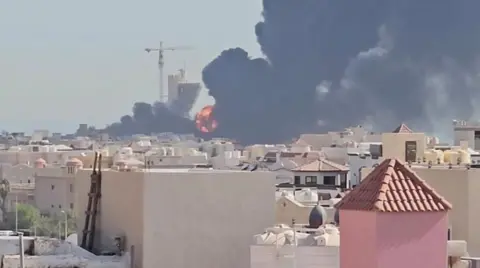
Iranian media reported that an under-construction nuclear power plant in the south-western city of Darkhoveyn had been struck overnight, as well as Qeshm Island. In Kuwait, an electricity and water plant was hit for a second time, local officials said.
Later on Sunday, three Iranian missiles were shot down by Jordan's military and a fourth fell in a remote area, Jordan's state news agency reported.
It followed a US warning that the Jordanian port of Aqaba could be targeted.
Jordan summoned Iran's charges d'affaires in Amman to demand an immediate end to what the foreign ministry called "unjustified and blatant Iranian attacks", insisting that its security was "a red line that cannot be crossed".
The US and Iran have ramped up attacks against each other in recent days, with both sides accused of striking critical infrastructure.
Washington has also reimposed its blockade of Iranian ports and Tehran has declared the Strait of Hormuz closed and targeted US allies in the Gulf, with their preliminary ceasefire collapsing less than a month after it began.
Israel's military said that "several interceptors were launched toward missile debris in order to prevent debris impact within Israeli territory" after projectiles were launched towards Jordan on Sunday.
It said "interceptor fragments" were subsequently identified near the southern city of Eilat, near the countries' shared border, with no damage or injuries reported.
Meanwhile, Iran's Islamic Revolutionary Guard Corps (IRGC) said two vessels had ignored Iranian warnings not to transit the Strait of Hormuz and were consequently involved in "an accident".
It warned that all vessels "influenced" by the US and which used "unsafe routes" would "certainly face accidents".
The UN's nuclear watchdog called for restraint after Iranian authorities said a nuclear plant under construction had been hit, while noting that the site was "in the very early stages" and contained no nuclear material during its last visit.

 Reuters
The US military said its eighth successive night of attacks on Iran had been "designed to further degrade Iran's ability to threaten commercial shipping in the Strait of Hormuz".
It also said it sought to "swiftly punish Islamic Revolutionary Guard Corps forces who launched attacks against American service members in Jordan" on Friday.
Verified footage from inside the Jordanian facility showed at least two impacts and an explosion.
Responding to the deaths of US soldiers on Saturday, Defence Secretary Pete Hegseth said: "Godspeed, heroes. Their sacrifice only stiffens our resolve."
The US death toll in the conflict has now risen to 16 after an American Navy pilot who went missing earlier this month was declared dead.
In Iran, at least 50 people have been killed and more than 500 injured in US strikes over the past three weeks, the country's health ministry says.
 EPA/Shutterstock
On Saturday the Gulf Cooperation Council - an alliance including Bahrain, Kuwait, Oman, Qatar, Saudi Arabia, and the United Arab Emirates - accused Tehran of targeting civilian infrastructure after the first strike on a Kuwaiti power plant and a water distillation plant.
On Sunday, Kuwait said the same power and water distillation plant had been hit for the second time by Iran in two days, resulting in a fire.
Iran said it had also targeted an air base and a depot used by US forces in Kuwait on Saturday.
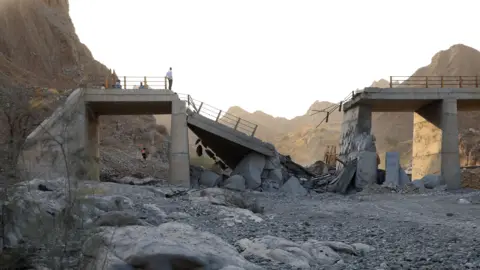
The US has meanwhile said it "carried out strikes exclusively on military targets, including military logistics infrastructure" after Iran said bridges and a station were hit earlier this week.
Under international law, attacking civilians or civilian areas is illegal. However, in certain circumstances, civilian objects - like a bridge or a power plant - lose their protection if they are used to support the enemy's war effort.
Washington and Tehran struck a preliminary deal to end the war in June, but the agreement unravelled within weeks - with President Donald Trump declaring the agreement "over" on 8 July.
Late on Saturday, Iran's Supreme Leader Mojtaba Khamenei said in a written statement that America's "repeated breaches" of the agreement had "laid bare a fundamental truth: the signature of the US president is utterly worthless and devoid of credibility".