Patient's killer was 'not suitable' for low-risk ward

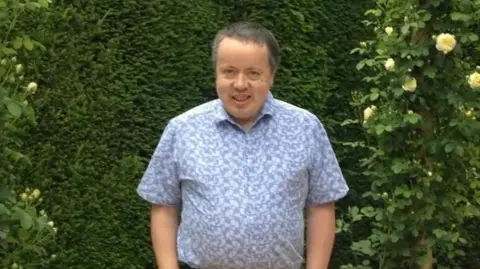 Family photo
A deputy manager of a low-risk mental health ward where a teenager killed a fellow patient had previously told a crisis team that he was "not suitable" for admission there, an inquest heard.
Owen Herbert, 19, strangled Richard Laversuch, 63, hours after being admitted to Juniper Ward - an acute mental health ward at Parklands Hospital in Basingstoke - in the early hours of 27 November 2021.
On Monday, deputy manager Maggie Tilbrook gave evidence at Winchester Coroner's Court into the death of Laversuch, who was from Andover, Hampshire.
She told jurors at the ongoing inquest she had verbally told the Crisis Home and Resolution Team (CHRT) Herbert was "too high risk" for Juniper Ward.
The court was told that Herbert had been held in the psychiatric intensive care unit at the same hospital two months before the attack in the early hours of 27 November 2021.
After pleading guilty to manslaughter, Herbert was given an indefinite hospital order in 2023.
Tilbrook, who was working until 21:30 BST on 26 November, said she had received a call from a social worker during the mid-afternoon, who had told her that he had an admission and that they were doing a Mental Health Act (MHA) assessment.
She said the social worker provided her with Herbert's details so she could search him up on Rio, an electronic patient records system, but he said he had not contacted the CHRT.
The inquest heard that after hearing some background about Herbert from the social worker, Tilbrook rang the CHRT and told them Herbert "wasn't suitable for an admission to an acute ward".
Tilbrook said, upon searching for details about Herbert on the system, she had discovered he had previously carried a four-inch blade, there had been a "documented assault" against his mother, he had delusional beliefs he was part of a game, he believed he was being controlled and needed to kill someone, and that he was sexually disinhibited.
She told the inquest this confirmed her belief that the Juniper Ward was not suitable for Herbert and he should be sent to a Psychiatric Intensive Care Unit (PICU), which is locked and more secure.
She said for the rest of her shift she did not hear anything back from the CHRT, and at about 20:30 she rang them again and was told that the CHRT had "heard nothing".
She then did a handover for the night team, the inquest heard.
Tilbrook said: "I handed over that Mr Herbert needed to go to a PICU and he was too high risk to be on an acute admission ward."
The jury also heard from Dr Bilal Talat, a consultant psychiatrist who was part of the team that did Herbert's mental health act (MHA) assessment at his family home in Overton, Hampshire, on 26 November.
The inquest was previously told Herbert had been hearing "voices" that urged him to kill people and his parents struggled to stop him leaving their family home with weapons.
In a statement read out to the court on Monday, Talat said "although we didn't initially think he posed a risk", by the time the team had begun speaking to him, "the risk level had increased in my mind".
He told the court that Herbert was taking cannabis and had "increased" his alcohol intake, which made his medication "ineffective".
Talat said he recommended that a Section 3 of the MHA - which allows for the compulsory admission and treatment of a patient in a psychiatric hospital for up to six months - was more suitable.
However, it was decided Herbert would be detained under Section 2 of the MHA, which allows for compulsory hospital detention for up to 28 days for the purpose of a mental health assessment.
Admission of 'failures'
On Friday, the inquest heard that Everton Bolton, a retired locum social worker who was part of the team that carried out Herbert's mental health assessment, had been previously suspended for a year by Social Work England after admitting dishonesty and misconduct.
Bolton, who was a locum-approved mental health practitioner working for Hampshire County Council, told the inquest he had carried out his role with the "utmost integrity".
He was asked detailed questions about conversations he had had with medical staff in the lead-up to Herbert's admission to hospital.
There were differences of opinion about who he had spoken to and he had not kept any records of the conversations.
Two doctors involved in the assessment said Bolton had told them Herbert was going to a high-risk ward.
Oliver Lewis, the lawyer representing the victim's family, revealed Bolton's suspension had related to him working overlapping shifts for more than one employer.
In a series of admissions, Hampshire and Isle of Wight Healthcare NHS Foundation Trust said there were internal and external communication failures before Herbert's admission to Parkland's Hospital.
It said Herbert should have gone to the PICU and had an appropriate nursing and risk assessment following his arrival.
The inquest continues.