Deputy
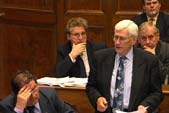
First Minister Seamus Mallon resigns, 15 July 1999
This
ruling was ignored when David Trimble refused to give up his position after
Seamus Mallon resigned his post on 15 July 1999 in protest at David Trimble's
refusal to jointly nominate an Executive. Much to the anger of the DUP,
Seamus Mallon was reinstated as Deputy First Minister on 29 November 1999
without being re-elected as prescribed by the rules.
The
obstacle to the setting up of an Executive centred on the UUP's refusal
to enter government with Sinn Féin while the IRA held on to its weapons.
The impasse was resolved temporarily when US Senator George Mitchell presided
over a review process that began on 6 September 1999 and reported on 19
November. The UUP then held a meeting of the 860-member Ulster Unionist
Council at the Waterfront Hall in Belfast to reflect on the Mitchell Report
and vote on whether they should agree to enter government with Sinn Féin.
On 27 November the Ulster Unionist Council backed David Trimble by 58 per
cent to 42 per cent to enter government with Sinn Féin with the proviso
that if decommissioning had not occurred by February 2000 it would withdraw
and bring the Executive down.
The
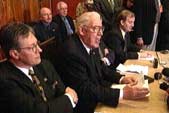
DUP leader Dr Ian Paisley explains why his party will not sit in the
Executive with Sinn Féin
On
the basis of this reprieve the Assembly met on 29 November and under the
d'Hondt rule 10 ministers were appointed. The Chairpersons, Deputy Chairperson
and members of the ten Departmental Committees were appointed on a roughly
proportional basis through the 'usual channels' i.e. the whips. The DUP
decided to take up their Executive seats on a rotation basis but not to
participate in its meetings while the IRA held on to its weapons.