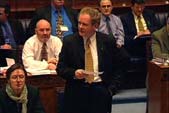
Sinn Féin MLA Martin McGuinness accepts post of Minister for Education, 29 November 1999 |
Neither
the First nor Deputy First Ministers have the power to formally appoint
Ministers to the ten designated posts. Government ministries are allocated
to parties on the basis of their strength in the Assembly. Individual parties
choose their preferred candidate whose appointment is then decided by a
procedure known as the d'Hondt rule. This means the Assembly is not required
to give a vote of confidence to each party's nominated choice. This rule
allows the DUP, who are opposed to the Agreement, to be "partly in, and partly out" of the Executive. However, an individual minister can be deposed
from office if, under the cross-community rules, there is support. But the
party whose minister has been ousted under the cross-community rules can
appoint a successor from its own party.
Under the Northern Ireland Act 1998, ministers enjoy executive powers and
are not bound by the rules of collective responsibility except where the
Executive Committee and the Assembly have agreed a programme for government.
|
|
|
| Unlike
the Westminster government, ministers are not required to take an Oath of
Allegiance to the Crown or the Union. Instead, they take a Pledge of Office
that requires Ministers to discharge their duties in good faith, to follow
exclusively peaceful and democratic politics, to participate in preparing
a programme of government, to support and follow the decisions of the Executive
Committee and the Assembly; and to comply with the Ministerial Code of Conduct.
The
duties of office require ministers to serve all the people equally, to
promote equality and to prevent discrimination. Civil Servants are also
obliged to run their departments on the same basis. Having an Equality
Unit within the Office of the First and Deputy First Minister bolsters
this requirement. There is also a requirement that the relevant Minister
serve in the North-South Ministerial Council. However there is provision
in the Agreement/Act enabling the First/Deputy First Minister to make
proxy arrangements in the light of the refusal of an executive party to
participate in the Council.
In
October 2000 the North-South Ministerial Council became embroiled in the
politics of decommissioning when First Minister David Trimble received
Ulster Unionist Council backing for his pledge to ban Sinn Féin
ministers from attending cross-border ministerial meetings until the IRA
resumed contact with the Independent International Commission on Decommissioning. His action was subsequently deemed unlawful by the Appeal Court in Belfast.
|
|
|