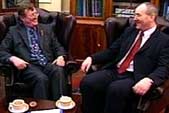
First Minister David Trimble and the new Deputy First Minister Mark Durkan relax over a cup of tea after their election. |
The
First and Deputy First Ministers
The Northern Ireland power-sharing Executive has ten Ministers and a dual
premiership of a First and Deputy First Minister who preside over the
Executive Committee of Ministers and co-ordinate its work and are responsible
for the Assembly's external relationships. The First Minister, the leader
of the largest political party in the Assembly, is required to "act
jointly" with the Deputy First Minister and does not possess "sole"
powers in any regard.
On 1 July 1998 David Trimble of the Ulster Unionist Party and Seamus Mallon of the SDLP were elected First and Deputy First Ministers designate. They were elected by the cross-community Parallel Consent voting procedure that stipulates they have the support of 50 per cent of registered nationalists and unionists as well as a majority of the Assembly. The same voting procedure was employed in November 2001 when David Trimble and SDLP leader-designate Mark Durkan were elected to the top posts.
The
Parallel Consent procedure has two important political consequences. If
David Trimble were deposed as leader of the Ulster Unionist Party he would
not automatically lose his position as First Minister. He could only be
deposed if enough nationalists supported unionists to remove him; and
if the nationalists colluded in that then they would have to bring down
their own Deputy First Minister. Secondly, the voting procedure is calculated
to force unionists and nationalists to nominate candidates acceptable
to at least a majority of the other party's members in the Assembly. Each
side has the power to veto an unacceptable hard-line candidate. The rules,
in effect, ensure that a unionist and nationalist share the top two positions.
Should the First or Deputy First Minster resign an alternative would have
to be found in six weeks who was acceptable on a cross-community basis.
If an acceptable alternative could not be found then the Secretary of
State would trigger elections for the Assembly.
|