The
Secretary of State Peter Mandelson then triggered the necessary legislation
and power was devolved to Northern Ireland for the first time in 27 years.
The Secretary of State suspended the Executive 10 weeks later on 11 February
2000 because of the impasse over decommissioning. The Executive was reconvened
on 31 May 2000 after the IRA pledged to put its arms beyond use.
Trimble resigned as First Minister on 1 July 2001 in protest at the IRA's failure to decommission, forcing the Deputy First Minister to step down. However, Trimble's resignation did not leave the Executive in a parlous state. He had nominated Sir Reg Empey to act on his behalf and with Seamus Mallon acting as a sort of unofficial Deputy First Minister, Northern Ireland retained a semblance of political leadership.
John Hume announced on 17 September that he would step down as SDLP leader and his deputy Seamus Mallon indicated that he would also step down. Finance Minister Mark Durkan became SDLP leader designate and his party's choice for the role of Deputy First Minister.
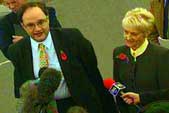
UUP MLAs Peter Weir and Pauline Armitage
On 23 October the IRA announced they had begun a process of disposing of arms. Ulster Unionist leader David Trimble was satisfied but two dissident MLAs from his own party and the anti-Agreement Democratic Unionist Party were not. This political dissent had implications for Trimble's chances of being re-elected First Minister.
Under the Assembly's complex voting rules he needed a majority of unionists to support him for the top post. On 3 November Trimble failed to get re-elected despite the Women's Coalition re-designating its two MLAs to give him at least one extra unionist vote.
The Alliance Party was then encouraged to re-designate a number of its MLAs as unionists so that Trimble would have the necessary vote. On 6 November Trimble and Durkan were elected First and Deputy First Minister at a special meeting of the Stormont Assembly.
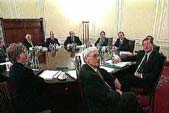
The
first sitting of the Northern Ireland Executive
The
Agreement states that there must be at least six but no more than ten other
Ministers. The First Ministers decided on ten and this was agreed by cross-community
consent in the Assembly. This has the advantage of more proportional representation
of parties on the Executive. Initially the UUP wanted a maximum of seven
on the Executive, which would have given unionists an overall majority.
The SDLP argued for a larger Executive giving nationalist better representation.
On 18 December 1998 the Assembly approved the plan for a larger Executive
responsible for ten departments. These are: Agriculture; Environment; Regional
Development; Social Development; Education; Higher and Further Education,
Training, and Employment; Enterprise, Trade and Investment; Culture, Arts,
and Leisure; Health, Social Service, and Public Safety; and Finance and
Personnel.