|
The Binnian Tunnel - The Tunnellers
|
|
|
 |
Bobby
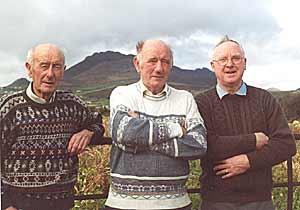
& Willie Davey, and Tom Newell |
|
A courageous workforce
About 150 men were involved over the three year
period and the story of how they achieved their
fantastic goal is almost unbelievable. In September
2001, Your Place & mine was able to find three
men still living in the Annalong area who worked
inside the tunnel. Fifty years since they'd been
underground, Brothers Willie Davey and Bobby Davey
met with Tom Newell and recounted to us how the
job was done and what the conditions were like.
Pictured right (From left to right): Bobby Davey,
his brother Willie and Tom Newell, three of the
many courageous men who burrowed underground for
three solid years. The scene behind them is, of
course, Slieve Binnian. |
|
|
|
 |
Bobby
Davey |
|
Drilling & Blasting
The process of tunnelling followed a cyclical routine
of; drilling a precise pattern of deep holes in
the rock face, setting up explosive charges in those
holes, blasting the section of rock away and then
'mucking out' the debris. Each time the routine
could take many hours. At certain points the engineers
would come to inspect the progress and calculate
the straightness of the line.
When the charges of dynamite were set off the
tunnel behaved like a giant peashooter and there
are stories of unsuspecting workers near to the
tunnel-mouth being blown off their feet. Although
the workers at the face remained inside during
blasting it was the done thing to stand in one
of the 'lay-by' sidings where the locomotive and
skips parked. Bobby Davey learnt this the hard
way as he explains here..
Listen
to Bobby Davey
- Dynamite |
|
|
|
 |
Demonstration
|
|
How it worked
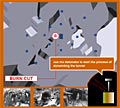
Using explosives to drive a tunnel is an exacting
process and was done with great care. Precise amounts
of explosive charge must be employed and in a calculated
way.
Click the diagram on the left
to view an interactive demonstration of the blasting
process that was used. |
|
|
|
 |
Willie
Davey |
|
The hole that joined them
When the two squads of tunnellers eventually did
meet in the middle on the 6th December 1950, the
final bore-holes were just inches out of alignment
with each other. How did they manage to achieve
that level of accuracy? Willie Davey, the man who
drilled the final hole, explains how the shift bosses
hung candles from the ceiling to gauge the straightness
of the tunnel's progress.
Listen to Willie Davey
- How we kept it straight... |
|
|
|
 |
| 6th December
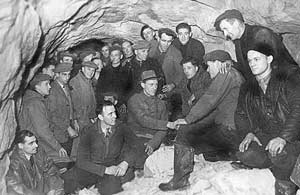
1950. Click on picture to view a larger version
|
|
the day when they met...
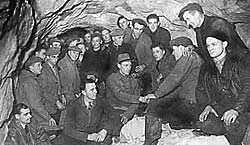
On that day in 1950 when the two squads of men
finally met in the middle there was much celebration
and sense of history in the tunnel. A group photograph
was taken. The Davey brothers were there but the
photo became lost somewhere in the last fifty
years. Willie Davey told us (in September 2001)
that he had long ago given up hope of ever seeing
this photograph again. However we asked on the
your place and mine website if anyone knew where
this photo might be. Now, thanks to your responses
to that appeal, the picture has been rediscovered...
and here it is.
When it was first put on the website we then
asked if you could name any of the men. You have.
Click on the photo to see a much larger version
with the names of the men you gave us. |
|
|
|
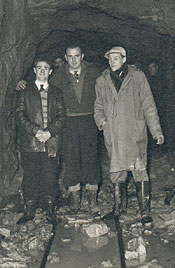 |
Willie
Davey (middle) and
Richard Meade King who was an
Assistant Engineer with the firm
of Binnie, Deacon & Gourley.
The man in the striped jumper
is believed to be Leslie Hanna. |
|
Tough conditions
Work in the area was hard to come by and men
took work wherever they could get it. Squads were
recruited from various trades. Some came from
Mourne quarries and were used to tough conditions
and working with dynamite. A great attraction
to working on the tunnel was that the pay was
around half a crown an hour which was about threepence
more than local quarrying work paid. Although
some, like Willie Davey, remained with the job
for its entire duration, many men only stayed
a few weeks or even days, unable to put up with
the heavy work and tough conditions.
Working conditions were pretty dreadful by today's
standards. The further they drove into the mountain
the harder it became and the longer it took to
clear debris away to the outside world. As they
neared the middle of the tunnel, the two teams
had to travel a mile in near darkness, breathing
diesel fumes and stale air laden with granite
dust and dynamite fumes. That was before they
even started their shift. The three men reflect
on the conditions they spent over 3 years working
in.
Listen
to discussion about working conditions
The work went on seven days a week by two shifts
working 12 hours each. There was a rotating pattern
where night shifts and day shifts swapped over
at weekends and one full day off was about as
much relaxation as they got. Even when work had
to stop one winter for a fortnight due to very
bad snow making the mountain inaccessible, the
work squads still had to report to their foremen
in order to be paid.
Despite the working environment and the obvious
danger of using explosives to drive a tunnel under
millions of tons of granite, not one worker lost
his life in the building of the tunnel, indeed
there were very few accidents at all. |
As you would expect, life on a job like this was not
without its lighter moments and practical jokes were
often played at the expense of others. Willie Davey
tells us two tales of pranks between the workers.
Listen
to stories about practical jokes |
|
|
|
 |
| Sandy
Heaney |
|
|
|
Record breaker
Sandy Heaney is one of the few men who worked at both
ends of the tunnel. Although he spent time at the Dunnwater
face, he was later a Shift Boss on the Silent Valley
heading
Sandy's shift held the record for the longest length
(or "pull" as they called it) of tunnel driven in a
single shift. It is reported to have been 160 feet.
When asked about it Sandy told us that they "just hit
it lucky" but his contemporaries who hold him in high
esteem tell us that he was an excellent shift boss and
got the very best from his team of men. Perhaps the
record pull can be put down to both factors. |
Drilling & Blasting
Sandy had his fair share of problems with the blasting
process. When the holes had been bored and the dynamite
was being set up a device known as a "clock" was used
to check that all of the connections were sound and that
the explosions would take place in the correct sequence
and at the right interval. Sandy described what happened
when the clock reported a fault.
Listen
to Sandy - Dynamite Clock Failure |
When it failed to go off...
Another thing which caused great concern was a "misfire".
This was when some of the dynamite charges didn't go off.
Someone had to go back to the rock face and inspect it.
This was both important and dangerous. There was always
the potential for a team to start drilling into the rock
for the next 'pull' with live dynamite sticks still lurking
in the rock. There were also differing schools of thought
about setting up a charge. Sandy explains here how a Scottish
tunnel 'ganger' preferred to use sticks of sand in between
the sticks of dynamite to fill up the space. This however
increased the incidence of misfires.
Listen
to Sandy - Dynamite Misfires |
|
|
|
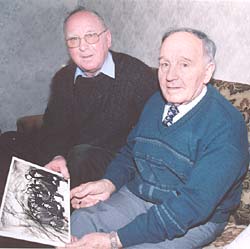 |
| Sandy Heaney &
Tom Newell |
|
The day the roof came in
The tunnelling process ran into severe difficulties
when soft ground was encountered. (You can read about
this in detail in the " Engineers
" section of this site.) Sandy was there at the
face when the pneumatic drill punched through into a
void and water and sand, under enormous pressure, blew
it back out of the hole. There was no mistaking that
they were possibly in great danger of the roff caving
in and there was a sense of panic. Some of the workers
actually turned from the workface and ran to get out
of the tunnel.
Sandy chats here with his old workmate Tom Newell about
the incident and how it brought the tunneling to a complete
standstill for months.
Listen
to Sandy - Disastrous complications |
|
|
|
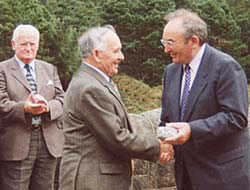 |
Sandy receiving his
commorative plaque
from the CEO of the NI Water Service
on the occasion of the 50th anniversary reunion.
|
|
Counting sheep...
Although many of the workers made their own way to
work by foot or bicycle, there was a bus which would
collect men from various points around the countryside
and deliver them to the tunnel heading. Sandy recalls
a humerous traffic incident involving sheep. What is
particularly interesting is the method of reparation
that the company used.
Listen
to Sandy - Sheep |
Your Responses
Alex Smith May '06
I have a school project and it involves a kid who blows up
part of a mine with 2 sticks of dynamite. We are fitting it
in to a novel and so needs a lot of description. I was wondering.
How do you set up dynamite inside a mine?
|



 print version





















 POST
A COMMENT ON THIS ARTICLE
POST
A COMMENT ON THIS ARTICLE 