|
The Binnian Tunnel - Introduction and Background
2½ miles through a mountain - a major feat
|
|
|
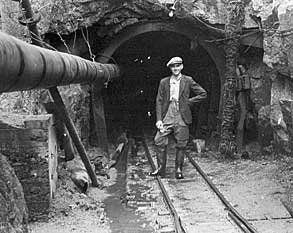 |
Sam
McMurray, the contractor's engineer
standing at the Dunnywater entrance in 1950
|
|
Between 1947 and 1950/51 a workforce of over 150 men drove a tunnel nearly two and a half miles long underneath Slieve Binnian in the Mourne Mountains. The purpose of the tunnel was to carry water from the Annalong valley to top up the Silent Valley Dam which had been completed just twenty years earlier. This was in response to the ever increasing demand for water in the greater Belfast area. The seemingly impossible task of cutting such a tunnel was undertaken by two work squads, starting at either end and meeting in the middle nearly 800 metres under the roof of the mountain. It was done without modern hi-tech aids - they used candles to determine the straightness of their bore, yet when they did meet in the middle they were only inches off each others centre-mark! |
|
|
|
 |
The
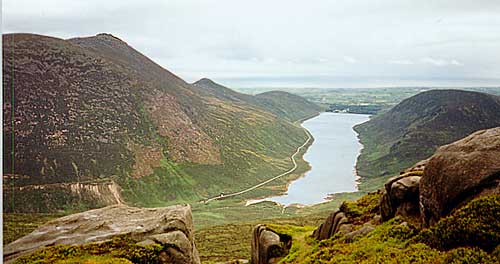
Silent Valley Reservoir - Slieve Binnian
on the left |
|
|
A truly mammoth task
 The
size of the task was immense. The tunnel had to pass
right through the base of Slieve Binnian to reach the
Silent Valley Reservoir. Slieve Binnian is the mountain
on the left in the above picture. It stands 747 metres
tall. To give an impression of scale, it's worth pointing
out that the little white dot on the tarmac road in
the picture above is an open-topped double-decker tourist
bus which is run by the visitors' centre. The tunnel
measures about 8 feet square throughout it's length
of two and a quarter miles (3.6km). Its entry point
is at Dunnywater and its exit into the Silent Valley
Reservoir can be seen at the roadside a short walk from
the Silent Valley Visitors' Centre. A plaque there tells
some of the facts about the tunnel. The
size of the task was immense. The tunnel had to pass
right through the base of Slieve Binnian to reach the
Silent Valley Reservoir. Slieve Binnian is the mountain
on the left in the above picture. It stands 747 metres
tall. To give an impression of scale, it's worth pointing
out that the little white dot on the tarmac road in
the picture above is an open-topped double-decker tourist
bus which is run by the visitors' centre. The tunnel
measures about 8 feet square throughout it's length
of two and a quarter miles (3.6km). Its entry point
is at Dunnywater and its exit into the Silent Valley
Reservoir can be seen at the roadside a short walk from
the Silent Valley Visitors' Centre. A plaque there tells
some of the facts about the tunnel.
|
|
|
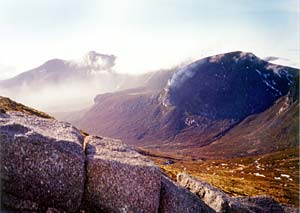 |
Looking
southwards down the Annalong Valley from
the Mourne Wall on Slieve Donard. The distinctive
"Dinosaur's Back" profile of Slieve Binnian
is
visible in the distance shrouded in mist.
|
|
Why was a tunnel needed?
The ever increasing demand for water meant that the Mourne catchment area had to be exploited more fully. The Silent Valley Reservoir alone was not enough. The Belfast City & District Water Commissioners had originally planned to build a second dam in the Annalong Valley however serious problems had been encountered in the building of the Silent Valley Dam. In short, what had at first seemed to be solid bedrock turned out to be huge glacial boulders with the real bedrock far below.
An enormous trench 210ft deep in the middle had to be dug and drained before foundations for the dam wall could be poured. This was an engineering challenge that almost brought the project to a close. It was assumed that the Annalong Valley would be no different and so the decision was taken not to attempt a second dam there. Click here to view two photographs of the Silent Valley taken before and after the dam was built. |
Ingenuity finds a way
The solution they came up with was to redirect all of the water coming down the Annalong Valley catchment area to top-up the Silent Valley Dam. The challenge however was that there was a huge mountain in the way - Slieve Binnian which stands 747 metres high.
So, late in 1947, work commenced on driving a tunnel through the mountain. The tunnel would have to be carefully planned and created with exactly the right gradient to deliver water into the Silent Valley at a pre-calculated rate and volume. This brought about major challenges both for the engineering experts who had to mastermind the plans and also for the tunellers who would have to blast an eight foot wide corridor through the mountain, starting from either end, maintaining a dead straight line and then meeting each other in the middle... by no means a simple job for anyone involved.
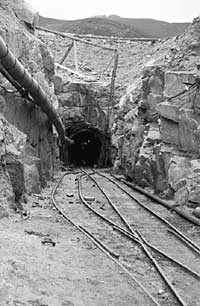
The picture on the left shows the Dunnywater entrance of the tunnel disappearing into blackness as it headed slowly downhill below the familiar profile of Binnian's majestic granite Tors some two and a half thousand feet above. The railway tracks you can see were for locomotive driven skips to bring out rubble. Early loco's were diesel and later ones were electric, using huge accumulator batteries. The pipelines carried unwanted seepage water out of the tunnel and delivered high-pressure air to drive the drills at the workface. The large pipe sucked stale air from the tunnel. |
|
|



 print version





















 POST
A COMMENT ON THIS ARTICLE
POST
A COMMENT ON THIS ARTICLE