|
It
was agreed that the Independent International Commission on Decommissioning
headed by Canadian General John de Chastelain should be responsible for
reviewing and verifying progress and report to the British and Irish governments
at regular intervals. The Agreement does not require the formal surrender
of illegal weapons to either the British or Irish governments. Nor does
it confer on any political party or leader the right to exercise a veto
on the implementation of the Agreement until decommissioning takes place.
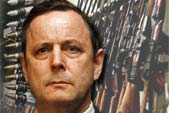
General
John de Chastelain leads the Independent International Commission
on Decommissioning |
Unionists
and republicans differ on their interpretation of the 200-word text that
outlines how decommissioning is to be dealt with. The unionists claim
that Sinn Féin is inextricably linked with the IRA and cannot understand
why Gerry Adams does not instruct the IRA to decommission. Sinn Féin
claim they are an independent political party, have no formal links with
the IRA and are in no position to instruct them to do anything. They did
however agree, in the words of the Agreement, "to use any influence
they may have, to achieve the decommissioning of all paramilitary arms
within two years" of the referendum.
This
decommissioning deadline of 22 May 2000 began to unravel when Trimble
invoked his manifesto commitment of "no guns, no government"
and refused to form an Executive shortly after he was elected First Minister
on 1 July 1988. Sinn Féin regarded Trimble's refusal as an act
of bad faith. They argued that decommissioning was linked to the "implementation
of the overall settlement" and therefore the IRA was under no legal
obligation to disarm until that remit had been fulfilled. Moreover, their
democratic mandate entitled them to have two Ministers in the Executive.
Loyalist paramilitaries said they would consider decommissioning when
they had evidence of IRA decommissioning.
|