The
Ulster Unionist Party put the review findings to a vote of the Ulster Unionist
Council on 27 November 1999 and they agreed by 58% to 42% to set up the
Executive with Sinn Féin. A year and five months later and following
the intervention of the Mitchell review Unionists voted on 27 November 1999
by 58% to 42% to set up the Executive with Sinn Féin. This followed
positive statements from Sinn Féin about decommissioning and an IRA
commitment to appoint a middleman who would negotiate with the Decommissioning
Body. There was, however, a rider; if progress on decommissioning had not
occurred by February 2000, the Ulster Unionists would collapse the Executive.
International
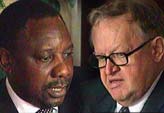
arms inspectors; former ANC negotiator Cyril Ramaphosa and former
Finnish president Martti Ahtisaari
Powers
were devolved to the Northern Ireland Assembly and power-sharing Executive
on 2 December 1999 but the government was short lived. Disagreement over
what progress should have been made on decommissioning led to the suspension
of the Northern Ireland Executive on 11 February 2000. After protracted
negotiations the IRA announced it was ready to begin a process to put its
weapons "completely and verifiably" beyond use and checked regularly
by two international arms inspectors, the former ANC negotiator, Cyril Ramaphosa,
and the former Finnish president, Martti Ahtisaari. Powers were restored
to the Assembly and Executive on the 22 May 2000. On the 26 June it was
announced that the two international arms inspectors had examined three
IRA arms dumps.
By
October 2000, the Ulster Unionist Party was unhappy with the IRA's failure
to engage constructively with the Independent International Commission on
Decommissioning (IICD). Instead of provoking a return to direct rule the
Ulster Unionist Council supported David Trimble's decision to ban Sinn Féin
ministers from attending cross-border ministerial meetings until the IRA
had demonstrated substantial engagement with the IICD.
Efforts
to resolve the decommissioning impasse continued and on 8 March 2001 the
Prime Minister Tony Blair and the Taoiseach Bertie Ahern had intensive negotiations
at Hillsborough Castle but after 13 hours of talks there was no conclusive
breakthrough. The IRA released a statement indicating it would resume contact
with General John de Chastelain's decommissioning body. In March Taoiseach
Bertie Ahern told US President George W Bush that he believed negotiations
on policing, demilitarisation and decommissioning could be brought to a
"successful closure" in June 2001.
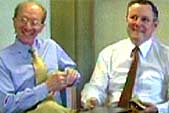
Commission members Andrew D Sens (left) and General John de Chastelain
International inspections failed to satisfy unionists demands and on 1 July 2001 David Trimble resigned in protest at the IRA's failure to decommission. However, it was events outside Northern Ireland that changed the political dynamic. The arrest in Columbia of three IRA suspects who were allegedly assisting FARC guerrillas cast a shadow of suspicion over the IRA's commitment to decommission. Then on 11 September Islamic extremists attacked the World trade Centre and the Pentagon. This cataclysmic event put enormous international pressure on the IRA and on 23 October they announced that a process of putting arms beyond use had begun. The Independent International Commission on Decommissioning verified this. Not all unionists are satisfied and decommissioning remains an obstacle to the peace process.
Legislation that bound loyalist and republican groups to legally put their weapons beyond use under the supervision of the Decommissioning body by 26 February 2002, was amended in 20020131 under the Northern Ireland Arms Decommissioning (Amendment) Bill. The legislation extended the deadline for another year with the option for further annual extensions up to 2007.