Stormont Assembly Under
the Agreement, the Assembly has full legislative and executive authority
in respect of those matters currently within the responsibility of the six
Northern Ireland Government Departments, with the possibility of taking
on responsibility for other matters later. The Assembly has control over
economic development, health and social services, agriculture, environment
and finance (including the Northern Ireland Civil Service).
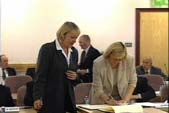
Jane
Morrice and Monica McWilliams of the Women's Coalition, designate
themselves as Inclusive Other, 1 July 1998
Under Assembly rules members can designate themselves as Nationalist, Unionist or Other. In 1998 the two Northern Ireland Women's Coalition members initially sought to designate themselves Nationalist, Unionist, Other, but this was ruled unacceptable so they designated themselves Inclusive Other and the Alliance Party designated itself as Other. The rules of the Assembly allow a party to change its designation once during the life of an Assembly provided the presiding officer is given 30 days notice.
When it was clear this rule would inhibit the re-election of David Trimble as First Minister in November 2001 the Women's Coalition put forward a motion that the rule be changed. On 2 November, the day of the crucial election, their proposed change to Assembly standing orders achieved the necessary cross-community support and Monica McWilliams redesignated as a nationalist and Jane Morrice as a unionist. In return for their decision to redesignate three MLAs the Alliance Party were promised a review of what they consider to be "a tribal and unjust" voting system.
Controversial
legislation cannot be carried by a majority vote but requires special voting
procedures that ensure cross-community support. These are Parallel Consent,
Weighted Majority and Petition of Concern. The legislation suggests the
Parallel Consent procedure should be attempted first.
Parallel
Consent requires "a majority of those members present and voting, including
a majority of the unionist and nationalist designations present and voting".
Based on the June 1998 election returns this means that parallel consent
will require 22 nationalists and 29 unionists as well as an overall majority
in the Assembly.
Weighted
Majority requires support from 60 per cent of members present and voting,
including at least 40 per cent of nationalist and 40 per cent of unionist
members present and voting.
Petition
of Concern is not strictly a voting procedure. To work it must contain the
names of 30 MLAs in order for a debate to be triggered and thence subject
to the special voting procedures. Normal laws covering non-contentious issues
may be passed by simple majority rule.