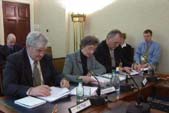
Minister
for Agriculture, Bríd Rodgers (centre), at a committee meeting
The
Assembly also has a committee system that scrutinises each of the ten departments.
The Committee Chairs and Deputy Chairs are allocated according to the d'Hondt
rule, providing yet another example of how the power-sharing ethos of the
Agreement is integrated into every aspect of governance. The Chairs and
Deputy Chairs cannot be from the same party as the relevant minister. The
other Committee members are allocated in proportion to their party strength
in the Assembly. The Northern Ireland Unionist Party and the United Kingdom
Unionist Party are boycotting the committees because of their opposition
to Sinn Féin in government.
These
Committees have responsibility for approving any new laws within their jurisdiction
tabled by a Minister but, if they consider it necessary, they can initiate
legislative proposals. The political consequence of this scrutiny procedure
is that a committee dominated by other parties may block the legislative
proposals of a Minister from a different party or it may initiate legislation
the Minister does not approve of. However, the success of such proposals
would depend on cross-community support.
First
Minister David Trimble addresses the Assembly
Under
the Agreement all legislation and key decisions taken by the Assembly must
be proofed to ensure that they infringe neither the European Convention
on Human Rights nor any future Bill of Rights. Under the Agreement there
is provision for a special committee to be appointed to "examine and
report on whether a measure or proposal for legislation is in conformity
with equality requirements, including the ECHR/Bill of Rights." This
special committee has not yet been convened.
There
is however, no provision under the Agreement or the 1998 Act for the Office
of the First and Deputy First Minister (OFMDFM), or the Office of the Centre,
to be scrutinised by a statutory committee. The Assembly was unhappy with
this omission and set up two scrutinising committees. However, the First
and Deputy First Ministers tabled an amendment and the two committees were
replaced with a single Committee of the Centre with a narrower scrutinising
remit.
The
Committee of the Centre is responsible for overseeing the Equality Unit,
plus another 12 or so functions of OFMDFM. However, half of the Office's
functions - the 'external ones' - lie outside the committee's remit. The
Committee's responsibility is to ensure that the statutory obligation upon
members to "promote equality of opportunity" and the "equality-proofing"
of proposed legislation is adhered to. The Equality Unit is based at the
Office of the First and Deputy First Minister. It is the responsibility
of this Unit to ensure that Northern Ireland departments and other public
bodies comply with Policy Appraisal and Fair Treatment (PAFT) requirements
introduced in 1994 and made a statutory duty by the Northern Ireland Act
(1998).
As
an additional safeguard, the Assembly is required to seek the view of the
Northern Ireland Human Rights Commission on whether a bill is compatible
with the European Convention on Human Rights and (when it comes into being)
a Northern Ireland Bill of Rights. The Commission has a duty to advise the
Secretary of State and the Executive "of legislative and other measures
which ought to be taken to protect human rights".