Summary

  1. How much do astronauts get paid, and what are the chances of becoming one?published at 15:39 BST 2 April

    Esme Stallard
    Science reporter

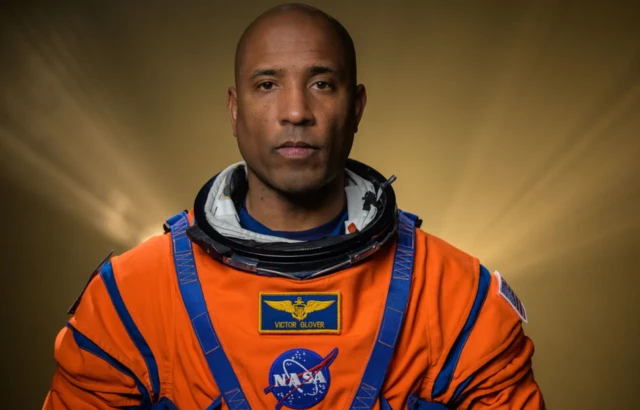
    Victor Glover stands facing the camera in his orange space suit, there is a yellow background and rays of light blocked by his bodyImage source, NASA
    Image caption,

    Victor Glover, one of the astronauts on the Artemis II mission, holds three masters degrees

    You need to be a certain height - between 5ft 2in and 6ft 2in (62in-75in), have a science degree, and face the risk of death on the job.

    But despite all that, Nasa astronauts don't earn millions for their endeavours. Currently they are paid $152,258 (£115,217) a year.

    And getting one of these coveted posts is one of the most competitive processes on Earth...and probably Space.

    When Nasa last opened its applications in 2024 more than 8,000 people stepped forward - from this, only ten were selected.

    And application rounds aren’t opened every year.

    Nasa has only ever selected 370 astronauts, so worth having a back-up plan.

  2. What happens next?published at 15:19 BST 2 April

    Georgina Rannard
    Science reporter

    Today is building up to the snazzily named "trans-lunar injection" burn. Basically, it is a massive push that will propel them out of Earth orbit and on course to the Moon.

    It is supposed to happen early Friday morning UK time, but if there are problems, it could be postponed or even cancelled.

    A cancellation would be a major setback for Nasa and the US as it tries to become the first country to land humans again on the lunar surface by 2028.

    If it all goes to plan, the burn will fire for six minutes to send them on a trajectory around the Moon that also uses lunar gravity to slingshot them back to Earth.

    Eventually they should fly 6,400 miles (10,299km) beyond the far side of the Moon, which always faces away from the Earth.

    That's meant to happen on Monday (6 April).

    The astronauts will be the first people to see some areas of the far side of the Moon, although probes from countries including India and China have previously documented this region.

    They'll be taking photographs and making observations of this mysterious place for us to see and learn from back on Earth.

  3. A recap of Artemis II's journey so farpublished at 15:07 BST 2 April

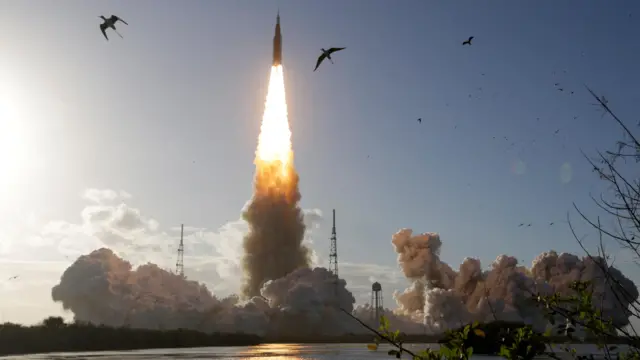
    A picture of Nasa's rocket taking off. A smoke cloud erupts underneath while birds fly in the sky nearbyImage source, Reuters

    While the astronauts catch four-and-a-half hours of shut-eye, let's recap Artemis II's journey so far.

  4. Where are the astronauts, and what are they doing now?published at 14:51 BST 2 April

    Georgina Rannard
    Science reporter

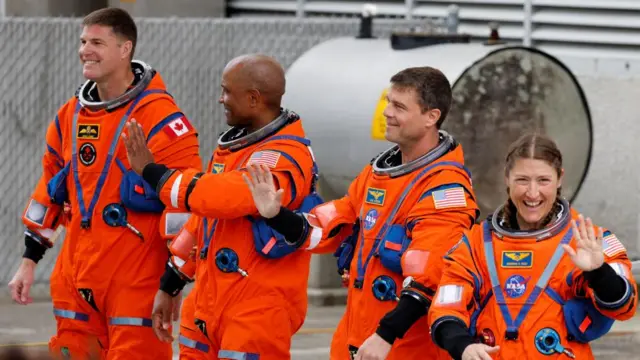
    Artemis crew in orange space suitsImage source, Reuters
    Image caption,

    The Artemis crew before launch on Wednesday

    The crew of the Orion space craft are asleep at the moment - they rest in approximately four-hour periods.

    The Orion spacecraft that Commander Reid Wiseman, Victor Glover, Christina Koch and Jeremy Hansen are on is now orbiting Earth about 42,500 miles away (68,397km).

    When not resting, the crew is testing the spacecraft.

    The craft's solar wings were fully deployed not long after launch, giving it power to help sustain its journey.

    About the size of a minibus, the spacecraft has never been flown in space before by humans, so pilot Victor Glover is spending the day pushing it to the extreme.

    Nasa want to be sure Orion is voyage-worthy before the crew push on into deep space from where there is no easy return.

    They're testing out the life support systems too.

    If something goes wrong, the crew has specially-designed suits that could keep them alive for around six days.

  5. Can Nasa really pull off a Moon landing by 2028?published at 14:26 BST 2 April

    Pallab Ghosh
    Science correspondent, in Florida

    That is the official line, but many experts believe that to be optimistic.

    The plan for the Moon landing is elaborate. First, the SLS mega rocket launches an Orion capsule into lunar orbit.

    Waiting there is a second, commercially built spacecraft that acts as a lunar lander. Two astronauts climb aboard, ride it down to the surface for several days of exploration, then blast back up to rejoin Orion for the journey home.

    It is being done in this complicated way because the US Congress has effectively locked Nasa into flying SLS and Orion, pushing the agency towards buying the lander from private firms rather than building a single all-in-one spacecraft, like Apollo.

    SpaceX’s Starship, owned by Elon Musk, is first in line for that job, with Blue Origin - owned by Amazon founder Jeff Bezos - developing a rival lander later in the decade.

    But Starship still has to prove it can reach orbit, refuel in space and dock reliably - all before Nasa will risk a crew.

    Looming large over all this is the prospect of China attempting its own crewed landing around 2030.

    If Artemis keeps slipping, Washington risks watching Beijing plant the next flag on the Moon, and that is a race US politicians are very reluctant to lose.

  6. Goodnight Earthpublished at 14:04 BST 2 April

    Esme Stallard
    Science reporter

    They have done crucial system checks, tested the comms system and completed two burns to get the spacecraft into the correct orbit - now it's time for the astronauts to go back to sleep.

    Their sleep schedule is tightly controlled as with everything on this mission, to make sure they are well rested but running the critical tasks when required.

    For this round they will only get four and a half hours before their alarms go off again.

    For now, from their small home for the next nine days, the commander Reid Wiseman signs off.

    "Goodnight Earth."

  7. Tiny Moon can be seen from high Earth orbitpublished at 13:57 BST 2 April

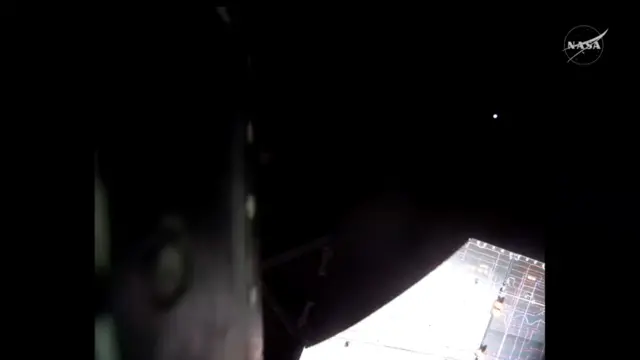
    If the crescent Earth in our last post doesn't convey the scale of this mission, here's another picture - this time showing the Moon.

    On the top right of the photo below, you can see a small white dot - that's our closest neighbour.

    We'll hopefully be getting much closer to it over the next few days.

    View from the outside of the Orion capsule where a distant Moon can be seen on the top right of the screenImage source, Nasa
    Image caption,

    A distant view of the Moon on the top right

  8. Crescent Earth visible from spacecraftpublished at 13:51 BST 2 April

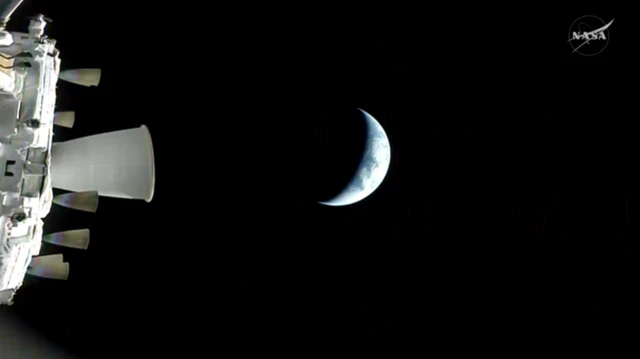
    If you're wondering what the blue planet looks like from space, a view from the Artemis II stream a little earlier shows a crescent Earth. In our last posts, we brought you comments from Commander Reid Wiseman about how his view of half the Earth was "spectacular", while mission specialist Christina Koch said it was "phenomenal".

    You're welcome to wave up at the Orion spacecraft from the ground, but we're not totally sure that the astronauts are going to see you.

    The view is being streamed from the solar array wing of the Orion spacecraft.

    A partial sliver of the Earth, known as crescent Earth, is seen from the Orion spacecraft. Black surrounds the earth and the edge of the spacecraft is visible in the left of the frame.Image source, NASA
  9. 'It is just phenomenal', mission specialist sayspublished at 13:45 BST 2 April

    "I just wanted to describe for you guys the beauty that we're seeing," mission specialist Christina Koch says.

    "You can actually make out the coastline of the continent, you can make out rivers because of the sunglare, you can see high thunder clouds [...] the South Pole lit up."

    "It is just phenomenal," she adds.

    "It is just absolutely phenomenal. You guys look great."

  10. View of the Earth is 'spectacular', commander sayspublished at 13:39 BST 2 April

    We've just heard from Artemis II Commander Reid Wiseman as the crew do their last checks before going back to sleep.

    "We just didn't want to let you go without saying that the view out of window three, from about 38,000 nautical miles, the entire half of the earth is spectacular," Wiseman says.

    "I love to hear that so much Reid, so glad you guys are getting to experience it," the control room replies.

  11. Emergency communications system checked by crewpublished at 13:27 BST 2 April

    The Artemis II crew have checked the emergency communications system following the successful perigee raise burn.

    This consists of various voice tests to make sure the spacecraft can regain communications with mission control in the case of an issue, despite such a situation not being expected.

    The emergency communications system uses Nasa's Deep Space Network - an international array of giant radio antennae which support interplanetary spacecraft missions.

    The network provides radar services and aids astronomers who are studying the solar system and universe.

  12. On a 10 day mission, it's all in the secondspublished at 13:12 BST 2 April

    Esme Stallard
    Science reporter

    The crew have successfully completed the perigee raise burn, where the lowest point of the elliptical orbit the spacecraft is on is moved higher.

    "It was a good burn," declared mission control.

    The move only took around fifty seconds.

    Years of design, 10 days to get to the Moon and back. But the series of manoeuvres that the team need to make it a success often only last a few minutes.

    It shows how much this multi-billion dollar endeavour is in the detail.

  13. Perigee raise burn carried out - but what is it?published at 13:11 BST 2 April

    The perigee raise burn is now under way, the Nasa control room says.

    This burn will help prepare the capsule for its trans-lunar injection burn, which Nasa mission control describes as the "last major engine firing of the mission".

    That means that the spacecraft's lowest point in orbit is being raised higher, a crucial step in sending the capsule Moon-ward.

  14. Spacecraft's solar array wings in positionpublished at 13:05 BST 2 April

    The Orion is due to perform the perigee raise burn in just a few minutes, with the spacecraft's solar array wings now in position.

    The service module of Orion has four of these wings in total, with each about 23 feet (7m) in length. Each wing is made of three panels.

    The solar array wings are used to convert light into electricity and can turn on two axes, remaining aligned with the sun for maximum power.

  15. Crew cleared to carry out perigee raise burnpublished at 12:50 BST 2 April
    Breaking

    After a few checks between mission control and astronaut Christina Koch, the team have completed their final "burn conference" ahead of the perigee raise burn.

    These conferences take place ahead of any burn during the mission to ensure the crew on the ground and the astronauts in the capsule are "on the same page", Nasa says.

    Artemis II have been given the all clear to execute the perigee raise burn in just under 20 minutes' time - that will help prepare the capsule for its trans-lunar injection burn, which Nasa mission control describes as the "last major engine firing of the mission".

    Here's what to know about the burn.

  16. What we're hearing: It's cold in the Orion spacecraftpublished at 12:45 BST 2 April

    There's been a bit of chatter between astronaut Christina Koch and the control centre. Temperature is the crew's concern right now.

    Koch asks mission control: "It is very cold in the cabin, any chance you can make it warmer, or reduce the cabin fan speed a bit more so the ventilation is not blowing as hard?"

    The control team say that while the crew were asleep they turned one of the knobs and saw a slight temperature increase.

    "We're going to take a look at some of these shell heaters and we'll let you know when we start putting some of that in work and we can see if that affects the temperature in a positive way," mission control says.

    "Thank you, Mike," is Koch's response.

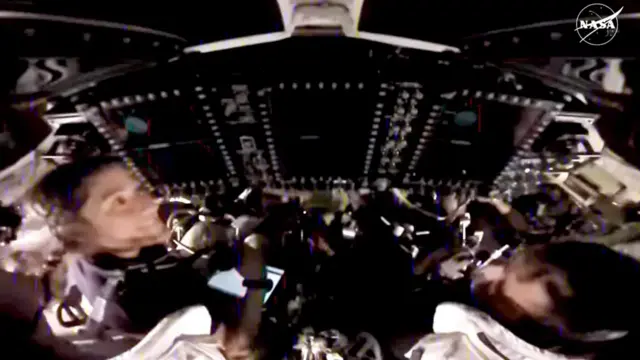
    a webcam image shows Christina Koch at the control panel of the spacecraft.Image source, NASA
    Image caption,

    Last night, we got a look at the astronauts in the Orion spacecraft

  17. Astronauts wake up and prepare for testingpublished at 12:40 BST 2 April

    Astronauts aboard the Artemis II Moon mission have woken up to carry out some critical tests.

    We can hear the crew speaking to the mission control centre in Houston.

    "Houston integrity, good morning, we are with you for PRB ops," Christina Koch says.

  18. Crew prepare for 'last major engine firing of the mission'published at 12:15 BST 2 April

    The crew are waking up from their nap to prepare for the perigee raise burn, an additional engine firing.

    It will lift the lowest point of Orion’s orbit around Earth.

    This burn will help prepare the capsule for its trans-lunar injection burn, which Nasa mission control describes as the "last major engine firing of the mission".

    The trans-lunar injection burn will propel Orion on a path towards the Moon and set it on its return trajectory to bring the astronauts back home in a few days' time, Nasa says.

    After this morning's perigee raise burn, the astronauts are set to go back to sleep at around 09:40 EDT (14:40 BST).

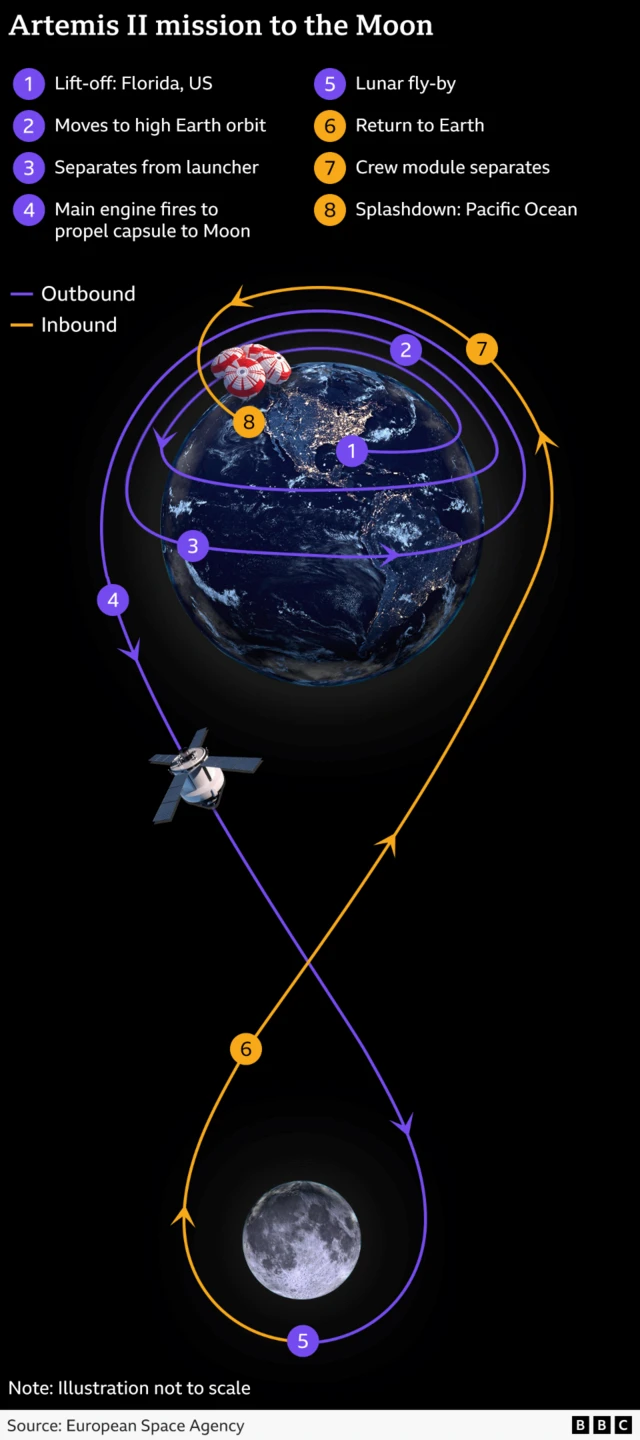
    Graphic showing the Earth and the Moon, with the spacecraft’s figure of eight orbital trajectory highlighted. Specific points are labelled. These are: 1. Lift-off at the Kennedy Space Centre, 2. Orbit around the Earth, 3. Rocket separation, 4. Main engine fires to take spacecraft to the Moon, 5. Lunar fly-by, 6. Return to Earth, 7. Crew module separates, 8. Splashdown in Pacific Ocean
  19. Crew to be woken up shortlypublished at 12:02 BST 2 April

    The crew have been resting for the last four hours following the launch excitement, but mission control says they will be woken up in the next five minutes to prepare for the next step of their mission.

    The team are waking up for about 07:00 EDT (12:00 BST) and will work for a little under three hours to prepare the Orion spacecraft for trans-lunar operations.

    They'll then go back to sleep for another four hours.

  20. Mango salad, smoothies and spicy beans: Here's the Artemis II menupublished at 11:38 BST 2 April

    Like most of us down on Earth, on a typical mission day astronauts have scheduled time for breakfast, lunch and dinner - Nasa says its menu is "designed to support crew health and performance".

    What's on the menu?

    Artemis II has 189 unique menu items - listed among the most common are tortillas, mango salad, spicy green beans and granola with blueberries.

    There are also more than 10 types of beverages, ranging from coffee to a mango-peach smoothie and a strawberry breakfast drink. Each astronaut is allotted two of these per day.

    Here's why

    The Artemis II crew had direct input into menu selection, with their preferences balanced alongside nutritional requirements and what the Orion spacecraft can accommodate.

    These foods must be easy to store, prepare, and consume in microgravity while minimising crumbs and waste. There is no fresh food on board, as Artemis II has no refrigerator.

    While on board the crew uses Orion's portable water dispenser to rehydrate food and drink. There's also a briefcase-style food warmer to heat meals.