Summary

  • Our live coverage of the Iran war continues on a new live page. Follow this link for the latest updates.

  • In Jerusalem, sirens sounded and there were booms in the skies above, as families celebrated the first night of Eid - Iranian state TV has confirmed it fired four salvos of missiles in quick succession, writes our correspondent there

  • Elsewhere in the region, Saudi Arabia and Bahrain both say they have intercepted and destroyed drones

  • Iran's foreign minister earlier warned that Tehran would act with "zero restraint" if there were further attacks on its infrastructure

  • Prime Minister Benjamin Netanyahu has said Israel "acted alone" in strikes on Iran's South Pars, part of the world's largest natural gas field. He added Trump was not "dragged" into the war with Iran - here's the context

  1. European Council condemns Iran's 'indiscriminate' strikes, vows to 'fully mobilise' resourcespublished at 21:55 GMT 19 March

    The European Council says it "strongly condemns" Iran's "indiscriminate military strikes against countries in the region and expresses its solidarity with countries affected".

    In a statement issued on behalf of EU leaders, the council says it recalls the need to safeguard regional airspace and ensure maritime security, and vows to contribute to de-escalation.

    It also welcomes the increased efforts announced by member states to "ensure freedom of navigation in the Strait of Hormuz, once the conditions are met".

    It is "ready to fully mobilise its diplomatic, legal, operational and financial tools to prevent uncontrolled migratory movements to the EU and preserve security in Europe", the statement adds.

    We'll have more from this statement in our next post.

  2. Analysis

    US-Israel unity over war aims brought into question by strikes on Iran's gas fieldpublished at 21:40 GMT 19 March

    Sebastian Usher
    Global affairs correspondent, in Jerusalem

    The attack on Iran's main natural gas field has raised questions over how united Israel and the US remain in their war aims.

    Clearly mindful of this, Netanyahu sought to dismiss such speculation as fake news, especially claims that Israel dragged the US into the war.

    As he has done many times before, the Israeli prime minister drew a stark picture of what he believes is the global threat that the Iranian regime has posed - and insisted that Trump had long shared the same view.

    In Hebrew, he praised the Israeli public for their resilience and implied that the world needed to share a similar long-term view of the conflict.

    He also claimed that after the first 20 days of war, Iran had no ability to enrich uranium and no capability of manufacturing ballistic missiles.

    But Tehran has continued to launch rockets at Israel, with fragments of one missile hitting an oil facility in the northern city of Haifa.

  3. New strikes on Tehranpublished at 21:16 GMT 19 March
    Breaking

    Ghoncheh Habibiazad
    Senior reporter, BBC Persian

    Strikes are happening on Tehran, two sources tell me.

    Iranian media are also reporting a fresh attack on the Iranian capital.

  4. Iranian man tells BBC he fears nothing will be left of Iran besides burnt landpublished at 21:08 GMT 19 March

    BBC Persian

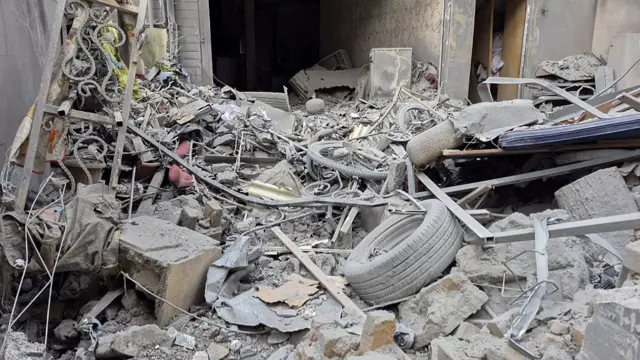
    A view of major destruction at Javadiyeh and Beryanak districts as a result of US-Israeli attacks in Tehran, Iran on March 17.Image source, Getty Images
    Image caption,

    The aftermath of US and Israeli strikes on the Javadiyeh and Beryanak districts of Tehran on Tuesday

    BBC Persian has been speaking to Iranians following Israel's attack on Iran's South Pars, part of the world's largest natural gas field.

    “They’re not really thinking about the people, and their own objectives matter more to them", says one woman in her 20s, from Tehran.

    "But even if you want to weaken the regime, there’s no need to attack infrastructure", she adds.

    One man in his 20s, from Karaj, says he's "really sad about the attack on the gas field in Iran", adding that he is scared "nothing will be left of Iran besides burnt land" after the war.

    Another man in his 30s, from Tehran, says "if either side ends up winning the war" it is "in their interest for the infrastructure to remain intact so they can make better use of it afterwards".

    • BBC Persian is the Persian language service of BBC News, used by 24 million people around the world - the majority in Iran - despite being blocked and routinely jammed by Iranian authorities.
  5. Netanyahu dismisses suggestions Israel dragged US into Iran war - what's the context?published at 20:56 GMT 19 March

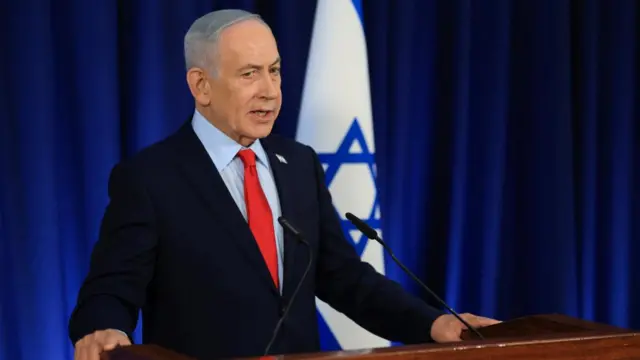
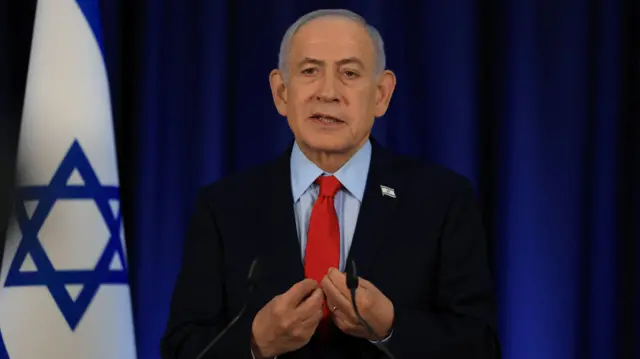
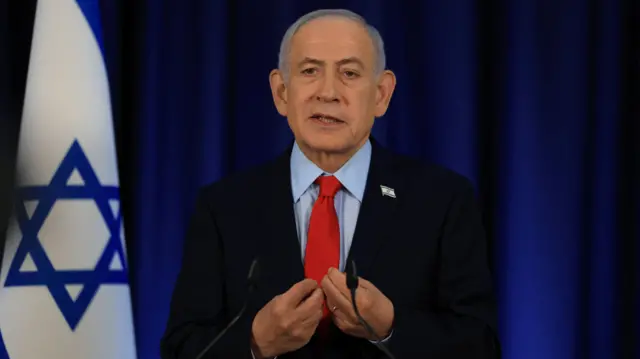
    Benjamin Netanyahu in a blue suit and red tie, stood behind podium speaking into a microphone. Behind him is an Israeli flagImage source, Reuters

    During his earlier news conference, Netanyahu denied that the US had been dragged into a war in the Middle East by Israel.

    "Does anyone really think that someone can tell President Trump what to do? Come on," he said.

    The war in Iran began on 28 Feburary when the US and Israel launched a joint strike across the country, killing its supreme leader Ayatollah Ali Khamenei.

    The attack came after negotiations between the US and Iran over its nuclear programme, and Trump has consistently denied that his hand was forced by Israel.

    Speaking at the White House at the start of March, Trump reiterated: "I might have forced their hands. You see, we were having negotiations with these lunatics, and it was my opinion that they [the Iranians] were going to attack first".

    But, there have been questions about whether the US and Israel remain in lockstep, external, after Trump criticised Israel for its attack on Iran's South Pars gas field - which he said he "knew nothing" about.

  6. US says it has destroyed Iranian missile plantpublished at 20:42 GMT 19 March

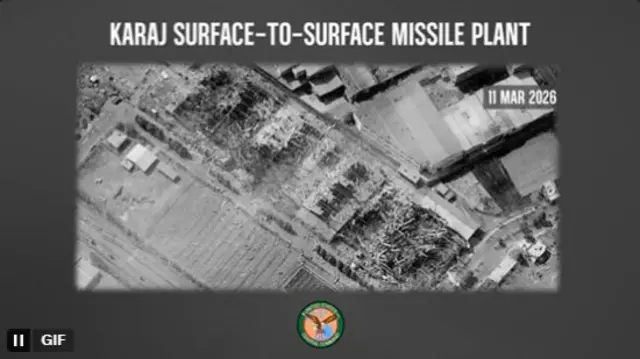
    Aerial photo showing flattened buildings at Karaj plantImage source, US Central Command

    US Central Command says it has destroyed the Iranian regime's surface-to-surface missile plant in Karaj, Iran.

    The plant was used to "assemble ballistic missiles that threatened Americans, neighboring countries, and commercial shipping," Centcom says.

  7. Iran executes 19-year-old wrestler as crackdown on protesters continues, CBS reportspublished at 20:26 GMT 19 March

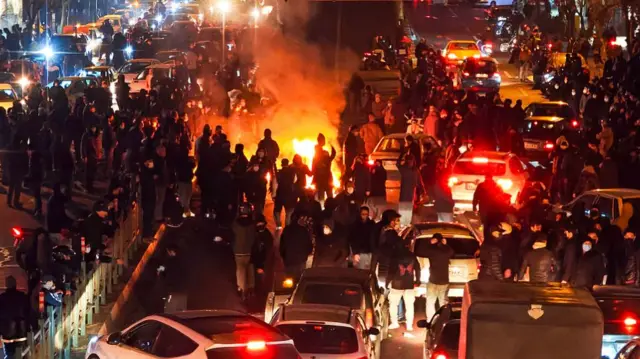
    A protest in Tehran in January, people gather near a fireImage source, Getty Images
    Image caption,

    Before the war broke out, Iran's leadership faced unrest due to the cost of living

    Iran has executed a young member of its national wrestling team who was accused of taking part in anti-establishment protests, according to the BBC's US partner CBS News.

    Before the war in Iran broke out, following US-Israeli strikes on 28 February, protesters had been taking to the streets in large numbers. The demonstrations were against the rising cost of living, as well as against the Islamic regime led by supreme leader Ayatollah Ali Khamenei - who has since been killed.

    CBS reports that Saleh Mohammadi, a member of the Iranian wrestling team, was executed on Thursday after being accused of killing police officers during the January protests.

    Mohammadi - who had just turned 19 - was executed along with two others.

    Charity group Amnesty International had argued to halt the execution, saying Mohammadi and the fellow accused protesters had faced "expedited grossly unfair trials".

  8. The war will take 'as long as necessary', Netanyahu sayspublished at 20:07 GMT 19 March

    Israeli PM Benjamin Netanyahu's press conference touched on a number of topics. Here's a quick look at some of the key points:

  9. Analysis

    Netanyahu dismisses suggestion US and Israel are out of syncpublished at 19:48 GMT 19 March

    Bernd Debusmann Jr
    White House reporter

    Prime Minister Netanyahu was seeking to pour cold water on any suggestion that Israel had influence over Donald Trump's decision to launch Operation Epic Fury in Iran.

    In the US, there has been considerable domestic debate over the reasons why the US entered this war, and the role Israel played.

    That debate reached a fever pitch earlier this week with the resignation of Joe Kent, the director of the National Counterterrorism Center.

    In his resignation letter, Kent - a longtime Trump ally and veteran of the US special operations community - said that "it is clear that we started this war due to pressure from Israel and its powerful American lobby".

    He expanded on those views in a subsequent, two-hour long interview with conservative commentator Tucker Carlson, saying that "Israel drove the decision" and that Israeli officials were circumventing normal channels to influence US lawmakers to push for war.

    And just yesterday, Trump took to social media to deny previous reporting that the US had prior knowledge of an Israeli attack on Iran's South Pars field - a message which some interpreted as frustration by the US president.

    With his remarks, Netanyahu is clearly trying to address, albeit indirectly, any suggestion that US and Israeli war aims are out of sync.

  10. 'It's up to Iranian people to make use of conditions Israel has created' - Netanyahupublished at 19:37 GMT 19 March

    Asked what his plans are in relation to Hezbollah in Lebanon, Netanyahu says Israel now has a "security corridor" that prevents their forces from invading.

    "And we have plans for the future", he adds.

    "Our number one effort is geared towards Iran", he says. "If the [Iranian] regime goes, Hezbollah goes."

    Netanyahu says there are rifts and internal tensions at the top of Iranian leadership, adding that the "authority and the hold" that the previous supreme leader had "is not going to be translated to anyone".

    He says that they're seeing cracks in the Iranian regime, and "if it cracks enough" he thinks "the regime could change. Is it guaranteed? No."

    "It's up to the Iranian people" to make use of the conditions Israel has created, he says.

    With that the news conference has ended, stay with us for a closer look at what was said and some analysis from our White House reporter.

  11. US is working hard to open Strait of Hormuz, Netanyahu sayspublished at 19:28 GMT 19 March

    Netanyahu stands in front of a blue wall with an Israeli flagImage source, Getty Images

    Moving on to oil prices, Netanyahu says that the US is working hard to open the Strait of Hormuz, with support from Israel.

    "If they succeed, which I think they will, then oil prices will come down", he says.

    However, he adds that if you succumb to blackmail and let Iran get on with developing nuclear weapons and ballistic missiles, "you're going to be blackmailed in ways you can never even imagine".

  12. Israel and US partnership is 'only way to avoid catastrophic development' - Israeli PMpublished at 19:27 GMT 19 March

    "I misled no one", Netanyahu says, in response a question about the US involvement at the start of the war.

    He says he didn't have to convince US President Donald Trump over the need to prevent Iran from developing its nuclear programme and putting it underground.

    He says that his partnership with Trump is the "only way to avoid this catastrophic development".

  13. Netanyahu: Trump asked us to hold off on future attacks, and we arepublished at 19:22 GMT 19 March

    Asked if Israel told Trump about the recent attack on Iranian gas fields, Netanyahu says that "Israel acted alone".

    "President Trump asked us to hold off on future attacks and we are," he adds.

    Responding to a question on what signs there are that the Iranian regime is "cracking", he says "there are a lot".

    "We're working to create the conditions for it to collapse, but it may survive it may not", he says.

    If it survives, he says it "be at its weakest point".

  14. Strait of Hormuz - why is it significant?published at 19:21 GMT 19 March

    We've just heard Netanyahu's objective to find alternative oil and gas routes, outside of the Strait of Hormuz, once the war ends.

    Here's a closer look at the key shipping channel, and why it matters:

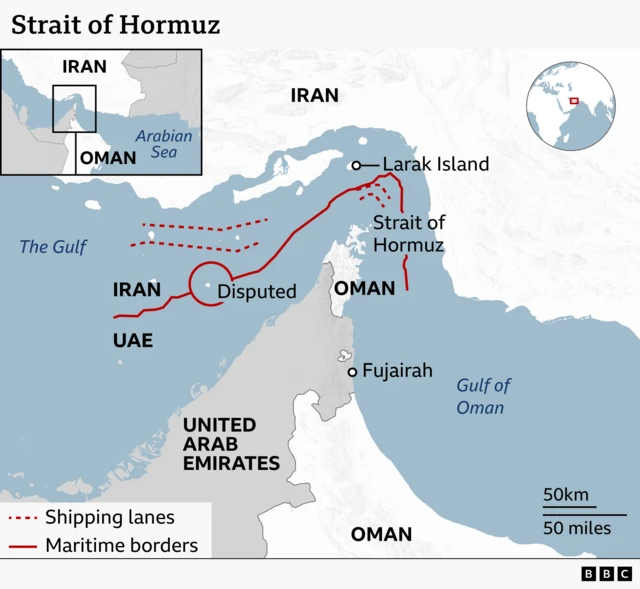
    Iran has effectively blocked the Strait of Hormuz, one of the world's busiest oil shipping channels, since the US and Israel attacked the country on 28 February.

    About 20% of the world's oil and liquefied natural gas (LNG) usually passes through the strait and the war has sent global fuel prices soaring.

    The oil comes not only from Iran but other Gulf states such as Iraq, Kuwait, Qatar, Saudi Arabia and the UAE.

    About 3,000 ships usually sail through the strait each month but this has dramatically decreased recently, with Iran threatening to attack tankers and other ships.

    The Strait of Hormuz, a narrow shipping route in the Gulf region, is one of the world's most important shipping routes. Bounded to the north by Iran and to the south by Oman and the United Arab Emirates (UAE), the Strait of Hormuz connects the Gulf with the Arabian Sea. The strait is deep enough for the world's biggest crude oil tankers, and is used by the major oil and gas producers in the Middle East - and their customers.
  15. Netanyahu wants alternative oil and gas routes outside of Strait of Hormuzpublished at 19:18 GMT 19 March

    Netanyahu is now taking questions from the media, and is asked how he sees the war ending.

    He replies that the US and Israel have "achievable goals" but that he won't speak about the full battle plans.

    Once those goals have been achieved, he continues, there need to be alternate routes for oil and gas outside of the Strait of Hormuz.

    He argues for oil and gas pipelines going west through the Arabian peninsula so that we are "done away with the choke points forever".

    He adds that he sees this war ending "a lot faster than people think".

    In our next post, we'll bring you some more on the Strait of Hormuz and why it is significant.

  16. Israel did not drag US into war with Iran - Israeli PMpublished at 19:05 GMT 19 March

    Netanyahu starts listing all the things in Iran that the Israeli military is working on destroying, including its missile and drone arsenal, missile launchers, as well as nuclear infrastructure - like the factories that produce missile parts.

    He says they're wiping out Iranian industry in a way "that we didn't do before", but "there's still more work to do, and we're going to do it".

    Netanyahu says he wants to dispel another piece of "fake news" - that Israel dragged the US into conflict with Iran.

    "Does anyone really think that someone can tell President Trump what to do? Come on," he says.

    Trump "always makes his decisions on what he thinks is good for America" and for "future generations", he adds.

    Media caption,

    'Israel did not drag the US into a conflict with Iran'

  17. Netanyahu outlines three goals in Iran warpublished at 19:02 GMT 19 March

    Netanyahu is now speaking in English, and says that America and Israel are acting together in Iran with "great determination", he says.

    He outlines Israel's three goals: removing the nuclear threat, removing the ballistic missile threat (and removing both threats before they are buried deep underground and immune from aerial attack), and creating the conditions for Iranian people to "grasp their freedom".

  18. War with Iran will take as long as necessary, Netanyahu sayspublished at 19:00 GMT 19 March

    In a direct message to Israelis who are asking how long the war will take, Netanyahu says "it will take as long as is necessary".

    "We together will work, and we will win together", he says.

  19. Israeli PM: 'Iran can no longer achieve what they had planned'published at 18:59 GMT 19 March

    Netanyahu stands in front of an Israeli flagImage source, Reuters

    Netanyahu says that they have destroyed Iran's capability "to such a degree" they can't achieve "what they have planned".

    He says Iran wanted to topple thousands of buildings in Israel, but instead they're falling in Lebanon and Iran.

    "We will change the Middle East, I promise you that", he says.

    He says Iran is "weaker than its ever been", while Israel is stronger.

  20. Netanyahu vows to crush Iran's capabilities 'entirely'published at 18:57 GMT 19 March

    Israeli Prime Minister Benjamin Netanyahu says that after 20 days of war Iran no longer has the possibility either to enrich uranium or create ballistic missiles.

    He begins by speaking in Hebrew, which has been translated into English. He adds: "We will crush them entirely, all those capabilities."