Summary

  • Our live coverage of the Iran war continues on a new live page. Follow this link for the latest updates.

  • In Jerusalem, sirens sounded and there were booms in the skies above, as families celebrated the first night of Eid - Iranian state TV has confirmed it fired four salvos of missiles in quick succession, writes our correspondent there

  • Elsewhere in the region, Saudi Arabia and Bahrain both say they have intercepted and destroyed drones

  • Iran's foreign minister earlier warned that Tehran would act with "zero restraint" if there were further attacks on its infrastructure

  • Prime Minister Benjamin Netanyahu has said Israel "acted alone" in strikes on Iran's South Pars, part of the world's largest natural gas field. He added Trump was not "dragged" into the war with Iran - here's the context

  1. Iran retains 'some' military capability, US' Gen Caine sayspublished at 12:41 GMT 19 March
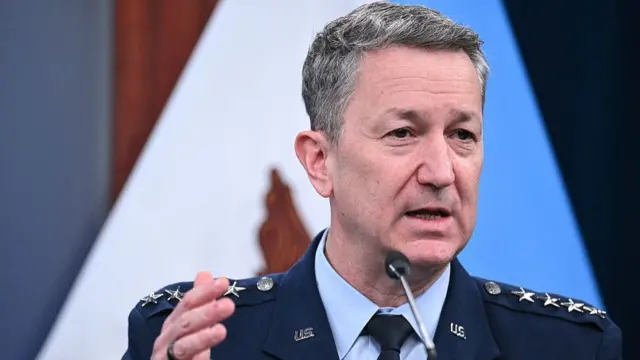
    Gen Dan CaineImage source, Getty Images

    A question now for Gen Dan Caine, who's with Pete Hegseth at the Pentagon briefing.

    He's asked about Iran still having the capability to launch strikes on energy infrastructure across the Gulf almost three weeks into the war.

    Caine says Iran "came into this fight with a lot of weapons, which is why the US is being as "aggressive and assertive" as it can.

    He says the US is continuing to "hunt and find them and kill them", but Iran does still retain "some capability".

  2. Pentagon asked which nations have supported US during conflictpublished at 12:37 GMT 19 March

    Pete Hegseth is taking questions from reporters - we'll bring you any key lines.

    Asked how close the US is to delivering on Trump's objectives in Iran, the US defence secretary says: "We don't want to set a definitive time frame on that" He adds that the US is "on plan".

    Which countries have been the most cooperative with the US during the conflict? Hegseth says Israel has been an "incredible and capable" partner since "day one".

    The Gulf states have also stepped up "incredibly", he says, adding that the conflict has brought them "squarely into our orbit".

  3. Analysis

    Hegseth's war briefing takes on new dimension after Kent resignationpublished at 12:31 GMT 19 March

    Bernd Debusmann Jr
    Reporting from Washington DC

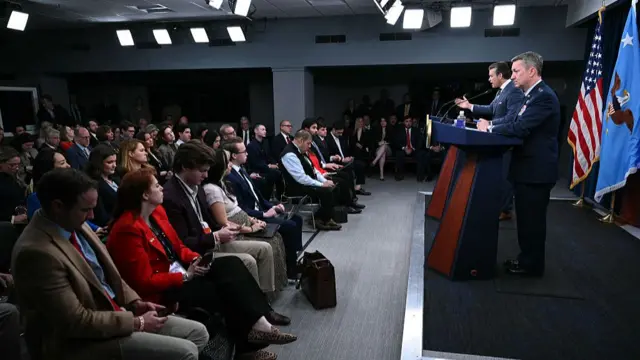
    Defence Secretary Pete Hegseth and General Dan Caine address the press at the PentagonImage source, Getty Images

    Pete Hegseth's briefing began - as his updates have in the past - with an overview of the long-running threat that the Trump administration believes Iran has posed, as well as a reminder to the American public that this is an "America First" campaign.

    Today's briefing, however, has taken on a new domestic dimension following the resignation earlier this week of Joe Kent, director of the US National Counterterrorism Center.

    Kent, an 11-times deployed veteran of America's special operations community, is a long-time supporter of President Trump. He's someone with tremendous respect from large swathes of Trump's Maga base.

    In an explosive interview with journalist Tucker Carlson last night, however, Kent argued that Operation Epic Fury is anything but "America First", adding that he believes Iran posed no imminent threat to the US.

    That assessment puts him at odds with Hegseth and many others still within the Trump administration, creating an awkward situation in which officials now must respond - even indirectly - to his claims.

    Kent has many detractors, and some Trump supporters have now referred to him as a "quitter", or pointed to reports that he may have been investigated for leaking information to the media.

    Even so, it is very likely Hegseth will be asked about this from many of the Maga-friendly media who now make up the Pentagon's permanent press corps.

  4. Caine: US military moving further east into Iranian airspace to hunt dronespublished at 12:27 GMT 19 March

    We're continuing to hear from Gen Dan Caine, who's joining US Defence Secretary Pete Hegseth to give an update on the war in the Middle East.

    He says the US is flying further east into Iranian airspace to "hunt and kill" one-way attack drones, and that the A-10 Warthog aircraft is now involved across southern Iran and is targeting "fast attack watercraft" in the Strait of Hormuz.

    AH-64 Apache helicopters have also joined the fight across southern Iran to target attack drones, Caine says.

    And in Iraq, he says the US has been striking against Iranian-aligned militia groups.

    Hegseth will now take questions from reporters in the room - we'll bring you any new bits of information we hear.

  5. US military chief says soldiers continue to pursue Iran's missile capabilities and navypublished at 12:25 GMT 19 March

    Next to talk is Gen Dan Caine, chairman of the Joint Chiefs of Staff.

    "Know that we share your grief," he tells killed US soldiers' families.

    He then begins an operational update, saying US Central Command remains "on plan" to achieve its objectives and is "unrelenting" in its pursuit of Iranian missile capabilities and the Iranian navy.

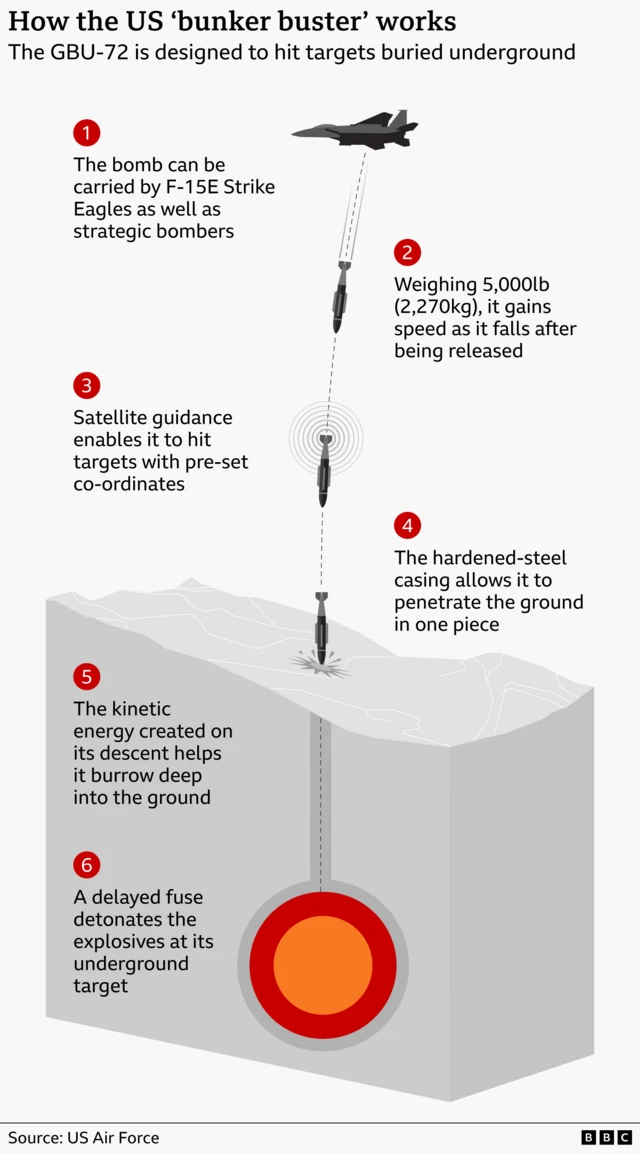
    He adds that 5,000lb (2,270kg) penetrative weapons have been used to strike underground targets. These are designed to get through concrete, and function after getting through those barriers, he says.

  6. World should be thanking Trump, Hegseth sayspublished at 12:21 GMT 19 March

    The US defence secretary says Iranian ballistic missile and one-way drone attacks against US forces are "down 90% since the start of the conflict".

    He says the "last job anyone in the world wants right now" is a senior leader within the Iranian military, calling them "temp jobs".

    The US, he goes on, has damaged or sunk at least 120 Iranian naval ships, with their surface fleet "no longer a factor" and their submarines "gone".

    "A regime like that, refusing to abandon its nuclear ambitions, is not just a regional problem, it's a direct threat to America, to freedom and to civilisation," Hegseth says of Iran.

    He also says the "world, the Middle East, our ungrateful allies in Europe, and even segments of our own press should be saying one thing to President Trump - 'thank you'".

  7. US defence secretary: Our capabilities continue to build, Iran's continue to degradepublished at 12:18 GMT 19 March

    Comparing the Iranian regime to Hamas in Gaza, Hegseth says Iran has poured money into tunnels, rockets, missiles and drones.

    But, he says, the US is hunting them down "methodically, ruthlessly and overwhelmingly, like no other military in the world can do".

    The US has struck over 7,000 targets in Iran to date, he goes on, adding that Thursday will see the largest strike package yet, "just like yesterday".

    "Our capabilities continue to build, Iran's continue to degrade," he says, adding that Iran's air defences have been "flattened".

  8. Objectives of war are unchanged and on target - Hegsethpublished at 12:16 GMT 19 March

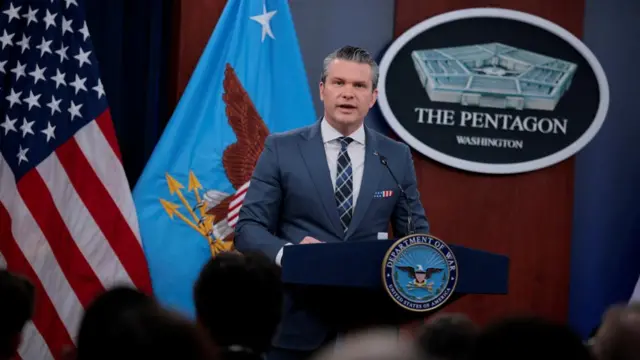
    Pete HegsethImage source, Reuters

    Looking directly into the camera, Pete Hegseth says he wants to address the American people directly.

    He accuses the media of wanting Americans to think "we're somehow spinning towards an endless abyss, or a forever war, or a quagmire". But, he adds, "nothing could be further from the truth".

    Hegseth addresses criticism that the Trump administration entered the conflict with Iran without a clear objective, saying their objectives today are the same as they were on day one: "unchanged", "on target" and "on plan".

    He says they include:

    • destroying missile launchers
    • destroying Iran's defence-industrial base
    • destroying Iran's Navy
    • ensuring "Iran never gets a nuclear weapon"
  9. Hegseth: Families of killed US soldiers want us to get the job donepublished at 12:11 GMT 19 March

    US Defence Secretary Pete Hegseth begins his briefing by saying he and President Donald Trump were present on Wednesday as the remains of US soldiers killed in the Iran war were brought back to the US.

    Their families, he says, asked Hegseth and Trump to ensure they "do not stop until the job is done".

    "Of course, we will finish this," Hegseth says. "We will honour their sacrifice."

  10. US defence secretary giving update - watch and follow livepublished at 12:05 GMT 19 March

    Pete HegsethImage source, Getty Images

    Pete Hegseth is now up on stage addressing the world's media.

    We're listening in to bring you the key updates and remember, you can watch his comments live at the top of this page.

  11. Hegseth briefing comes at extraordinary moment of escalationpublished at 11:55 GMT 19 March

    Tom Bateman
    US State Department correspondent, at the Pentagon

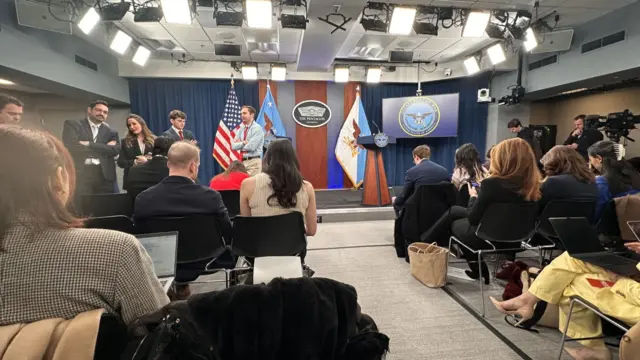
    Pentagon briefing room ahead of press conference

    I’m in the Pentagon press briefing room waiting for Hegseth and Caine.

    It’s the first news conference they’ve held this week and comes at an extraordinary moment of escalation, after Donald Trump's threat to destroy Iran’s South Pars gas field if it further retaliated against Qatar after Israel’s attack on the same site.

    It’s worth a quick mention of how these news conferences work - the Pentagon under Hegseth has become highly prescriptive about access for journalists, with major US and international news outlets - including the BBC - no longer having continuing access to the Pentagon’s press rooms.

    This came after some outlets last year declined to sign a new set of Pentagon conditions issued by Hegseth, which outlets saw as removing journalistic independence. The front rows in the press briefing are largely reserved for the new resident press corps who signed the conditions.

    On the way in, we were all issued wristbands which have been checked twice already. Seats are strictly allocated - you have to sit at the place with your name on it - and we have to be in the building at least an hour before it starts or there’s no access.

  12. US Defence Secretary Pete Hegseth to give update on warpublished at 11:50 GMT 19 March

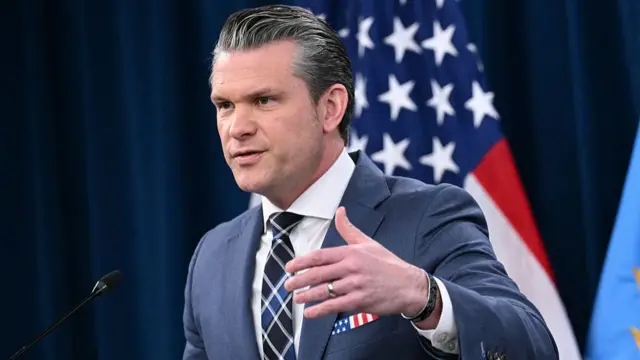
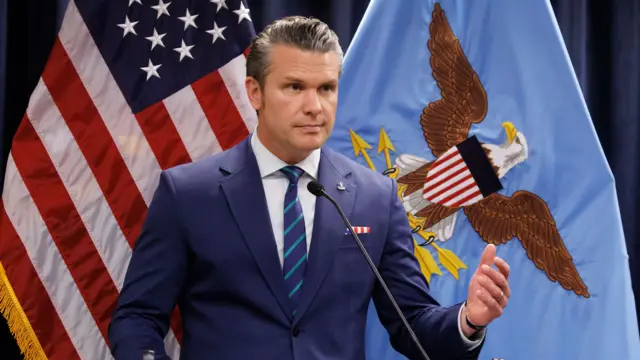
    Pete Hegseth speaks into a microphone, standing in front of a US flagImage source, EPA/Shutterstock

    We're due to hear from the US defence secretary and Gen Dan Caine, chairman of the joint chiefs of staff, shortly.

    They'll be giving an update on the war in the Middle East live from the Pentagon.

    We'll bring you key updates right here - you'll also be able to watch the briefing live at the top of this page.

  13. Italy approves temporary fuel price cutpublished at 11:44 GMT 19 March

    Sarah Rainsford
    Southern and Eastern Europe correspondent

    The Italian government has approved a decree which will cut fuel prices here for 20 days to help consumers hit by the surge in prices caused by war in the Middle East.

    The decree, which cuts excise duties, was passed by the cabinet on Wednesday and should mean a reduction in diesel and petrol prices at the pump of around 25 cents a litre. The package of measures also includes tax breaks for truckers.

    Announcing the measure, Deputy Prime Minister Matteo Salvini said this would mean Italians pay less than those in Spain, Germany and France.

    The measure is expected to cost the government about a billion euros and is a temporary move that could be extended, depending on the situation.

    It comes ahead of an important and hotly contested referendum in Italy this weekend on constitutional reform - changes to the judiciary - that has become a major political test for Prime Minister Giorgia Meloni.

    The surge in fuel prices, and concerns over the cost of living, risk eating into support for her - and for the reform that she’s made a key issue for her coalition.

  14. Gas prices spike as Israel and Iran strike energy sites - what you need to knowpublished at 11:40 GMT 19 March

    Katie Williams
    Live reporter

    Energy price spike: Gas prices jumped by more than 25% in early trading on Thursday, before falling back slightly. The price of gas in Europe is more than double what it was before the war between Iran, and the US and Israel started, says our business correspondent.

    Strikes on energy sites: It comes after Iran struck the Ras Laffan gas plant in Qatar, causing "extensive damage". Iran's strike was in response to Israel hitting its South Pars gas field, located offshore in the Gulf, between Iran and Qatar.

    The UAE's Habshan gas facility and Bab field have also been forced to shut down following retaliatory Iranian strikes, while Saudi Arabia reported thwarting attacks in the east of the country and in the capital, Riyadh.

    US says it "knew nothing": Donald Trump has said the US did not know about Israel's attack on South Pars before it took place. He also warned Iran against further attacks on Qatar.

    Iran and Israel exchange fire: Strikes have continued, with the Israeli military earlier saying it detected fire from Iran. No further casualties have been reported by emergency services at this stage. It comes after the Israeli military said on Wednesday that it had started air strikes on targets in northern Iran for the first time.

    Strait of Hormuz: And in Iran, a representative in parliament has reportedly said lawmakers are looking at charging a toll on countries moving goods through the Strait of Hormuz. Around 20% of global energy supplies move through the channel, but traffic has come to a standstill after Iran threatened to "set fire" to ships passing through.

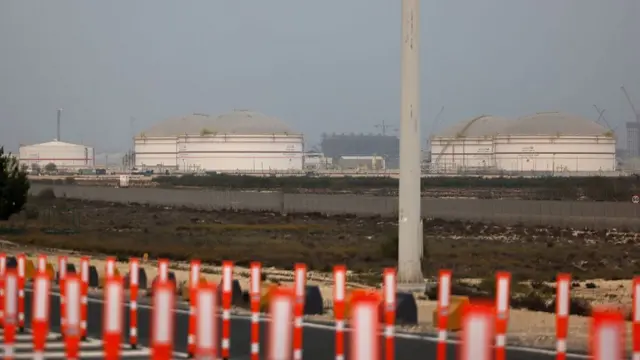
    Ras Laffan Industrial City, pictured earlier this monthImage source, Getty Images
    Image caption,

    Ras Laffan pictured earlier this month

  15. BBC Verify

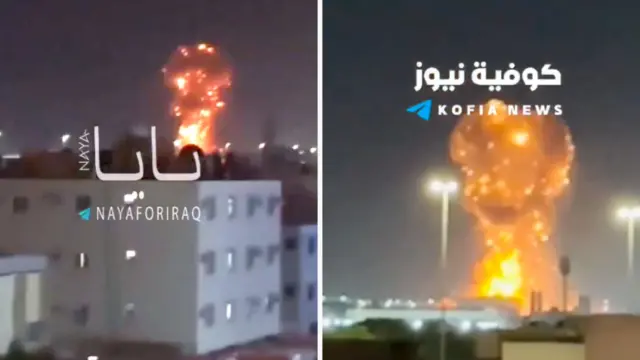
    Footage from Wednesday shows explosion in Saudi Arabia after reported missile attackpublished at 11:30 GMT 19 March

    Two screenshots of videos showing large explosions in the distance

    By Emma Pengelly and Peter Mwai

    Videos shared online late on Wednesday show an explosion and fire in two locations in Saudi Arabia’s capital, Riyadh, following reported Iranian attacks.

    We've verified videos showing the aftermath of a fiery blast in an industrial area to the south-east of the city and a fire burning in the direction of a nearby oil refinery, belonging to the oil company Saudi Aramco.

    Heat signatures were detected by Nasa in the same industrial area where the explosion seen in the screengrabs above occurred.

    Saudi Arabia’s defence ministry said on Wednesday it had intercepted and destroyed four ballistic missiles launched towards Riyadh, and that missile debris fell near a refinery south of Riyadh.

    In a new statement on Thursday, the ministry said a drone crashed into the SAMREF refinery in the Red Sea port of Yanbu, adding damage assessment was under way.

  16. UAE intercepting further missiles and drones from Iranpublished at 11:22 GMT 19 March

    The United Arab Emirates says its air defences have intercepted seven ballistic missiles and 15 drones fired by Iran on Thursday.

    Since the start of the conflict, it says it has dealt with 334 ballistic missiles, 15 cruise missiles, and 1,714 drones, it’s Ministry of Defence adds.

    It reports that these attacks have led to deaths of two military personnel, six civilians and seen 158 injured.

  17. Following the latest spike, what happens if oil and gas wholesale prices remain at current levels?published at 11:11 GMT 19 March

    Dharshini David
    Deputy economics editor

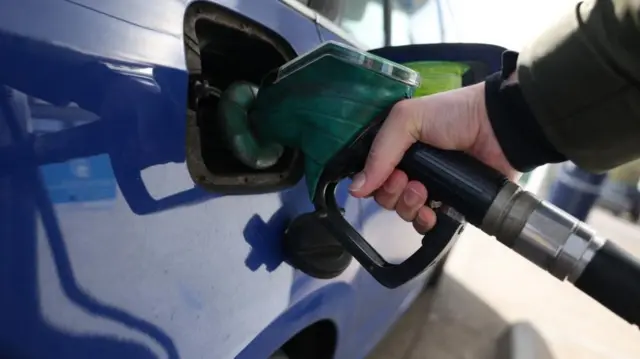
    A person refuels a car at a petrol forecourt in London, Britain, 10 March 2026. Global oil prices have risen sharply after Iran's response to US and Israeli airstrikes disrupted shipping.Image source, EPA

    Via the impact on the likes of petrol prices, shipping costs and other household bills, the hoped for decline in inflation this year will be derailed.

    Ahead of this conflict, it was hoped that inflation would fall to the 2% target and remain around there, so prices rising but modestly.

    As wholesale energy prices rose in the last couple of weeks, the official forecasters speculated that inflation could instead end the year at 3%.

    Now, other economists reckon we could be looking at a rate of 4%.

    That, after a bruising few years would be unhelpful (and that kind of inflation rate could threaten to linger for a while) - but would still mean prices rising at a far more moderate rate than during the period of double-digit inflation we saw a few years back.

    And of course, it may not be that bad - if for example, the government were to offer more support - or if energy prices were to fall back.

    That would be the easiest solution all round - but as recent days have underscored, it is impossible to predict where we go next.

  18. Iran vows 'complete destruction' of Gulf energy infrastructure if its facilities are attacked againpublished at 10:56 GMT 19 March

    Iran has vowed to attack the energy infrastructure of US and Israeli allies in the Gulf until its "complete destruction" if its own energy facilities are targeted further.

    Tehran has launched a wave of attacks against gas and oil sites across the Gulf region after its own facilities linked to the South Pars gas fields were struck by Israel.

    "We warn the enemy that you made a big mistake by attacking the energy infrastructure of the Islamic Republic of Iran," says a spokesperson for Iran's military central command, according to the Islamic Revolutionary Guard Corps-affiliated Fars news agency,

    "If this is repeated, subsequent attacks on your and your allies' energy infrastructure will not stop until its complete destruction, he says, adding the Iranian response will be “will be much more severe” than the attacks so far.

  19. Iran looking at charging toll on Strait of Hormuzpublished at 10:36 GMT 19 March

    Ghoncheh Habibiazad
    Senior reporter, BBC Persian

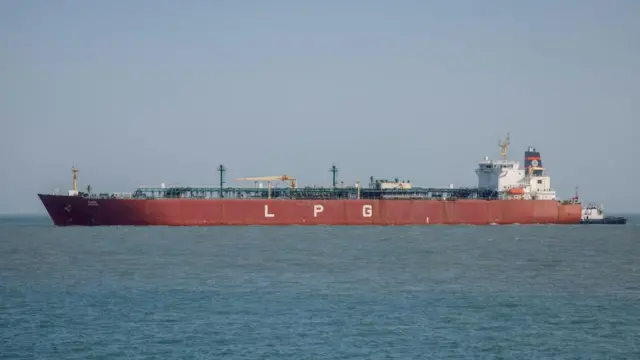
    Red tanker with LPG written on it in white at seaImage source, Reuters
    Image caption,

    A tanker arrives in India on Monday after travelling via the Strait of Hormuz

    A representative of Tehran in Iran’s parliament (Majlis), Somayeh Rafiei, says lawmakers are pursuing a proposal under which countries will be obliged to pay tolls and taxes to Iran, if the Strait of Hormuz is used as a secure route for the passage of ships, the transit of energy, and the provision of food security.

    According to a report from the ISNA news agency, Rafiei, speaking at a public gathering in Tehran’s Valiasr Square, highlighted Iran’s authority in “ensuring the security of the Strait of Hormuz and safeguarding the nation’s interests” saying: "We have deprived our enemies of their former comforts, and they are now unable to accept this reality; they simply cannot endure it."

    She also says that “God willing, this battle will end in Iran’s decisive and certain victory, and thereafter, passage through the Strait of Hormuz will continue to pose challenges for our enemies.”

  20. US targeting Iranian weapons deep undergroundpublished at 10:10 GMT 19 March

    Chris Partridge
    BBC News weapons analyst

    Despite some 8,000 targets struck by US forces alone, Iranian missiles and drones are still attacking neighbouring countries.

    With no air force and no navy to speak of, it's these missiles and drones that Iran is seeking to protect in any way it can.

    Iran’s topography and decades of planning means stocks of these weapons are buried deep underground - or literally deep into the sides of mountains.

    Getting weapons to these targets is difficult, hence the use of various types of bunker-busters, including the 5,000lb GBU-72 Advanced Penetrator we saw used this week.

    A graphic explaining how the US GBU 72 “bunker buster” bomb works. At the top, a military aircraft is shown releasing a long, dark coloured bomb. Numbered labels appear alongside each stage:1) The bomb can be carried by F 15E Strike Eagles and strategic bombers; 2) Weighing 5,000 lb (2,270 kg), it accelerates as it falls; 3) Satellite guidance steers it toward pre set coordinates; 4) A hardened steel casing allows the bomb to penetrate the ground intact; 5) As it descends underground, kinetic energy helps it burrow deeper; 6) A delayed fuse triggers the explosion at the underground target. The lower part of the graphic shows a cross section of the earth, with the bomb travelling vertically downward toward an underground structure, ending in a large orange blast sphere representing the detonation.

    Last Friday, US Secretary of Defence Pete Hegseth said: "Iran's entire ballistic missile production capacity, every company that builds every component of those missiles, has been functionally defeated, destroyed. Buildings, complexes and factory lines all across Iran, destroyed."

    Even if the means of producing these missiles is stopped, what's left is clearly still being launched.

    So the US and Israel will also be focusing on knocking out the mobile launchers, using intel and aircrafts' targeting pods to "seek and destroy".

    In the Gulf War of 1991 against Iraq, many USAF F-15E Strike Eagles and F-16s were tasked with hunting down Saddam Hussein's Scud missiles that were threatening Israel. These missions were called 'Scud Hunting'. Those same tactics are being used today too across the border.