Summary

  1. White House says talks with Iran 'productive and ongoing'published at 18:50 BST 15 April

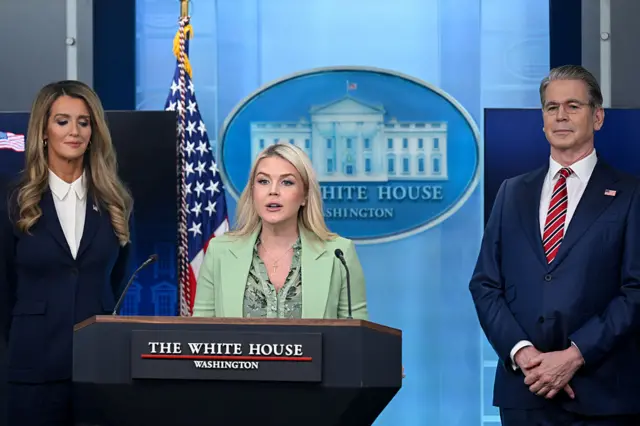
    Leavitt is next asked about the Iran ceasefire, and says that reports the US has asked to formally extend it are "not true".

    "We remain very much engaged in these talks," she says, and conversations are "productive and ongoing".

    On reports that there are in-person talks being planned, she says "those discussions are being had but nothing is official until you here it from us here at the White House".

    "We feel good about the prospects of a deal", Leavitt says, adding that it's "in the best interests of Iran" to meet Trump's demands - which she says he's made "very clear".

    If talks happen, they would "very likely" be in the same place they were last time - Islamabad - she says.
    Three people in suits stand in front of a blue backdrop with the White House logoImage source, Getty Images
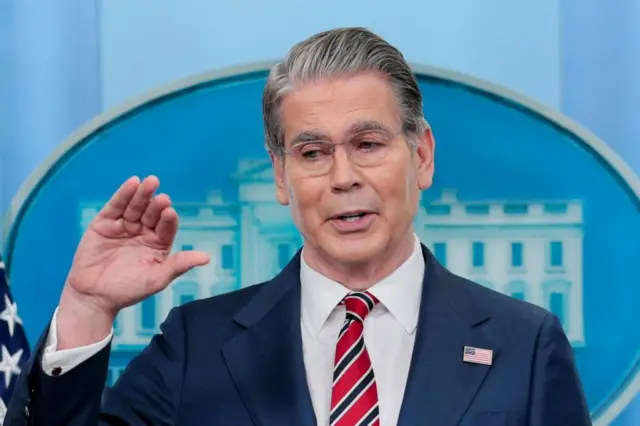
  2. Bessent 'optimistic' US petrol prices will fall before late Septemberpublished at 18:43 BST 15 April

    After an early section of the briefing focused on domestic issues, the news conference touched on the economic impact of the war in Iran - specifically, the price of oil.

    Bessent is asked when US drivers will begin to see lower petrol prices which have gone up considerably since the start of the war.

    He says prices will depend on how Iran negotiations go and that the US has obeyed the ceasefire conditions although the Strait of Hormuz hasn't been fully reopened.

    "I am optimistic that sometime between June 20 and September 20, we can have $3 gas again," he says.

    A man with grey hair and a red, white and blue striped tie wearing a blue suitImage source, Reuters
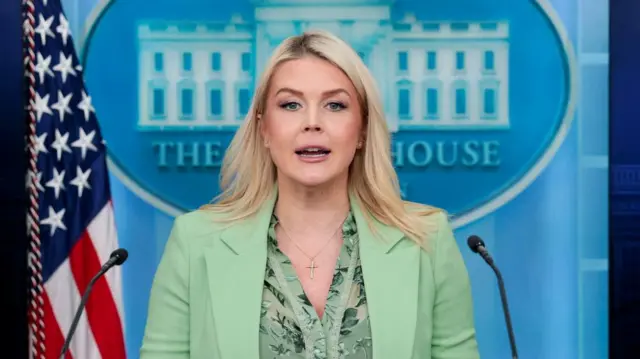
  3. White House briefing under way - watch and follow livepublished at 18:20 BST 15 April

    White House Press Secretary Karoline Leavitt speaks during a press briefing at the White House in WashingtonImage source, Reuters

    A briefing from White House Press Secretary Karoline Leavitt has just started.

    Leavitt is joined by Treasury Secretary Scott Bessent and is expected to speak mainly about domestic issues (specifically taxes as 15 April is Tax Day in the US).

    It's likely, though, that reporters will get the opportunity to pose questions about the war in the Middle East, too.

    We're listening across and will bring you the key lines. You can also watch live at the top of the page.

  4. BBC Verify

    'Zombie ship' transmitting false identity in Gulfpublished at 17:56 BST 15 April

    By Joshua Cheetham

    As part of monitoring the US blockade of Iran, BBC Verify has identified a vessel in the Gulf which appears to be trying to hide its real identity, sometimes referred to as a “zombie ship”.

    The ship, currently using its onboard tracker to identify itself as "Race", cannot be what it claims to be, as that is the name if a vessel which was scrapped in 2023. Its last reported position was close to the Strait of Hormuz on Tuesday.

    This practice of trying to hide a real vessel’s identity by adopting the name of a decommissioned ship is one of the tactics which means we can’t rely on onboard trackers alone to identify shipping and follow movements in the region.

    BBC Verify has seen evidence that many other vessels are turning off their trackers, having their signal jammed, or “spoofing” them to hide their location and suggest they’re elsewhere.

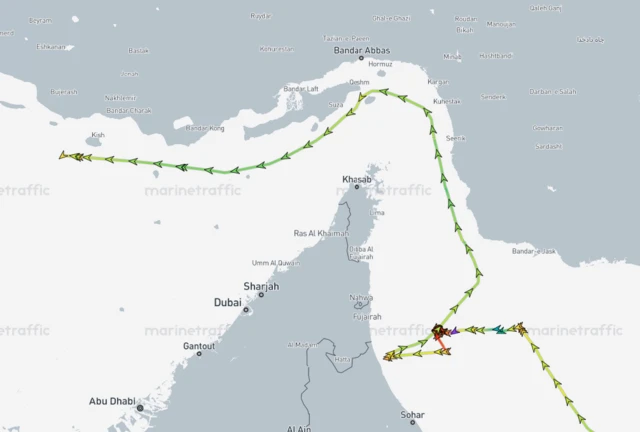
    Details of how the US is enforcing the blockade on ships entering or leaving Iranian ports are still unclear. BBC Verify has also tracked the US-sanctioned tanker Alicia, which sailed west across the Strait of Hormuz into the Gulf today.

    The vessel, which is falsely registered under the flag of Curaçao, is not publicly reporting any destination.

    A map of the route taken by Alicia, heading through the Strait of Hormuz to the west into the Gulf near Iran’s Kish islandImage source, MarineTraffic
    Image caption,

    A map of the route taken by Alicia through the Strait of Hormuz and into the Gulf

  5. Economise on energy and don’t rush rate rises, says IMFpublished at 17:39 BST 15 April

    Faisal Islam
    Economics editor, in Washington DC

    International Monetary Fund (IMF) Managing Director Kristalina Georgieva tells me at the IMF Spring Meetings that countries should start to economise on energy supplies.

    She says this is due to the reality of physical shortages, especially in Asia of some petrochemical derivatives - obviously energy, but also helium, naphtha, urea - used for semiconductors - plastics and fertilisers.

    She says it will still take weeks to turn around even if a ceasefire is agreed imminently, and perhaps longer given the damage to petrochemical facilities.

    “What do we tell countries? Use measures that can economise energy? And I have seen some countries doing exactly that, putting in place incentives like make public transport free... We did it during Covid. I don't see a reason why not do more of it now or switch to a less energy intensive activities over time.”

    She also warned the world’s central banks not to rush raising interest rates to deal with inevitably higher inflation, as assumed in markets.

    “What we tell central banks is: 'If you have high credibility, signal that your objective is to protect price stability, but don't rush wait to see how conditions would evolve if we are to move faster out of the war."

  6. British chancellor calls Iran war a 'mistake'published at 17:26 BST 15 April

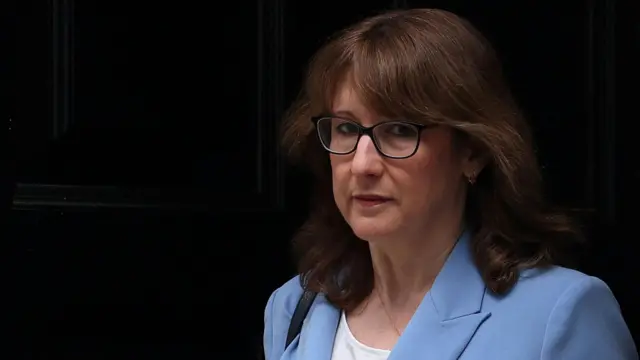
    Chancellor Rachel ReevesImage source, Reuters

    Chancellor Rachel Reeves has described the US-Israel war with Iran as a "mistake", adding that she is "not convinced" it has made the world a safer place.

    Reeves made the comments while speaking at an event hosted by the American news channel CNBC in Washington.

    “The question is not whether you like or dislike the Iranian regime – I strongly dislike the Iranian regime – but how to achieve the change that you want to achieve", she says.

    “There was a diplomatic channel open, conversations, formal discussions were happening."

    She adds that it was a "mistake" to end those discussions "and to enter into conflict, because I’m not convinced that we are safer today than we were a few weeks ago".

  7. At least three paramedics killed by Israeli attacks, Lebanese officials saypublished at 17:14 BST 15 April

    Hugo Bachega
    Middle East correspondent in Beirut

    Media caption,

    BBC joins paramedics on duty in Lebanon after Israeli strikes

    Three successive Israeli attacks have killed at least three paramedics in southern Lebanon, including one featured in a BBC report this week, Lebanese officials say, accusing Israel of deliberately targeting health workers in the war.

    According to the Lebanese health ministry, the first team of paramedics was attacked as it tried to rescue people from the site of an Israeli strike in the town of Mayfadoun, in the Nabatieh region. When a second then a third teams headed to the site, they too were attacked.

    The victims included 43-year-old Fadel Serhan. Earlier this month, the BBC spent days with his team as it operated in a tent set up outside the Nabatieh’s Nabih Berri Hospital after their own station in Mayfadoun was destroyed in an Israeli air strike in the first days of the war.

    The Israeli military has been approached for comment. Israel has frequently accused Hezbollah of using ambulances and medical facilities for military purposes, without provided evidence. Lebanon’s health minister has denied the claims.

    The ministry says 91 health professionals have been killed and 208 other wounded in the war, with more than 120 Israeli attacks recorded on ambulances and medical facilities.

    In a statement, the ministry said Wednesday’s attacks were a “flagrant crime”. “Paramedics have become direct targets, pursued relentlessly in a blatant violation that confirms a total disregard for all norms and principles established by international humanitarian law,” it said.

    Human rights groups say some of Israel’s actions in Lebanon may constitute war crimes.

  8. Death toll in Lebanon rises to 2,167 - state mediapublished at 16:57 BST 15 April

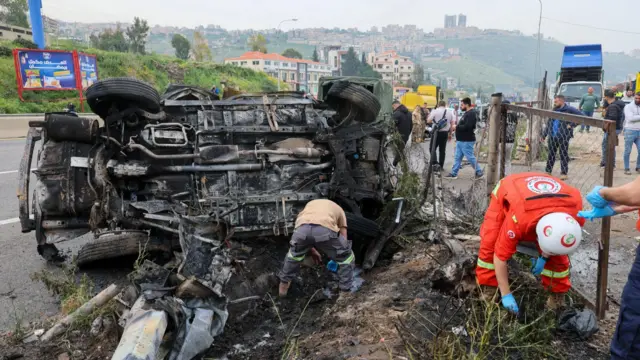
    Rescuers work at the site of an Israeli airstrike that targeted a vehicle in Jiyeh town, south of Beirut, Lebanon, 15 April 2026.Image source, EPA/Shutterstock
    Image caption,

    Israel issued fresh evacuation orders for parts of Lebanon on Wednesday, warning that "air strikes are ongoing"

    The death toll in Lebanon since the start of of the war has reached 2,167, according to an update from Lebanon's health ministry reported by the state-run National News Agency.

    This is an increase of 43 people on Tuesday's figures. A further 7,061 have been wounded - up from 6,921.

  9. Analysis

    Lebanon wants peace, but dispute over Hezbollah’s weapons remainspublished at 16:56 BST 15 April

    Hugo Bachega
    Middle East correspondent, in Beirut

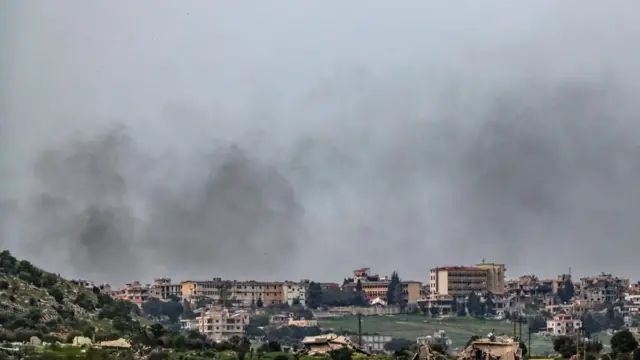
    Smoke rises over buildingsImage source, EPA
    Image caption,

    Smoke rises following an Israeli strike in the southern Lebanese village of Bint Jbeil earlier today

    We're now turning to the conflict in Lebanon, where Israel's attacks on Hezbollah targets continue.

    The Lebanese are exhausted, and the authorities say the priority here is for a ceasefire in a war that has been devastating for the country.

    More than 2,100 people have been killed, the health ministry says, without distinguishing combatants from civilians, and over one million have been displaced (or one in five of the population).

    One of the roots of this conflict is the dispute over Hezbollah’s arsenal.

    Opponents say the group defends the interests of its Iranian patron, dragging the country into unwanted wars, and want it to be disarmed.

    Supporters, mainly in the Shia Muslim community, say Hezbollah is the only protection they have in a weak state.

    The Lebanese government cannot deliver Hezbollah’s disarmament without the group's consent. The use of force could lead to violence in a country where the deadly 1975-1990 civil war is still remembered by many.

    Given Iran’s role, any decision about Hezbollah’s weapons will likely be made by Tehran.

    For now, Hezbollah says it opposes the talks between Lebanon and Israel and that it will not abide by any decision made there.

  10. Iran to decide on future talks with US after Pakistan meeting - state mediapublished at 16:48 BST 15 April

    Ghoncheh Habibiazad
    Senior reporter, BBC Persian

    Iran's Islamic Revolutionary Guard Corps (IRGC)-affiliated Tasnim news agency says Iran will decide about a next round of talks with the US after meeting with the Pakistani delegation today, citing an "informed source".

    They say the US and Israel agreeing a ceasefire deal with Lebanon would be a "positive sign for Iran’s decision" on the next round of talks.

    However, it adds that the US "must adhere to a reasonable framework for negotiations", must not "obstruct the process through excessive demands" or breach commitments made prior to the ceasefire.

    Tasnim also notes that US media outlets have reported Washington’s willingness to begin the next round of negotiations, but the Iranian the delegation has emphasised the need for the US to "observe certain principles required for initiating a reasonable negotiation".

  11. No vessels have passed blockade in first 48 hours, US sayspublished at 16:41 BST 15 April

    In the first 48 hours of the US blockade on ships entering and exiting through Iranian ports, no vessels have made it past American forces, says the US Central Command (Centcom).

    Centcom adds that during this period nine vessels have "complied with direction from US forces to turn around and return toward an Iranian port or coastal area".

  12. Two sets of talks on two fronts: What you need to knowpublished at 16:23 BST 15 April

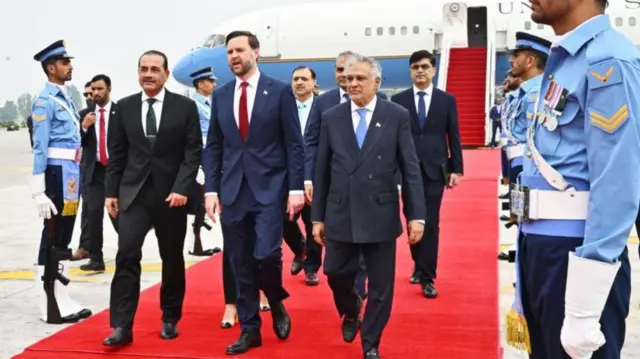
    JD Vance walks down a red carpet flanked by Pakistani officialsImage source, EPA/Shutterstock
    Image caption,

    US Vice-President JD Vance arrives for US-Iran talks in Pakistan on Saturday

    A two-week ceasefire between Iran and the US is still in place. Meanwhile, Israel and Lebanese group Hezbollah are continuing to exchange fire across the border.

    Talks have opened up on both fronts, in the hope of bringing peace to the region. Here's what you need to know about them:

    US-Iran talks

    • Twenty-one hours of talks between Washington and Tehran - hosted by Pakistan - ended on Sunday without any breakthrough towards ending the war
    • On Tuesday, Donald Trump suggested talks could resume in "the next two days". Iran said it had "no information" about a follow-up meeting
    • The BBC understands the US is having discussions with Iran about a second round of talks, but nothing has been scheduled yet. Iran said exchanges with the US were "continuing" via a Pakistani intermediary
    • A White House official has separately told the BBC that talks to extend the current ceasefire are ongoing
    • Meanwhile, a delegation from Pakistan has arrived in the Iranian capital, Tehran

    Lebanon-Israel talks

    • A meeting between the Israeli and Lebanese ambassadors to the US was held in Washington on Tuesday
    • Both parties agreed to launch "direct" negotiations following the meeting. Lebanon's ambassador called the talks "productive", while her Israeli counterpart said they showed the US, Lebanon and Israel to be on "the same side of the equation"
    • As the talks took place, Israel and Hezbollah continued to strike each other. Israel had previously said the ceasefire did not apply to its operations in Lebanon
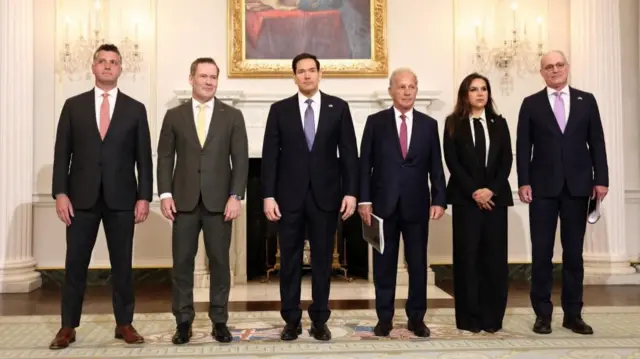
    A row of six people stand inside a State Department buildingImage source, Reuters
    Image caption,

    The Israeli and Lebanese ambassadors head into talks hosted by the US State Department on Tuesday

  13. US and Iran discussing more talks - but no date setpublished at 16:03 BST 15 April
    Breaking

    The US is having discussions with Iran about a second round of negotiations, but nothing has been scheduled yet, the BBC understands.

    It is also understood that US President Trump is content to leave the US's naval blockade in place until he feels Iran is serious about reaching a deal.

  14. Pakistani delegation arrives in Tehranpublished at 15:49 BST 15 April
    Breaking

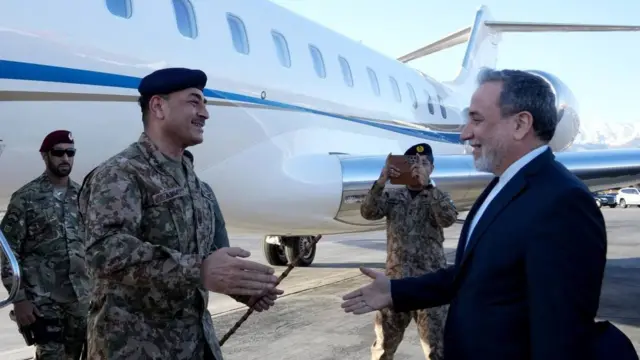
    Pakistan's military chief Asim Munir, greeted by Iran's foreign minister Seyed Abbas Araghchi.Image source, Government of Iran
    Image caption,

    Pakistan's military chief, Asim Munir, greets Iran's foreign minister, Seyed Abbas Araghchi

    A delegation from Pakistan, which has been acting as a mediator in talks to end the war, has arrived in Tehran.

    Among them are field marshal Asim Munir - who Trump has previously described as his "favourite" - and Interior Minister Mohsin Naqvi, according to a statement from Pakistan's UN mission.

    Earlier, Iranian state media IRIB news agency said the delegation was going to convey a message from the US and plan a second round of talks. (The first round in Islamabad last weekend failed to yield a deal.)

    Meanwhile, Pakistan's Prime Minister Muhammad Shehbaz Sharif arrives in Jeddah, Saudi Arabia, "to exchange views on the regional situation", according to his office.

  15. BBC Verify

    How many ships are crossing the Strait of Hormuz?published at 15:24 BST 15 April

    By Thomas Copeland

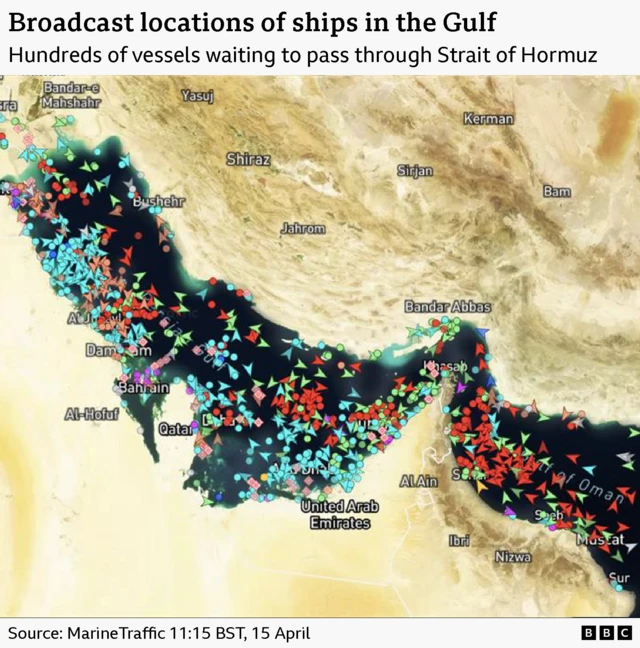
    Since the start of the US blockade on Monday, 15 vessels have crossed the Strait of Hormuz, nine of which have links to Iran, BBC Verify analysis of ship-tracking data suggests.

    US Central Command (Centcom) has said its blockade applies to all ships entering and exiting Iranian ports. Vessels transiting the Strait of Hormuz to and from non-Iranian ports would not be impeded, it added.

    In an update on Tuesday, Centcom said in the first 36 hours no vessels made it past the blockade, and six obeyed instructions to turn around.

    Tracking data suggests six of the ships which passed through the strait had previously visited an Iranian port.

    We've not been able to verify the US claim about the number of ships that have been turned round, but tracking data indicates that at least one vessel which passed through the strait has reversed course.

    The US-sanctioned tanker Rich Starry sailed east from Sharjah in the UAE through the strait but turned round and crossed back into the Gulf on Wednesday.

    In addition, two Iranian-flagged ships have been tracked leaving the vicinity of Iran's Chabahar port, east of the Strait of Hormuz on Iran's southern coast, after the start of the blockade.

    A satellite image of the Strait of Hormuz with ships marked with arrows. It shows hundreds of ships clustered by the strait waiting to pass. It is timestamped to 11:15 BST on 15 April
  16. Forty-eight hours on, US naval blockade holds - the latest developmentspublished at 15:12 BST 15 April

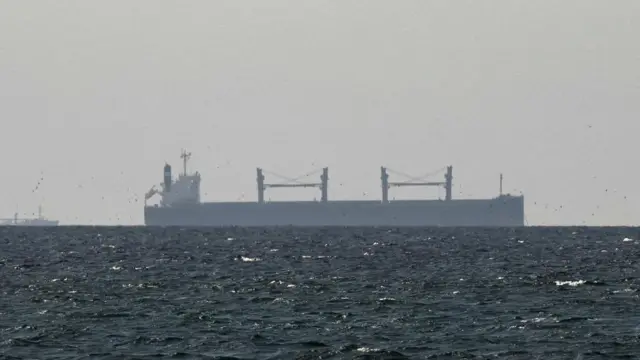
    A cargo ship in the Gulf, near the Strait of HormuzImage source, Reuters

    The US naval blockade remains in force.

    • The US blockade on ships entering and exiting Iranian ports has now been in place for 48 hours
    • Earlier, US President Trump told Fox News that the Strait of Hormuz "is opening", without providing further detail
    • He also said China had agreed "not to send weapons to Iran" as it was "very happy" with the US' operations in the vital waterway

    Iran responds with threats to shipping in the Gulf and Red Sea.

    • Iranian commander Ali Abdollah warned that Iran would prevent "any exports or imports to continue in the Persian Gulf, the Sea of Oman, and the Red Sea" if the blockade was not lifted
    • Despite Trump claiming the US has completely destroyed Iran's navy, it is still able to pose a threat to shipping in the region, writes BBC security correspondent

    The status of US-Iran talks remains unclear.

    • Yesterday, Donald Trump told US media that peace talks between the US and Iran may resume this week - but we're yet to get official confirmation
    • This morning, Iran's Foreign Ministry spokesperson said communication with the US was "continuing", following talks in Pakistan last weekend, which failed to yield a deal
    • A short while later, a senior US official told the BBC that talks on extending the two-week ceasefire with Iran were ongoing

    Israel and Hezbollah continue exchanging fire.

    • The Israel Defense Forces (IDF) warned that it was operating with "significant force" in parts of south Lebanon - announcing it had hit 200 Hezbollah targets in the past 24 hours
    • Hezbollah has also targeted several sites northern Israel. It said attacks would continue until "Israeli-American aggression against our country and our people ceases"
    • It followed peace talks between Israel and Lebanon in the US on Tuesday, which led to both sides committing to direct negotiations in the future
  17. Finance ministers urge 'swift and lasting' end to warpublished at 14:53 BST 15 April

    As we've been reporting, UK Chancellor Rachel Reeves is in Washington DC today for a meeting of finance ministers.

    Ahead of the International Monetary Fund (IMF) event, Rachel Reeves has joined up with counterparts from Ireland, Australia, Japan, Sweden, Netherlands, Finland, Spain, Norway, Poland and New Zealand to urge a “swift and lasting” end to the US-Iran war.

    They say they want to see a "free and safe transit" through the Strait of Hormuz, which they hope "mitigates impacts on growth, energy prices and living standards, in particular for the poorest and most vulnerable".

    “Renewed hostilities, a widening of the conflict or continued disruption in the Strait of Hormuz would pose serious additional risks to global energy security, supply chains, and economic and financial stability.

    “Even with a durable resolution of the conflict, impacts on growth, inflation and markets will persist.”

  18. Analysis

    How real is Iran’s threat?published at 14:40 BST 15 April

    Frank Gardner
    Security correspondent

    You might be wondering how Iran could still be in a position to threaten shipping across three seas if, as President Trump claims, the US has completely destroyed its navy.

    But Iran doesn’t need a conventional navy to still pose a threat to shipping. The navy of Iran's Islamic Revolution Guard Corps (IRGC), which took over the lead from Iran’s mainstream navy in the Gulf some years ago, has spent years practising for special operations.

    These include small, discreet units trained to attach mines to the hulls of ships or launching cheap, easy-to-conceal drones, packed with C4 high explosive, from ambush points along its coast.

    Then there are the Houthis in Yemen, more of an Iranian ally than a proxy, who share Tehran’s antipathy towards Israel and Western nations.

    The nightmare scenario for global shipping and the world’s economy is if the Houthis decide to resume their full-scale attacks on shipping passing their coast at the narrow, southern end of the Red Sea.

    This could have a disastrous effect on the roughly seven million barrels of oil a day Saudi Arabia currently exports through its Red Sea terminal at Yanbu.

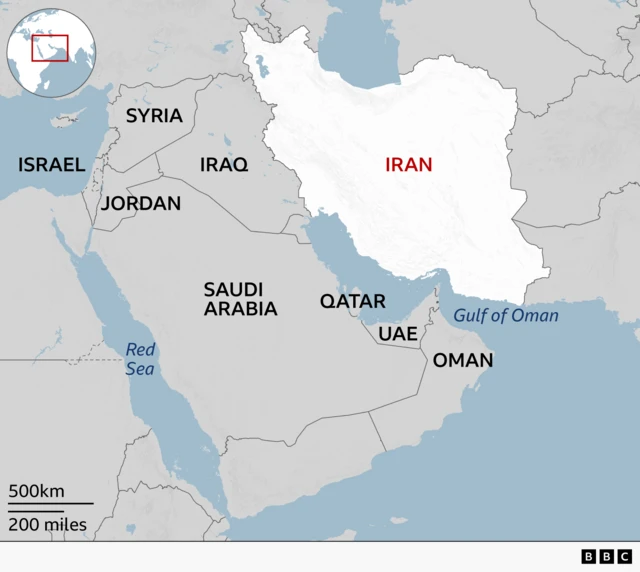
    A regional map highlighting Iran in white with its name in red. Surrounding countries are labeled in grey, neighbouring Iraq to the west and other Middle Eastern countries including Syria, Jordan, Israel, Gaza and Saudi Arabia, Qatar, UAE, and Oman. Bodies of water such as the Red Sea and the Gulf of Oman are marked in blue.
  19. US official: 'Continued engagement' with Iran on ceasefirepublished at 14:30 BST 15 April

    A senior US official tells the BBC that talks on extending the two-week ceasefire with Iran are ongoing.

    The ceasefire is due to run out next week, on 22 April.

    "The United States has not formally agreed to an extension of the ceasefire," a senior US official says.

    "There is continued engagement between the US and Iran to reach a deal," they add.

    Earlier, the AFP news agency cited Iranian state media as saying reports about a ceasefire extension were not confirmed.

  20. Analysis

    Mixed messaging from Trump on Iran warpublished at 14:23 BST 15 April

    Bernd Debusmann Jr
    Reporting from the White House

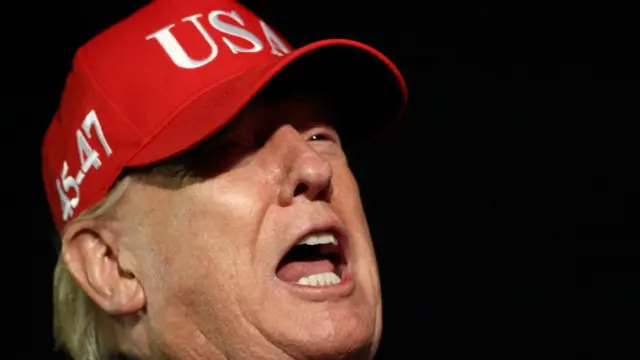
    Donald Trump speaks to the members of the media. He wears a red 'USA' capImage source, Reuters

    US President Donald Trump has been giving conflicting comments on the war in Iran, and the path to its end.

    In an interview with Fox News this morning, Trump said that the war is "very close to being over" amid a two-week ceasefire agreement currently in place.

    But in the very same interview, Trump suggested further strikes could take place.

    "If I pulled up stakes right now, it would take them 20 years to rebuild that country. And we're not finished," he added. "We'll see what happens. I think they want to make a deal very badly."

    There's similarly conflicting reports on whether the two-week ceasefire could be extended. While the Associated Press has reported that mediators are moving closer to extending the two-week ceasefire, the White House has so far pushed back.

    "The United States has not formally agreed to an extension of the ceasefire," a senior US official said in a statement sent to the BBC. "There is continued engagement between the U.S. and Iran to reach a deal."

    As things stand, we have no expectation of seeing Trump on camera today, although he may well post on Truth Social or make phone calls.

    There will also be a White House briefing at 13:00 EST (18:00 BST). While it will largely focus on domestic economics, Iran questions are likely as well.