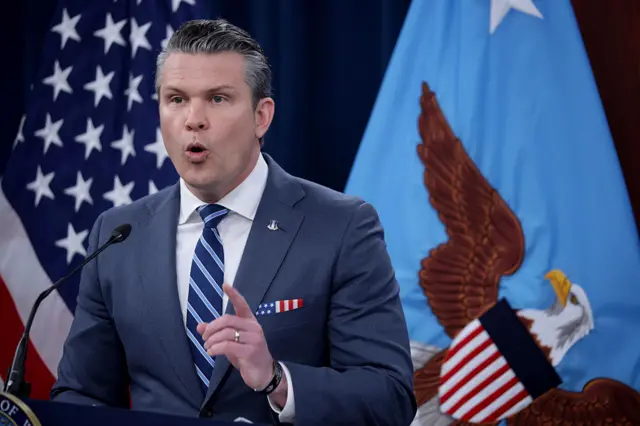
Summary

  1. Lebanon's president thanks Trump for 'efforts' towards ceasefire - Beirutpublished at 15:55 BST 16 April
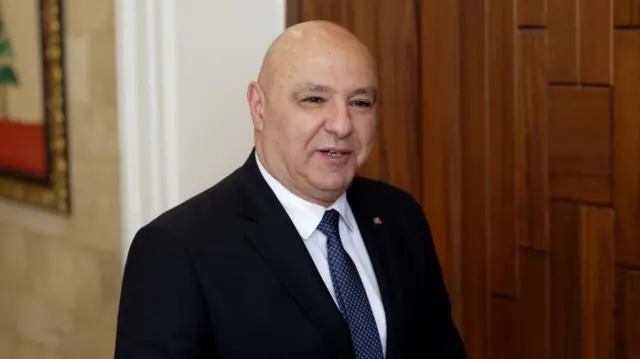
    Joseph Aoun, a bald man wearing a dark suit, white shirt and blue tie, smiles off-camera as he walks down a corridor.Image source, Reuters

    The office of Lebanese President Joseph Aoun confirms he had a phone call with US President Donald Trump today.

    In a post on X, it says Aoun thanked Trump for his efforts to reach a ceasefire in Lebanon and "secure lasting peace and stability".

    Aoun reiterated that he wants a ceasefire between Israel and Hezbollah "at the earliest possible time", it says.

    Trump responded with support for President Aoun and Lebanon, it adds.
  2. Israel isolates Litani region in south from Lebanon's north - state mediapublished at 15:50 BST 16 April

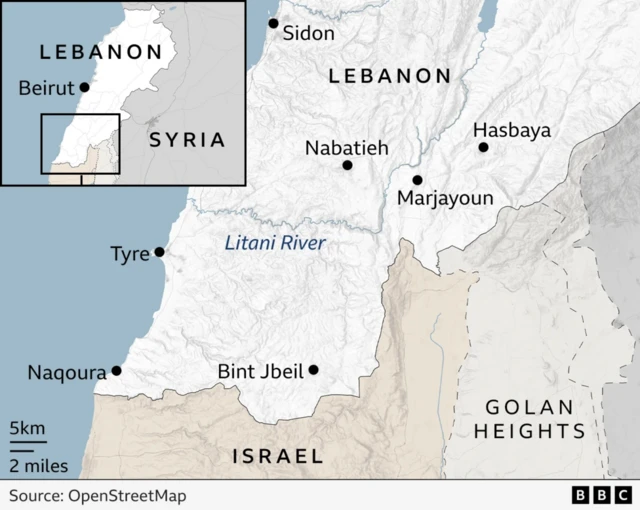
    Lebanese state media is reporting that Israel's fatal strike on a key bridge in Lebanon has isolated the southern Litani area from the northern region, citing the nation's army.

    According to Lebanon's National News Agency, the Qasmiyeh bridge - which connects the Tyre area with Sidon - was destroyed, killing one person and injuring two.

    Israel's destruction had "the aim of separating the southern Litani region from its north and isolating it," the army says.

    Israel has previously said its forces target bridges in the country to stop Hezbollah using Lebanon's state infrastructure.

    A map of southern Lebanon showing towns, rivers and borders near Israel and the Golan Heights. Major towns are marked with black dots, including Sidon on the coast in the north, Nabatieh inland, Hasbaya to the east, Marjayoun slightly southwest of it, Bint Jbeil near the southern border, and Tyre and Naqoura along the Mediterranean coast. The Litani River is labelled in blue, flowing down from north and then turning abruptly and heading west to the Mediterranean Sea. The southern border with Israel is shown, and the Golan Heights lies to the southeast. An inset map in the top left highlights Lebanon’s location within the wider region, showing Beirut and the border with Syria. A scale bar indicates distances of 5km and 2 miles. Source: OpenStreetMap.
  3. US military says 14 vessels turned round since blockade beganpublished at 15:25 BST 16 April

    A short while ago, chairman of the joint chiefs of staff, General Dan Caine, said 13 ships had turned around since the US implemented its blockade of Iranian ports on Monday.

    In an new update, US Central Command (Centcom) says 14 have turned round over 72 hours.

    "US forces are focused, vigilant, and highly motivated as they execute a blockade on vessels attempting to enter or exit Iranian ports," Centcom says.

  4. Israeli defence minister threatens Iran with 'even more painful' strikespublished at 15:09 BST 16 April

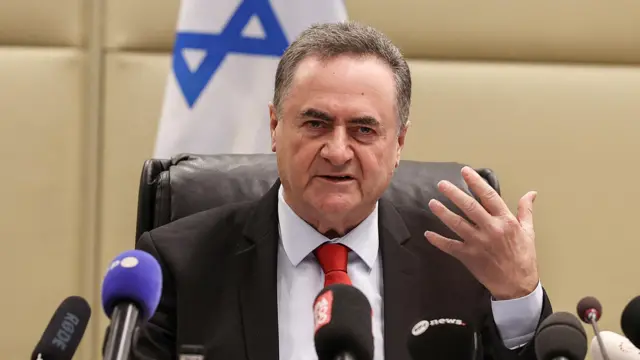
    Israel's Defence Minister Israel Katz talks during a meeting with his Greek counterpart Nikos Dendias, in Athens, Greece, January 20, 2026Image source, Reuters

    Israeli Defence Minister Israel Katz has warned that his country will launch "even more painful" strikes against Iran if it does not agree a deal in negotiations with the United States.

    "Iran is facing a historic crossroads. This is their moment of choice - between a bridge to the future and an abyss of isolation and destruction," he says.

    He says if Iran chooses the latter option, it will "very quickly discover" that targets Israel has not yet struck are "even more painful that the ones we have already attacked".

    "The choice is in their hands and the consequences are on them," he concludes.

  5. No talks set between Israeli and Lebanese leaders, Lebanon sources tell BBCpublished at 14:56 BST 16 April

    Carine Torbey
    BBC Arabic correspondent, in Beirut

    Earlier today, an official from Lebanon's presidential office told the BBC it wasn't aware of any upcoming contact with Israel.

    It came after Donald Trump said Lebanon's President Joseph Aoun and Israeli Prime Minister Benjamin Netanyahu were speaking today, which has since been echoed by an Israeli cabinet minister.

    Now, official Lebanese sources tell the BBC that there won’t be any talks between the two leaders for the moment.

    Aoun has informed US Secretary of State Marco Rubio he won’t take the call, they say.

    The president’s office has been careful not to put out the above in a statement, perhaps for fear of antagonising Trump.

    Speaking to Netanyahu as Israel's operations continue may have further strained Aoun's relations with both Hezbollah and a large part of Lebanese society.

    The Lebanese president is advocating for dialogue with Israel, but says a ceasefire is key. Israel has so far refused to stop its military campaign here.

  6. Trump heads to Las Vegas as Iran war questions loompublished at 14:43 BST 16 April

    Bernd Debusmann Jr
    White House reporter

    US President Donald Trump will head to Las Vegas later today, where he will turn his attention towards domestic issues after weeks spent largely focusing on Iran.

    In the early afternoon, Trump will leave the White House and head to nearby Joint Base Andrews, from where he will fly to Nevada to deliver remarks on his "No Tax on Tips" policy at an event marking Tax Week in the US.

    That policy was one of his campaign promises, and administration officials - such as Treasury Secretary Scott Bessent - have been busy speaking about its impact on American workers. The policy is particularly important in Nevada, home to thousands of hospitality sector workers.

    Aside from that event, there is little on the president's public schedule.

    At 11:00 EST/ 16:00 BST, the president is scheduled to receive his intelligence briefing, which is likely to focus heavily on Iran. That briefing takes place behind closed doors.

    Trump, however, may take to Truth Social to deliver comments on the ceasefire, the blockade, or a potential longer-term end to the conflict.

  7. What's the latest on the US naval blockade of Iran?published at 14:31 BST 16 April

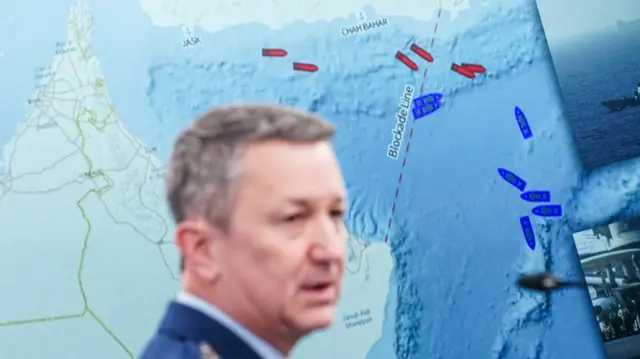
    Chairman of the Joint Chiefs of Staff General Dan Caine speaks during a briefing on the Iran war, with a map in the background showing a blockade line on the Strait of Hormuz, at the Pentagon in Washington, D.C., U.S., April 16, 2026Image source, Reuters

    Since Monday, the United States has said it's been enforcing a blockade on all vessels entering and exiting Iranian ports.

    Chairman of the joint chiefs of staff, General Dan Caine, says a total of 13 ships have been ordered to return to Iran by the US Navy - up three on the total given yesterday.

    However, it's not clear if the navy has turned away any vessels suspected of heading toward Iranian ports, rather than departing them.

    Caine detailed the warning being given to commercial vessels in breach of the blockade, which reads: "Turn around or prepare to be boarded. If you do not comply with this blockade, we will use force."

    So far, he says, the US Navy has not needed to board any vessels.

    On Wednesday, the White House said the blockade was "fully implemented". It declined to give a timeline as to how long it would remain in place.

  8. Pope criticises 'tyrants' who spend billions on warspublished at 14:06 BST 16 April

    Davide Ghiglione
    Reporting from Rome

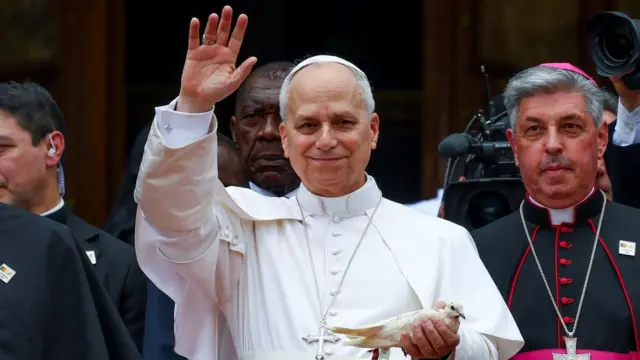
    Pope Leo XIV waves as he holds a bird after a meeting for peace with the community of BamendaImage source, Reuters
    Image caption,

    Pope Leo in Bamenda today

    Pope Leo criticises leaders who spend billions on wars, in unusually blunt remarks in Cameroon. It comes after US President Donald Trump attacked him again on social media.

    Speaking in Bamenda, in the country’s conflict-hit English-speaking region, the first US pontiff also denounces those who "manipulate religion and the very name of God for their own military, economic and political gain", warning against the use of faith to justify violence.

    Addressing a community scarred by nearly a decade of unrest, he says he has come “to proclaim peace”, but found that locals were already "proclaiming peace to me, and to the entire world".

    Leo highlights the human cost of war, criticising what he described as a global imbalance in priorities.

    "The masters of war pretend not to know that it takes only a moment to destroy, yet often a lifetime is not enough to rebuild,” he says, adding that “billions of dollars are spent on killing and devastation, yet the resources needed for healing, education and restoration are nowhere to be found."

    Calling for a “decisive change of course”, the pope urges a shift towards "a sustainable path rich in human fraternity".

    Despite the bleak picture, he strikes a note of hope, saying that while "the world is being ravaged by a handful of tyrants", it is also being "held together by a multitude of supportive brothers and sisters".

  9. What we learned from US military updatepublished at 13:54 BST 16 April

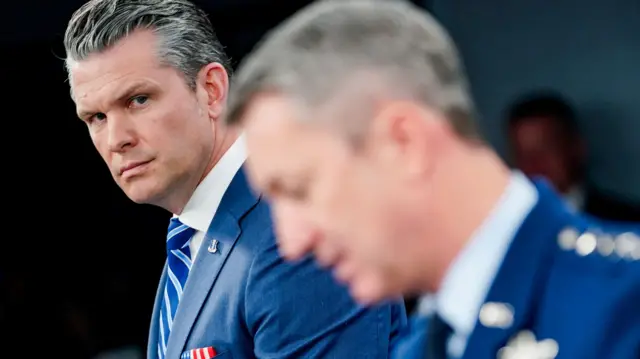
    U.S. Secretary of Defence Pete Hegseth and Chairman of the Joint Chiefs of Staff General Dan Caine hold a briefing on the Iran war, at the Pentagon in Washington, D.C., U.S., April 16, 2026.Image source, Reuters

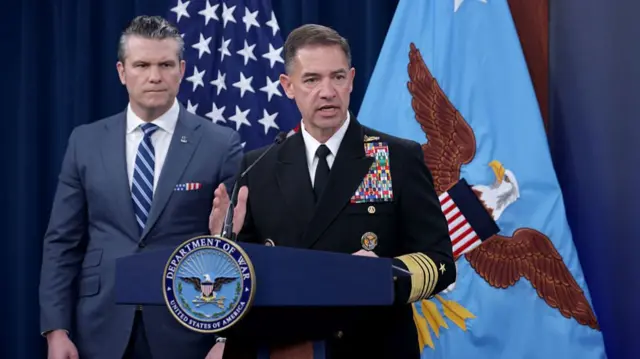
    We've just had an update from US Secretary of Defence Pete Hegseth, chairman of the joint chiefs of staff General Dan Caine and US Central Command (Centcom) commander Admiral Brad Cooper.

    We did not get many substantial updates at this briefing, but here are a few things we heard:

    • Hesgeth warns Iran to "choose wisely" in negotiations with the US. The military is "reloading" and "ready to go" at the push of a button, he adds
    • He says the US will ensure Iran "never" attains a nuclear weapon, which he says can be done the "nice way" or the "hard way"
    • The defence secretary tells Iran that the US is enforcing the blockade with "less than 10%" of its naval power, adding that Iran threatening to strike commercial ships is "piracy" not control
    • He adds the blockade - aimed at stopping ships entering or leaving Iranian ports - will last "as long as it takes"
    • General Caine reiterates Hegseth's point that US forces are ready to resume combat "at literally a moment's notice"
    • On the blockade, he says so far 13 ships have made the "wise choice" of turning around when ordered to do so, adding that the US has not yet had to board any ships
    • Admiral Cooper, who has just returned from a visit to the Middle East, says the US is using the ceasefire period to adjust tactics and techniques, adding there has been "no better teammate" in the region than Israel
  10. Iran's motivation for ceasefire is 'very high', Hegseth sayspublished at 13:44 BST 16 April

    A reporter asks Hegseth how the US is enforcing a ceasefire with an enemy that has degraded control over its military forces.

    Hegseth says while Iran's ability to command has been degraded, its motivation for the ceasefire is "very high".

    He adds that so far, the Iranian-backed Houthi militia in Yemen appears to be staying out of the conflict, "and we think that is a good decision by them".

    The briefing has now finished. But stick with us as we continue to follow developments.

  11. Centcom commander says US forces are adjusting 'tactics, techniques'published at 13:41 BST 16 April

    Admiral Brad Cooper with US Defence Secretary Pete Hegseth standing behind him at a press briefingImage source, Getty Images

    Admiral Brad Cooper, commander of Centcom, is speaking about his trip to visit troops.

    He says he visited the Middle East region twice in the past 15 days.

    The Centcom commander says US forces are retooling and adjusting "tactics, techniques and procedures" during this time.

    Cooper says discussions are being held with regional allies to reinforce security in the area, saying such allies have been exceptional "teammates".

    He adds that there is "no better teammate" than Israel, saying that the country and the US have achieved their military objectives "over and over again".

  12. Unclear if ships heading towards Iranian ports have been turned backpublished at 13:38 BST 16 April

    Anthony Zurcher
    North America correspondent at the Pentagon

    Gen Dan Caine just talked reporters through the details of the US Navy blockade.

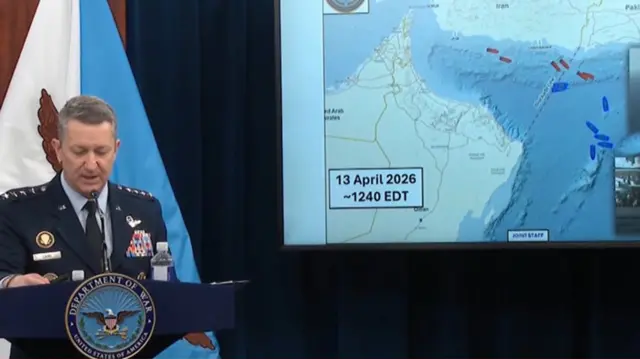
    All the ships shown were attempting to pass out of the Strait of Hormuz.

    It’s unclear if the Navy has turned back any vessels that they suspect were heading toward Iranian ports.

  13. Caine says 13 ships turned around after blockade startedpublished at 13:36 BST 16 April

    Dan Caine shows a maritime map of the Gulf with blue and red boats representing ships in and out of the US blockadeImage source, Reuters

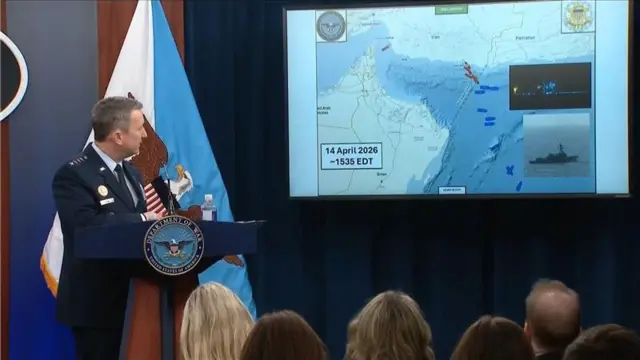
    Another graphic mapping the Gulf shows the status of the blockade 24 hours after it began. Caine points out 13 ships that he says made the "wise choice" of turning around.

    He adds that any vessels who attempt to run the blockade "will be dealt with accordingly".

    So far, US Central Command has not been required to board any ships, he says.

  14. 'Turn around or prepare to be boarded' - Caine reads warning sent to ships in blockadepublished at 13:35 BST 16 April

    Caine shows a graphic showing ships in the Strait of Hormuz near the US blockade

    Caine says there were seven ships that were of concern to US Central Command when the blockade started.

    He says the US forces "began to hunt" by using a variety of tools and assistance from intelligence agencies once it was in place.

    A graphic is shared, which shows US forces as they compressed Iranian ships. A US strike group is pictured as it moved towards the vessels and warned them not to breach the blockade.

    Caine reads out a Navy transmit warning: "Turn around or prepare to be boarded. If you do comply with this blockade, we will use force."

  15. US ready to resume combat at a moment's notice, Gen Caine sayspublished at 13:25 BST 16 April

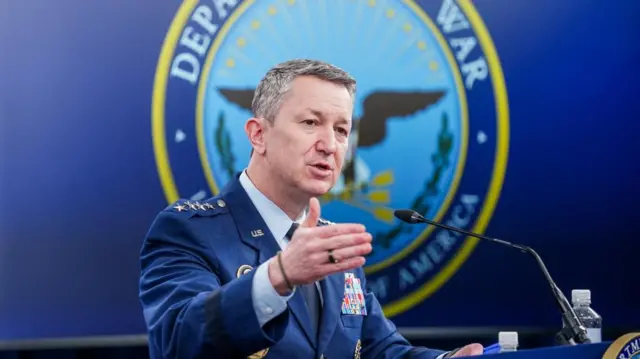
    Gen Dan Caine, Joint Chief of StaffsImage source, Reuters

    Gen Dan Caine, the Joint Chiefs of Staff, is speaking now.

    He refers to President Trump's direction for a ceasefire, and says US forces remain ready to resume combat "at literally a moment's notice".

    Caine says the US joint force began a naval blockade on Monday, 13 April, at 10:00 ET (15:00 BST).

    He clarifies that the US action is a blockade of Iran's ports and coastline, rather than the Strait of Hormuz.

    It applies to all ships regardless of nationality heading into or from Iranian ports, he says.

    "Enforcement will occur inside Iran's territorial seas and in international waters."

  16. Hegseth repeats call for Iran regime to choose next steps 'wisely'published at 13:20 BST 16 April

    Hegseth continues by saying the US will ensure Iran "never" has a nuclear weapon.

    He says that they would prefer to do this the "nice way", through a deal led by Vice-President JD Vance and the negotiating team. Hegseth says it can also be done the "hard way".

    He again tells the regime to "choose wisely".

    If it "chooses poorly", there will be a blockade and bombs dropping on infrastructure, power and energy, Hegseth says.

  17. Hegseth takes dig at press during blockade updatepublished at 13:16 BST 16 April

    Anthony Zurcher
    North America correspondent at the Pentagon

    Pete Hegseth began this press conference with an update on the ongoing US military blockade and a warning to Iranian leaders that the US is “locked and loaded” to resume bombing if talks break down.

    But, as is his tendency, he has turned to an extended criticism of what he calls the “Trump-hating press”.

    “It’s hard to figure out what side some of you are actually on,” he said. “It’s unpatriotic.”

  18. Hegseth says blockade is using less than 10% of US naval powerpublished at 13:16 BST 16 April

    US Defence Secretary Pete Hegseth pointing with one finger while delivering a press conferenceImage source, Getty Images

    Hegseth says the US blockade is "the polite way this can go", and he says that Iran's energy industry is not destroyed yet.

    He adds that Iran likes to say it controls the Strait of Hormuz but it does not have a navy. "You cannot control anything," he says.

    He adds that Iran is threatening to shoot missiles and drones at commercial ships, but that is not control. "That's piracy, that's terrorism."

    He says that the US Navy controls traffic going in and out of the strait and it is controlling it with less than 10% of US naval power.

  19. Iran cannot replace lost firepower, Hegseth sayspublished at 13:12 BST 16 April

    Hegseth tells Iran's military leadership: "We're watching you."

    The capabilities of US and Iran are not the same, he says, and that this is "not a fair fight".

    "We are only getting stronger. You are digging out your remaining launchers and missiles with no ability to replace them."

    He says the US military is reloading with more power than ever before.

    "We're ready to go at the command of our president and at the push of a button."

  20. Hegseth warns Iran regime to 'choose wisely'published at 13:09 BST 16 April

    Hegseth says Admiral Brad Cooper, the Centcom commander, will be sharing an update on the conflict in the Middle East.

    He says the US has urged the Iranian regime to "choose wisely", adding that the US has the forces to restart combat operations should the regime choose "poorly" and not agree to a deal.