


Scientific surveys
The funds provided by the developer for the excavation of the site, as it was originally defined, would not cover the excavation of this unpredicted - and potentially very expensive - addition, so who would pay for it and then deal with the fragile artefacts that it could well contain? As this was clearly a site of major importance, expert advice was sought from both English Heritage and the British Museum.
It was decided that as the site was so important a full scientific excavation should be carried out. English Heritage would provide the additional funds required, and the British Museum would send a team to help record the excavation, lift the artefacts and then carry out their eventual conservation back in the Museum's London laboratories. Given the potential for the grave to contain a wide range of fragile and complicated artefacts, this was a very generous offer.
'Subtle changes in soil colour ... could provide evidence of the internal structure of the grave ...'
The excavations took place mainly in March of 2001, in wind, rain and snow - and on a building site, as work had already started on the new houses. Once the outer square ditch had been examined, work concentrated on the grave itself, and a plastic tent was erected to keep out the worst of the weather.
Although previous experience suggested that the grave, and consequently the actual burial deposit, could be over one metre deep, its excavation had to proceed very cautiously. Subtle changes in soil colour and composition, even at a comparatively high level, could provide evidence of the internal structure of the grave, or of funeral rites.
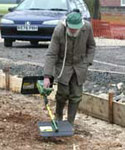
The soil was therefore carefully removed in thin horizontal slices, or spits, then photographed and planned as each level was exposed. Scanning the grave with a metal detector before excavation suggested that it contained large metal objects, but they were not interpreted as being the iron tyres from chariot wheels.
Published: 2005-01-25
