


Layers of antiquity
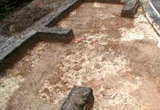
These revealed part of a Romano-British ditched enclosure, a medieval building dating from the 13th or 14th century, and the upper part of a huge well estimated to be about 50m deep. A large and more recent quarry occupied part of the site, and would have destroyed any earlier archaeological remains.
'... a square ditch enclosing a large rectangular pit was revealed.'
It was obvious at this stage that the site contained archaeological remains that, although not important enough to warrant refusing planning permission, would require full excavation before building could take place.
Consequently, the archaeological team returned to the site in 2001 to complete the work, this time excavating the line of the entrance road and the sites of the houses that were due to be built. However, due to a tree preservation order, the line of the road had been moved slightly and it was when this new area was stripped of soil that the outline of a square ditch enclosing a large rectangular pit was revealed.
This immediately rang alarm bells, as in this part of Yorkshire, something of this description is most likely to be a square barrow, the levelled remains of a burial mound built between 300 and 100BC. Many barrows of this type have been discovered and excavated in the area around the villages of Wetwang and Garton, most of them lying in the bottom of valleys. So this new discovery was unusual in that it lay on the top of a chalk ridge.
These barrows belong to a very localised Iron Age culture and, when excavated, some have been found to contain the dismantled remains of carts or chariots. This is a very rare phenomenon in Britain - only found once in another part of the British Isles (Newbridge, Edinburgh, in the spring of 2001) - but is more common in northern France and western Germany.
Published: 2005-01-25
