|
The existence of jobs for women above the level of operative at
Rowntrees may have been a relatively advanced policy but it was
also a point of tension amongst the women.
The relationship with authority, particularly female authority,
was highly complicated. Womens memories of their immediate
superiors show signs of the tension between their preferred view
of Rowntrees as a good and fair firm and their negative experiences
of authority. Many of the women I spoke to had fond memories of
those in charge:
Miss O
She was lovely
used to talk to you in a nice
way
talked more or less in our language. (Margaret)
Amy remembered those in charge as strict but fair:
they used to say, not you laughing again. Cos
we always used to be sat laughing. But yet, that same person
when
my uncle died
she saw how upset I was
she sent me home
she
were very nice really.
These individual kindnesses, whilst they could certainly be interpreted
as resulting from the personality of the person in question, were
interpreted by the women as indicative of Rowntrees as a whole and
reinforced loyalty to the firm.
Authority was mediated through the language of human relations.
Indeed, this was likely to be a consequence, at least in part, of
the discourse of the human factor so important to the
Rowntrees business ideology.
Where human contact was diminished, women felt resentment at being
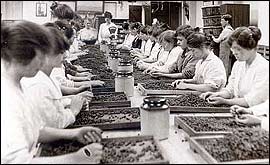
subjected to the will and gaze of their superiors. Thus, the practice
of an overlooker sitting high on a chair in the centre of the room,
watching over everything that went on, was critiqued by several
women:
She was bloomin Queen o Sheeba sat up there. She
used to have her seat risen up so she could see everybody.
(Gladys)
Despite such feelings, women continued to stress to me their love
of their job: you used to think, God shes watching
me.
So you used to talk with your head down and try and
do as fast as you could but it was all good fun. (Mavis)
As with so many aspects of womens memories of the Rowntree
factory, there is ambiguity surrounding womens assertion of
company loyalty; they must negotiate with both positive and negative
experiences of employment and a sense of duty to Rowntrees as former
employees and York residents.
In the end, most women prefer to emphasise the positive aspects
of working at Rowntrees and are proud of the firm as one of the
most important and successful industries in York.
This article is based on the oral histories of 13 women who worked
at the Rowntree factory between 1930 and 1988. To learn more about
them and their working lives, please visit www.cocoareworks.co.uk.
|