Summary

  • AstraZeneca says it is "unprecedented" the world has produced multiple vaccines in a year, after the EU approved its jab

  • Prof Andrew Pollard, director of the Oxford vaccine group, adds there is "no reason" to be concerned about using the vaccine on over-65s

  • Some EU states are considering only giving the Oxford-AstraZeneca vaccine to under-65s, citing a lack of data for its use on older age groups

  • Meanwhile, a new coronavirus vaccine developed by Janssen prevents 66% of Covid cases after a single dose, the Belgian company says

  • And another new vaccine, Novavax, is said to be the first to show in trials it is effective against the new virus variant found in the UK

  • Meanwhile, lockdown will continue in Wales for a further three weeks, First Minister Mark Drakeford says

  • The UK's R rate - the average number of people each person with Covid-19 goes on to infect - is now estimated to be between 0.7 and 1.1

  1. 'We've got staff desperate to come into the office'published at 15:08 GMT 29 January 2021

    Carole
    Image caption,

    Carole says she knows her staff have to work from home but some are desperate to be in the office for the sake of their mental health

    We told you this morning how a BBC investigation has found offices have had more clusters of cases of Covid-19 than other workplaces.

    Radio 5 Live's Your Call asked people to talk about their experiences - and it underlined how the situation is not always simple.

    Carole, an employer in Newcastle, says a number of her staff are struggling with their mental health working from home.

    “How do we balance our duty of care to our staff from a mental health point of view with our physical duty of care? That's something that we are really grappling with.

    “We've got a number of people who are saying to us that they want to be in the office.”

    She tells 5 Live her offices are Covid-secure and that she is confident people will be safe.

    “The government guidance is that if people can work from home then they should, and it's a hard balance," she says.

    "We have people who live alone in small apartments in London - they are living, working, sleeping and eating often in the same room sometimes, they haven't seen another human being for weeks and they are saying to us 'Please can I come into the office? I'm really desperate.'"

    Under England's lockdown rules, in force since 6 January, people should work from home if they can.

  2. What’s all this about anal swabbing in China?published at 14:59 GMT 29 January 2021

    Kerry Allen
    BBC Monitoring, Chinese Media Analyst

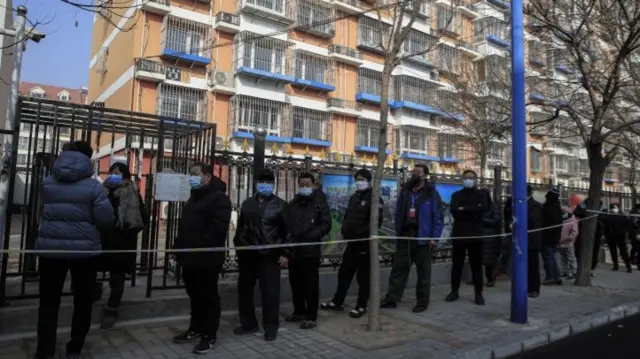
    Local residents line up for nucleic acid testing in Daxing district of Beijing, China, 26 January 2021. Beijing"s Daxing district started a second round mass COVID-19 testing for local residents on 26 and 27 January after a COVID-19 outbreak in this districtImage source, EPA
    Image caption,

    Residents line up for testing in the Daxing district of Beijing earlier this week

    You might have seen reports earlier this week about China rolling out anal swabs to test people for Covid-19.

    So what’s it all about? It’s currently not a widespread trend; it's only evident that this has been carried out within a small group of people in the south of the capital, Beijing.

    A school in the Daxing district "conducted a variety of tests including serum antibody tests, nasal, throat, and even anal swabs, external for all its staff and students", the national Global Times newspaper reported.

    An infectious disease expert in the city explained the tests were being conducted following studies showing “the coronavirus survives longer in the anus or excrement” than in the upper body tracts. So such tests are more accurate at detecting “silent carriers”.

    State media say these tests have been “controversial among experts”, and that they are far less efficient than tests in the upper respiratory tracts. The existing tests are preferred, as they believe most people contract the virus orally.

    Anal swabbing has been a major talking point on Chinese social media this week. As national broadcaster CCTV publicised these tests, and they were carried out in the Chinese capital, people have been voicing their hopes that these tests won't become nationwide.

    It’s been effective in discouraging some Chinese from travelling during the largest annual migration for Spring Festival and the Chinese New Year. Negative Covid-19 tests are a requirement this year for all travellers within seven days of their journey, and some people don't want to take the risk!

  3. Janssen vaccine results 'very encouraging', Boris Johnson sayspublished at 14:51 GMT 29 January 2021

    News that a single dose of the Covid-19 vaccine developed by Janssen is 66% effective has been welcomed by Prime Minister Boris Johnson.

    "Very encouraging that early trials of the vaccine developed by Janssen show it to be effective against coronavirus," he said.

    Unlike some other vaccines, the Janssen jab can be stored at normal fridge temperatures.

    And crucially, the effectiveness of 66% came from one dose of the vaccine, making it much easier to roll out.

    This X post cannot be displayed in your browser. Please enable Javascript or try a different browser.View original content on X
    The BBC is not responsible for the content of external sites.
    Skip X post

    Allow X content?

    This article contains content provided by X. We ask for your permission before anything is loaded, as they may be using cookies and other technologies. You may want to read X’s cookie policy, external and privacy policy, external before accepting. To view this content choose ‘accept and continue’.

    The BBC is not responsible for the content of external sites.
    End of X post
  4. AstraZeneca 'should do what it promised' - French MEPpublished at 14:41 GMT 29 January 2021

    The World at One
    BBC Radio 4

    Oxford Biomedica facility manufacturing the vaccineImage source, PA Media
    Image caption,

    The EU says AstraZeneca should use all its facilities, including UK factories, to meet its commitments

    The contract between the European Commission and AstraZeneca shows the company made a clear commitment to deliver a certain number of doses, says French MEP and medical doctor Veronique Trillet-Lenoir.

    She tells BBC Radio 4's World at One: "We are very concerned by the fact that AstraZeneca could not follow its commitments."

    While she hasn't seen the figures because they were blocked out in the copy shown to MEPs, she says there was a specific number of doses promised.

    Trillet-Lenoir, a member of French President Emmanuel Macron's En Marche party, says the company has to use its "best efforts" to meet its commitments, which means using factories in the EU and elsewhere, such as the UK.

    "The firm has taken engagements with the European Commission, with the UK, and should do what it promised to do," she says, adding that if it cannot meet its obligations it should use contract manufacturing companies, as Pfizer has done with Sanofi.

    Asked who the French public blame for the delay, she says: “People in France like to blame the government; in the present time they should really blame the firm."

  5. WATCH: Why roller skating is making a comebackpublished at 14:27 GMT 29 January 2021

    People have been turning to hobbies old and new to pass the time in lockdown, and during the pandemic generally.

    One that's really caught on is roller skating, and there's now a worldwide shortage of skates due to its popularity.

    So what's behind the comeback?

  6. Covid deaths in Scotland pass 6,000published at 14:16 GMT 29 January 2021

    More than 6,000 people have now died after testing positive for Covid-19 in Scotland since the pandemic began.

    A further 70 deaths have been recorded in the past 24 hours, bringing the total by that measure to 6,040.

    However, separate figures released by the National Records of Scotland earlier this week showed that the virus has been mentioned on 7,902 death certificates in Scotland.

    A total of 177,688 people have now tested positive in Scotland.

    But the number of people in hospital with the virus has been falling in recent days.

  7. What's happening around the world today?published at 14:07 GMT 29 January 2021

    Ambulances with Covid patients are queuing up at Lisbon's Santa Maria hospitalImage source, AFP
    Image caption,

    Ambulances with Covid patients are queuing up at Lisbon's Santa Maria hospital

    If you're just joining us, here are the latest coronavirus developments from around the world:

  8. UK's R number now at 0.7-1.1published at 13:57 GMT 29 January 2021
    Breaking

    The R rate - the average number of people each person with Covid-19 goes on to infect - for the UK is now estimated to be between 0.7 and 1.1.

    Last week the figure was 0.8-1.

    The estimates for R and the growth rate are provided by the Scientific Pandemic Influenza Group on Modelling (SPI-M), a sub-group of Sage, and published by the Department of Health and Social Care.

    You can read more about infection rates in the UK here.

    And you can read more about the R number and how it is calculated here.

  9. Brazil to investigate deaths of several indigenous childrenpublished at 13:47 GMT 29 January 2021

    Indigenous people from Yanomami ethnic group are seen, amid the spread of the coronavirus disease on 1 July 2020Image source, Reuters
    Image caption,

    The deaths alleged happened in the Yanomami indigenous community in a remote area of Brazil (file picture)

    Brazil's health ministry says officials have been deployed to an isolated region in the north of the country to investigate reports that nine indigenous children died with Covid-19 symptoms this month.

    According to health workers in the Yanomami indigenous community, the children were all under five and died in two villages in the west of Roraima state, in the Amazon region near the border with Venezuela. They all experienced difficulty in breathing and a fever.

    The health workers say the virus had spread widely among their community and that at least 25 other children have shown similar symptoms. They are urging the federal government to provide help and reopen medical posts in their territories which were closed two months ago.

    Indigenous groups say the situation has been made worse by the presence of illegal miners in protected areas.

    There are also fears that a new variant discovered in the Amazon region, believed to be more infectious, could be behind a sharp rise in cases in the area.

    Brazilian President Jair Bolsonaro has been heavily criticised for his handling of the pandemic. The country is one of the worst hit in the world, with more than nine million confirmed cases and 221,000 deaths.

    Official numbers say at least 540 indigenous people have died with Covid-19 but community leaders say that number is above 940., external

  10. UK has 'confidence' in vaccine supply despite EU row - No 10published at 13:38 GMT 29 January 2021

    Vials of the Pfizer-BioNTech vaccineImage source, Reuters
    Image caption,

    EU restrictions may affect UK supplies of the Pfizer-BioNTech vaccine

    The UK believes it will receive enough doses of vaccines to meet its targets, despite possible export restrictions being imposed on supplies made in the EU, Downing Street says.

    The prime minister's official spokesman says “EU policy is a matter for them" but stresses Boris Johnson's "confidence" in the supply "and the fact we remain committed to vaccinating the most vulnerable groups by the middle of February, the rest of phase one by the spring and offer a dose to all adults by September”.

    Asked whether the stance on sending doses made in the UK to the EU had altered, No 10 says: “I think the public would expect us to continue to vaccinate as many people as possible, and that’s what we will do.”

    He declines to comment on the amount of vaccines the UK possesses.

    But he says: “The deals we have in place with the seven vaccine developers will ensure our supply continues to grow as we rapidly expand the rollout of the plan in the weeks and months ahead.”

  11. Single dose jab could 'significantly bolster' UK vaccine programme - Hancockpublished at 13:28 GMT 29 January 2021

    Matt HancockImage source, PA Media

    The single dose Covid vaccine could "significantly bolster" the UK's vaccination programme if approved by the medicines regulator, Health Secretary Matt Hancock says.

    In a tweet, he writes, external: "This is yet more good news from Janssen on vaccines. If this jab is approved this could significantly bolster our vaccination programme, especially as a single-dose vaccine.

    "Once the full data has been submitted to the MHRA, they will consider the evidence to determine whether the vaccine meets robust standards of safety, effectiveness & quality.

    "We're rolling-out vaccines as quickly as possible across the UK, with more than 7.4 million people given their first dose so far."

    Janssen's jab with one dose has been found to be 66% effective, the Belgian company has just announced.

  12. Portugal tightens lockdown as Covid deaths surgepublished at 13:17 GMT 29 January 2021

    Ambulances with Covid patients queuing up at Lisbon's Santa Maria hospitalImage source, AFP
    Image caption,

    Ambulances with Covid patients are queuing up at Lisbon's Santa Maria hospital

    Portugal has tightened its coronavirus lockdown, banning all non-essential travel abroad and hiring foreign medics, as hospitals struggle and deaths reach record highs.

    The country's pandemic death rate is now the highest in the EU.

    "We really have to stop the surge under way, now," said newly re-elected President Marcelo Rebelo de Sousa in a TV address to the nation.

    Portugal reported a record 303 deaths and 16,432 new cases on Thursday.

    Ambulances carrying Covid patients are queuing up at Portugal's hospitals.

    The president, re-elected last Sunday, decreed that the state of emergency would be extended for two more weeks, until 14 February.

    Schools were due to reopen on 5 February, but that will not happen - instead students will have to continue studying at home and online classes will begin on 8 February.

    Portugal has the highest Covid-related death rate in the EU for the past 14 days: 247.5 per million inhabitants, the EU's European Centre for Disease Prevention and Control reports., external

  13. Single dose Covid vaccine 66% effectivepublished at 13:09 GMT 29 January 2021
    Breaking

    A vaccine developed by Janssen prevents 66% of Covid cases, the Belgian company has announced.

    The international trial looked at giving just one dose of the vaccine, which makes it significantly easier to roll out than those requiring two.

    The UK has already pre-ordered 30 million doses.

    The news comes shortly after Novavax announced its jab was 89% effective. Both will need to be reviewed by regulators before they can be used.

    There are also trials in the UK investigating whether giving two doses of the Janssen vaccine give either stronger or longer-lasting protection.

  14. Welsh Conservatives leader pledges to work with ministers on easing restrictionspublished at 13:04 GMT 29 January 2021

    In Wales, First Minister Mark Drakeford's press briefing is now finished.

    He confirmed lockdown restrictions would continue for another three weeks, but also reiterated plans to get children back into schools ahead of other UK nations - after half term - because of improving Covid rates in the country.

    Earlier today, the new leader of the Welsh Conservatives in the Senedd, Andrew RT Davies, pledged to work with ministers on the easing of Covid restrictions.

    "We want this to be the last lockdown and we will work with the Welsh government to do whatever it takes to make sure that's the case," he said.

    This X post cannot be displayed in your browser. Please enable Javascript or try a different browser.View original content on X
    The BBC is not responsible for the content of external sites.
    Skip X post

    Allow X content?

    This article contains content provided by X. We ask for your permission before anything is loaded, as they may be using cookies and other technologies. You may want to read X’s cookie policy, external and privacy policy, external before accepting. To view this content choose ‘accept and continue’.

    The BBC is not responsible for the content of external sites.
    End of X post
  15. Paris civil servants accused of jumping vaccine queuepublished at 12:59 GMT 29 January 2021

    Paris city hall, Dec 2019Image source, Getty Images
    Image caption,

    Paris city hall, in the heart of the French capital

    A row has erupted in Paris over a hospital union’s allegation that civil servants are getting Covid vaccinations, despite older medical staff being first in the queue.

    The CGT union at l’Hôtel-Dieu hospital in central Paris says any such VIP treatment is intolerable, as vaccines are in short supply and French medics are already having their second jabs postponed.

    A CGT statement quoted by Le Parisien says: “Daily, the [vaccination] centre’s teams have to refuse medics and vulnerable elderly people, as they are obliged to vaccinate staff from Paris city hall and other VIPs who are not a medical priority!”

    City hall says it is now checking all the names of its staff vaccinated at the hospital.

    The hospital managers admit that l’Hôtel-Dieu has a vaccination deal with city hall. But according to city hall, it only applies to civil servants doing social or medical work, who are aged 50 or above, or who have underlying health conditions.

    The Paris authorities say that under the existing rules, 2,000 civil servants are eligible for the Covid jab and, by Wednesday, 475 had received it.

    A top health official in the French capital, Anne Souyris, says the city’s vaccination centres are each doing just a few hundred jabs a day – yet the target for each is at least 10,000 a week.

  16. Scotland's Western Isles could go into lockdownpublished at 12:51 GMT 29 January 2021
    Breaking

    The whole of the Western Isles of Scotland could move up to the country's toughest tier of coronavirus restrictions - level four - as part of efforts to supress the spread of the virus.

    Health Secretary Jean Freeman said the Scottish government would make a decision over the "next few hours" following new cases on the islands.

    Barra and Vatersay are already under level four restrictions while the rest of the isles are at level three.

    Among the outbreaks is one affecting Western Isles Hospital in Lewis.

  17. Drakeford reiterates aim for some children to return to school after half termpublished at 12:43 GMT 29 January 2021

    More from Wales now, where First Minister Mark Drakeford says the country does not yet have the "head room to do everything we would like".

    But he says getting pupils back into schools and colleges for face-to-face learning is the government's "top priority".

    He says if infections continue to fall, the government wants to see children return to school after half-term from 22 February, starting with youngest children in primary schools.

    He says he is confirming this intention to give as much notice to parents, teachers and pupils of what the government hopes will lie ahead.

  18. Little change to coronavirus infections in UK, ONS figures showpublished at 12:39 GMT 29 January 2021

    Robert Cuffe
    BBC head of statistics

    The number of people infected with coronavirus has changed little in the week to 23 January 2021, figures from the latest Office for National Statistics infection survey suggest.

    The ONS says virus levels “remain high” in England, and are level in the other nations of the UK.

    According to the figures:

    • In England, 1 in 55 people tested positive for the virus
    • In Wales, 1 in 70
    • In Scotland, 1 in 110
    • And in Northern Ireland, 1 in 50

    The ONS survey swabs people at random in homes (rather than hospitals, care homes or prisons) and gives a clearer picture of how many infections there are than the daily numbers of confirmed cases, which depend on people coming forward for testing.

    In the last set of figures (the week ending 16 January):

    • In England, 1 in 55 tested positive (and in London roughly 1 in 35)
    • In Wales, 1 in 70
    • InScotland, 1 in 100
    • And in Northern Ireland, 1 in 60

    The figures for this week also suggested that roughly the same number of people with coronavirus “decreased slightly” in England, was “levelled off” Scotland and Wales and rose in Northern Ireland compared to the week ending 2 January.

  19. Two 'small but important' changes to restrictions in Walespublished at 12:35 GMT 29 January 2021

    Drakeford says because of improvements in infection rates he is announcing "two very small but important changes".

    He says he hopes these will "lay the foundations" for more changes to come.

    From tomorrow, two people from different households will be able to exercise outdoors together.

    People will also be helped if they need to change their support bubble, he says. Guidance will be published on how to do this safely.

  20. Restrictions will be eased 'carefully and gradually' in Walespublished at 12:31 GMT 29 January 2021

    More from Wales now, where Mark Drakeford says the advice for shielded group is also being extended to 31 March.

    He says people in Wales will need to stay at home and work at home for a while longer.

    When it comes to easing the lockdown, the government will be "careful, gradual and always with public health safety at the forefront of our decisions", he adds.