Summary

  • AstraZeneca says it is "unprecedented" the world has produced multiple vaccines in a year, after the EU approved its jab

  • Prof Andrew Pollard, director of the Oxford vaccine group, adds there is "no reason" to be concerned about using the vaccine on over-65s

  • Some EU states are considering only giving the Oxford-AstraZeneca vaccine to under-65s, citing a lack of data for its use on older age groups

  • Meanwhile, a new coronavirus vaccine developed by Janssen prevents 66% of Covid cases after a single dose, the Belgian company says

  • And another new vaccine, Novavax, is said to be the first to show in trials it is effective against the new virus variant found in the UK

  • Meanwhile, lockdown will continue in Wales for a further three weeks, First Minister Mark Drakeford says

  • The UK's R rate - the average number of people each person with Covid-19 goes on to infect - is now estimated to be between 0.7 and 1.1

  1. Oxford researchers 'working hard' to understand effect of jab on new variantspublished at 17:29 GMT 29 January 2021

    Prof Pollard says his team are working "really hard" to understand what level of protection the vaccine offers against new variants circulating around the world.

    He says this is a "complex process" and while his team are making "good progress", it will take a little longer to know this.

    He says all researchers are looking at these variants and considering the processes that will be required to amend vaccines, if necessary, to new variants.

  2. 'Great confidence' in vaccine, Oxford professor sayspublished at 17:25 GMT 29 January 2021

    Prof Andrew Pollard, director of the Oxford vaccine group, says there is "great confidence in the vaccine" and the "potential use of it".

    "We should be really encouraged that we've reached this point in the pandemic," he tells the webinar.

    "We have multiple tools that are becoming available to get ahead," he adds.

  3. Easy to forget vaccine work has taken place in nine months - AstraZeneca CEOpublished at 17:22 GMT 29 January 2021

    Pascal Soriot, chief executive officer of AstraZeneca, says the firm partnered with the University of Oxford about nine months ago.

    He says in that time they have developed manufacturing for the jab, been through clinical trials and gained approval.

    He says manufacturing normally takes years.

    He says of "course there will be glitches" but the important fact is that within a year the world has developed several vaccines.

  4. AstraZeneca press conference beginspublished at 17:15 GMT 29 January 2021

    The AstraZeneca press conference has started.

    It comes after the EU's drugs regulator approved the use of its vaccine for over-18s amid an ongoing dispute over whether the firm is breaking its vaccine delivery commitments to the bloc.

    Those speaking at the webinar include Pascal Soriot, AstraZeneca's chief executive officer, and Prof Andrew Pollard, director of the Oxford vaccine group.

    Stick with us for updates.

  5. Scotland's Western Isles to go into lockdownpublished at 17:10 GMT 29 January 2021

    Western Isles HospitalImage source, Google
    Image caption,

    Western Isles Hospital has reached capacity amid an outbreak affecting patients and staff

    The whole of the Western Isles in Scotland will move up to the highest level of lockdown restrictions - level four - as part of efforts to suppress the spread of Covid-19.

    Health Secretary Jeane Freeman said "quick and decisive" action was needed following new cases on the islands.

    Barra and Vatersay are already under level four restrictions. The rest of the isles will move up from level three at 00:01 on Saturday.

    One of the outbreaks is affecting Western Isles Hospital in Lewis.

    Ms Freeman said the hospital, the largest on the island, was reaching full capacity and the isles had seen six new Covid cases on Friday and nine on Thursday.

  6. AstraZeneca to hold press conference following EU approval of jabpublished at 17:00 GMT 29 January 2021

    Vaccine manufacturer AstraZeneca is due to hold a press conference at 17:15 GMT.

    The pharmaceutical company says the briefing is being held following the news that the EU's drugs regulator has approved the use of the Oxford-AstraZeneca Covid vaccine for people aged over 18.

    But there is also an ongoing dispute over whether Astra-Zeneca is breaking its vaccine delivery commitments to the bloc.

    The European Commission has published its contract with the Anglo-Swedish drug-maker, hoping to show a breach.

    Those speaking at the webinar press conference include Pascal Soriot, the firm's chief executive officer, and Prof Andrew Pollard, director of the Oxford vaccine group.

    We'll bring you updates from the press conference when it starts.

  7. Janssen vaccine results 'extremely encouraging', scientists saypublished at 16:52 GMT 29 January 2021

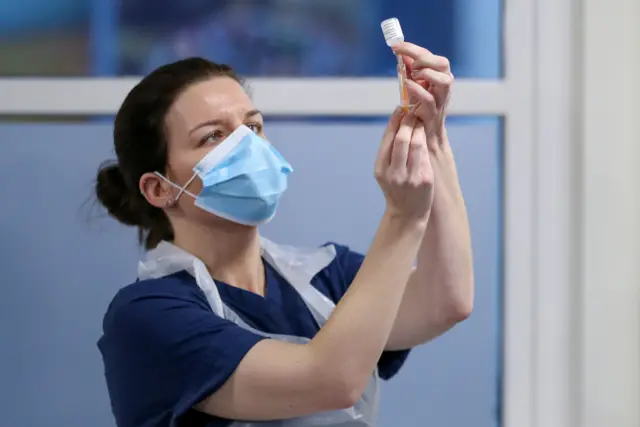
    A doctor receiving the Janssen jabImage source, PA Media

    Scientists are reacting to the news that the single-dose vaccine developed by Janssen is 66% effective.

    In a round-up of reaction, compiled by the Science Media Centre, external, Prof Kevin Marsh, from the University of Oxford, hails the "extremely encouraging" results, adding: "The real headline result is that a single-shot vaccine, capable of easy long-term storage and administration provided complete protection against hospitalisation and death.

    "This is important because the immediate requirement of vaccination globally is to limit deaths as quickly as possible."

    Dr Michael Head, from the University of Southampton, says the jab has "advantages in terms of cost and logistics for a large-scale roll-out. It can also be quickly manufactured at large scale.”

    But Dr Alexander Edwards, from the University of Reading, says that while the results are "great news", scientists are now eagerly awaiting the release of full trial data.

    Scientists also picked up on the fact the vaccine was found to be less effective against moderate disease in South Africa (57%).

    Dr Simon Clarke, from the University of Reading, adds: "These data provide further evidence that, in humans, the South African variant of the coronavirus may have developed partial resistance to vaccination.”

  8. 'Public has a right to clarity' over vaccine supply, Scotland sayspublished at 16:42 GMT 29 January 2021

    A nurse in Edinburgh draws a dose of vaccineImage source, PA Media
    Image caption,

    Scotland will begin publishing details of the doses promised and delivered

    Scotland's Health Secretary, Jeane Freeman, is defending the Scottish government's decision to begin publishing details of the vaccine supply, despite warnings from the UK government that it was a national security issue.

    Following the first minister's announcement yesterday, the Scottish government will publish the number of doses it expected to receive and the number it actually received - but it will not reveal details of anticipated future deliveries.

    Freeman says UK government briefings to journalists on the vaccine doses available have been used to suggest Scotland's roll-out is going more slowly than the rest of the country.

    That meant it was "not credible" for the UK government to claim it was an issue of national security, she says.

    “The public has a right to clarity and we will give them that," the health secretary says.

    After raising the Scottish government's plans to publish the figures at a four nations call, Freeman says she has not received any "panicked calls" from ministers in other nations or vaccine manufacturers.

  9. UK travellers arrive home from Dubai before new flight banpublished at 16:34 GMT 29 January 2021

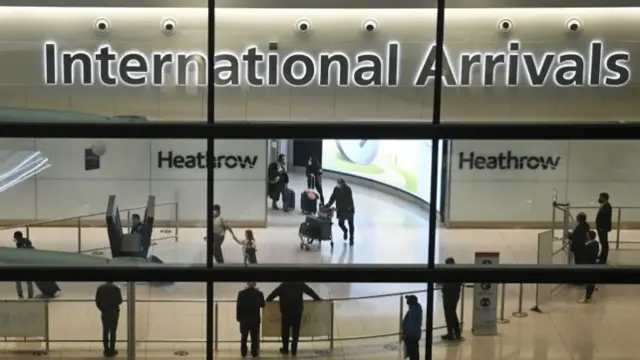
    Travellers in the international arrival area of Heathrow Airport, near LondonImage source, EPA
    Image caption,

    Under the new rules, visitors from the UAE are banned from entering the UK

    Passengers have been speaking after rushing to return to the UK on one of the last flights back from Dubai before a new travel ban came into force at 13:00 GMT today.

    The UAE, Burundi and Rwanda have been added to the "red list" of countries from where travel to the UK is banned.

    The policy is aimed at stopping the spread of the South African coronavirus variant.

    Arrivals into Birmingham Airport included 21-year-old student Emma Rhodes, who had been on a two-week holiday and was due to arrive back on Friday.

    Asked about criticism of those who had chosen to travel abroad for non-business trips, she said: "I had personal reasons why I went, I needed some 'me' time.

    "I do agree with what the government have done but I understand why people have chosen to go (abroad) as well."

    Emma had to get a negative Covid-19 test to initially fly to Dubai and then paid for a test in order to come back to the UK.

    She added: "I feel like now, I wouldn't advise people to go (to Dubai) because things have changed; they don't know if they'd get back, or have to pay for hotel quarantine."

  10. Ukraine to ban Russian vaccinepublished at 16:27 GMT 29 January 2021

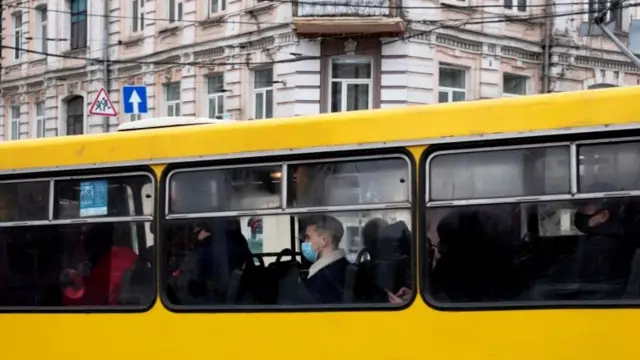
    A passenger wearing a protective face mask is seen on a bus amid the coronavirus disease pandemic in central Kyiv, Ukraine, on 27 January 2021Image source, Reuters

    Ukraine's parliament has approved a bill that aims to speed up the approval of Covid-19 vaccines, but also bans the approval of vaccines made in Russia.

    No vaccine has yet been approved in Ukraine, but officials have previously said Kyiv will not approve or use Russian vaccines.

    Ties between Russia and Ukraine are strained following the annexation of the Crimean peninsula in 2014 and Moscow backing separatist fighters in the east of Ukraine.

    "One political force just created some hysteria over the registration of the Russian vaccine," Ukraine's Health Minister Maksym Stepanov tells a televised briefing.

    "I can immediately say that no-one will register the Russian vaccine in the country," he says, adding vaccination will begin on time in February.

    However, medical staff are sceptical since no official date for a first delivery has been finalised, the AFP news agency reported earlier this month.

    President Volodymyr Zelensky has blamed the delay on richer Western countries who reserved the Pfizer and Moderna jabs in bulk.

    "The richest found themselves first in the global vaccine queue," he said in December.

    Ukraine has so far secured eight million doses through the UN Covax mechanism which helps poorer nations with distribution, and Kyiv expects to secure five million doses of the Chinese vaccine CoronaVac once it is registered, AFP reports.

    However, those quantities may not be enough for a country of more than 40 million people.

  11. Nearly eight million in the UK have had at least one vaccine dosepublished at 16:20 GMT 29 January 2021

    The figures also show that 7,891,184 people have received at least one dose of the vaccine.

    Some 478,254 have had two doses.

    Along with case numbers, hospital admissions data also appears to be improving.

    There were 2,903 patients admitted into hospital. It means the seven-day average for hospital admissions is down 14.3%.

  12. UK cases rise by 29,079published at 16:14 GMT 29 January 2021
    Breaking

    There have been a further 29,079 coronavirus cases in the UK, according to the government's daily figures, external.

    It a slight increase on the numbers reported in Thursday's figures, 28,680, but the seven-day average for cases is down 29.5%.

    The daily death figures, usually released at the same time, are not currently availalable due to a "technical issue", the Department for Health and Social Care says.

  13. £800 house party fines set to become law in Englandpublished at 16:13 GMT 29 January 2021

    House partyImage source, Getty Images

    Fines of £800 for people caught at house parties will become law in England in less than an hour - at 17:00 today.

    They are part of tougher measures to crack down on illegal gatherings during the pandemic.

    The penalty will apply for groups of more than 15 people and will double after each offence up to a maximum of £6,400 for repeat offenders, Home Secretary Priti Patel said last week when she announced the plans.

    This supersedes current rules where the fines stand at £200.

    But the £10,000 penalties for unlawful groups of more than 30 people will continue to only apply to the organiser.

    The £800 fine is cut to £400 if paid within 14 days.

    As well as those in private dwellings, the rule also applies to similar gatherings in "educational accommodation", the documents setting out the new law say.

  14. Algeria set to get batch of Russian Covid vaccinespublished at 16:03 GMT 29 January 2021

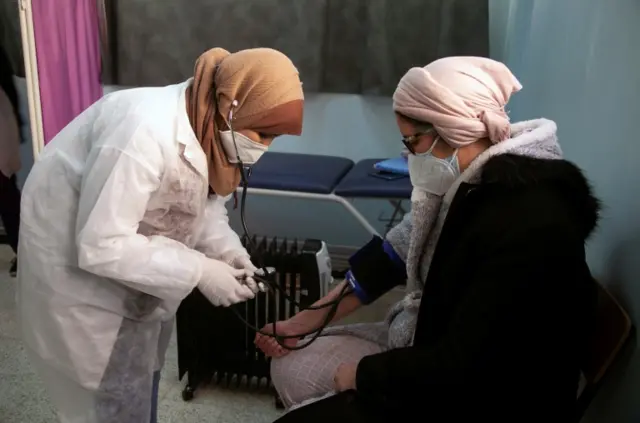
    A nurse examines a doctor in AlgeriaImage source, Reuters
    Image caption,

    Algeria has so far confirmed more than 100,000 coronavirus cases

    Algeria is set to receive its first doses of Covid-19 vaccine today and begin immunisation tomorrow, its communication minister says.

    The country will receive the Russia’s Sputnik V vaccine and says other doses from China and India are expected later.

    The elderly and health care workers are among first recipients of the vaccines.

    The immunisation is set to begin in the province of Blida.

    The country's President Abdelmadjid Tebboune is still in Germany where he is being treated for complications arising from his coronavirus treatment last year.

    The country has recorded 106,359 cases of coronavirus including 2,877 deaths, according to data from Johns Hopkins University.

    Algeria has said it will share Covid-19 vaccines with its neighbouring nation Tunisia that has been affected severely as well, news agencies report.

  15. Supplying AstraZeneca vaccine will be EU's big testpublished at 15:55 GMT 29 January 2021

    Michelle Roberts
    Health editor, BBC News online

    It would have been very surprising if EU regulators had not given the go-ahead for the AstraZeneca vaccine, of which they have been pre-ordering hundreds of millions of doses.

    The UK approved it weeks ago and millions of people in Britain have already received their first shot that should give them protection very soon.

    Trials show it is highly effective at preventing severe illness and deaths from coronavirus. But there have been questions about how well it works in people aged 65 and above, because there isn’t as much data for that age group - fewer than 10% of the trial volunteers were in this age bracket.

    But there is other evidence to suggest the vaccine works very well in older adults.

    Studies show that, like other age groups, the over 65s have a strong immune responses to the vaccine. After receiving the shots their blood has plenty of the required antibodies that can fight coronavirus.

    It will be up to individual countries to decide who – including which age groups - to offer the shots to.

    The bigger question will be how soon EU nations can get large deliveries of the vaccine. Supplies of this and other Covid vaccines are in huge demand, but there is a limit to how much can be manufactured at pace.

  16. Don't let lockdown exercisers make you feel inadequate, says Frypublished at 15:47 GMT 29 January 2021

    Stephen Fry in 2019Image source, Getty Images
    Image caption,

    Stephen Fry said Midsomer Murders, jazz and oat milk were getting him through lockdown

    As researchers say this lockdown has seen the UK do less exercise and watch more TV - as well as working more - the actor and writer Stephen Fry is urging people not to worry about their pandemic habits.

    He sent a message to school staff near his home in Norfolk to help boost morale of key workers, saying everyone is getting through lockdown "in our own way" - which didn't necessarily mean "baking and exercising".

    "Don't ever fall into the trap of thinking that you're somehow 'failing' or 'getting lockdown wrong'," he wrote.

    "It can be off-putting submitting oneself to the window of social media through which other people's lives can seem so healthy, happy and efficient.

    "All that baking and exercising that other people are doing - it can make one feel inadequate."

    Fry said he was spending lockdown reading historical novels and watching old TV series like Midsomer Murders and Agatha Christie mysteries - as well as listening to jazz and classical music while drinking "pints and pints" of oat milk to boost his mood.

  17. US detects first known cases of South African variantpublished at 15:38 GMT 29 January 2021

    Comparing Covid variantsImage source, Getty Images

    Health officials in the state of South Carolina have identified the first two US cases of the Covid variant initially seen in South Africa.

    The duo have no connection to each other and no history of travel to countries where the variant has been seen, indicating there has likely already been local spread of the strain within the US.

    It means the US has now identified three coronavirus variants from abroad.

    Back in December, a member of the US Army in Colorado tested positive for the UK strain of the virus.

    On Monday, a Minnesota resident who had recently traveled to Brazil tested positive for the version of the virus believed to originate there.

    In addition, researchers in California say large outbreaks in the state may be attributable to a homegrown strain that is spreading rapidly.

    All four variants are considered to be more contagious, but there is not yet any evidence that any of them cause more severe illness.

  18. Britain's Got Talent will not take place in 2021published at 15:30 GMT 29 January 2021

    David Walliams (left), Simon Cowell (centre-left), Amanda Holden (centre-right) and Alesha Dixon (right), the judges on Britain's Got TalentImage source, PA Media

    Britain's Got Talent will not take place in 2021 due to the Covid pandemic.

    ITV said the show was pulled from the schedules in order to safeguard "the wellbeing and health of every person involved in the programme".

    Earlier this month, the broadcaster announced that filming on the 15th series was being postponed due to the challenges of filming during the Covid crisis.

    However, it has now confirmed the recording and broadcast will not take place until 2022.

    A spokesman for Britain's Got Talent said: "Despite everyone at ITV, Thames and Syco doing their best to make it happen, and with our absolute priority of safeguarding the wellbeing and health of every person involved in the programme from judges, hosts and contestants to all of the crew and audience, the decision has been made to, unfortunately, move the record and broadcast of the 15th series of Britain's Got Talent to 2022.

    "BGT is known for its diversity of talent with big dance groups, wonderful choirs and lavish orchestras at its heart, and it has become clear that not only is it not possible to film auditions with these types of acts in a secure way but also that they are not able to adequately rehearse and prepare safely.

    "Safety has to come first and, as a result, the recording of the show can't currently go ahead as planned."

  19. EU approves AstraZeneca vaccinepublished at 15:22 GMT 29 January 2021
    Breaking

    And we've also heard that Europe's medicines regulator has just approved the use of the AstraZeneca Covid-19 vaccine for people over the age of 18.

    Read more here.

  20. EU confirms export controls on vaccinespublished at 15:18 GMT 29 January 2021
    Breaking

    The EU confirms it is introducing export controls on coronavirus vaccines made in the bloc, amid a row about shortfalls in delivery.

    Individual member states will decide whether to allow exports of vaccines produced in their territory.

    A European Commissioner said they were being introduced to enhance transparency and to ensure that all EU citizens had access to vaccines.

    Read more here.