Summary

  1. Drone strike fire at UAE gas field under control, authorities saypublished at 21:56 GMT 16 March

    Operations at the United Arab Emirates' Shah gas field are suspended following a fire that broke out due a drone attack, Abu Dhabi officials announced on X.

    "Abu Dhabi authorities and relevant response teams have contained and brought under control a fire that broke out at Shah gas field, caused by a drone attack," the statement said. "Operations at the facility have been suspended while damage is assessed, and no injuries have been reported."

  2. UAE president holds meeting with King of Jordanpublished at 21:54 GMT 16 March

    Azadeh Moshiri
    South Asia Correspondent reporting from Dubai

    UAE President Sheikh Mohamed bin Zayed Al Nahyan has received the King of Jordan in Dubai - in the presence of Mohammed bin Rashid and Mansour bin Zayed.

    During the meeting, Nahyan and King Abdullah II discussed regional developments in light of the escalating military situation and the serious implications it poses for security and stability in the region.

    The meeting also addressed continued Iranian attacks targeting countries in the region, which constitute a violation of sovereignty and international law and norms and represent a threat to international peace and security.

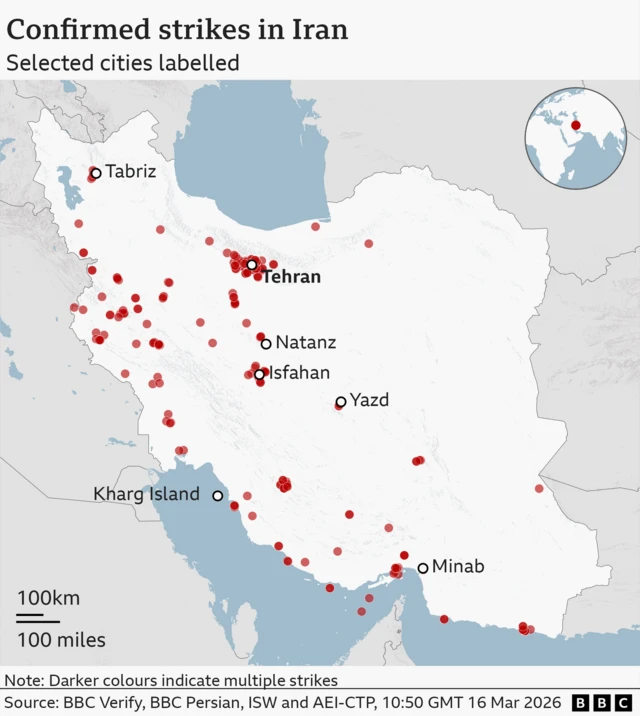
  3. Where in Iran have there been confirmed strikes?published at 21:43 GMT 16 March

    A map showing the locations of confirmed US and Israeli strikes on Iran.

    While the majority have centered around Tehran, several other cities have also been hit.

    The image is a map of Iran with red dot symbols indicating locations which have had one or more US and Israeli strikes. In addition some key cities are labelled, these include:  - Tabriz (north west Iran) - Tehran (north central Iran, the capital) - Natanz (central Iran) - Isfahan (central Iran) - Yazd (central Iran) - Minab (south Iran)  Also labelled is Kharg Island, to the south-west of Iran. The map includes a small inset globe in the top-right corner highlighting Iran’s location in the Middle East. A BBC logo appears in the bottom-right corner. The borders of surrounding countries and coastlines are faintly outlined, but the focus is on the distribution of strike locations across Iran.
  4. 'People are desperate and exhausted' - Iranians talk to the BBCpublished at 21:42 GMT 16 March

    Despite the tightened restrictions on internet use in Iran that we reported on earlier, our colleagues at BBC Persian have been able to receive some text messages from inside Iran.

    "Iran’s internet is really slow now", says a man in his 20s in Tehran. "We’re really worried about getting identified. If they do, I fear that we might be executed."

    Another man in Karaj, 30s, says the internet situation is "terrible". "The person who I bought my VPN from has increased their prices from yesterday to around 1.2 million for 1gb of internet!" he added.

    In Iran at the moment, an average salary is around 30 million Iranian Rial.

    "I went to the hairdresser today, although I was really worried about the situation outside," says a woman in her 20s in Tehran. "It was really busy. I feel like some people are still hopeful. I heard a loud explosion when I was there, but people are used to it now."

    A man based in Isfahan said the city was "hit very badly". Yesterday, there were "heavy bombardments" in Isfahan, he said, and this morning, there were strikes in an area near the Air Force neighbourhood.

    He said: "People are willing to accept the end of this in any way. People are hardly going out into the city to shop, and the dominant mood is closer to mourning than to a holiday.

    "My parents are in the north, at the Caspian sea and say there are some small local markets open and a kind of half-alive atmosphere there. People are desperate and exhausted."

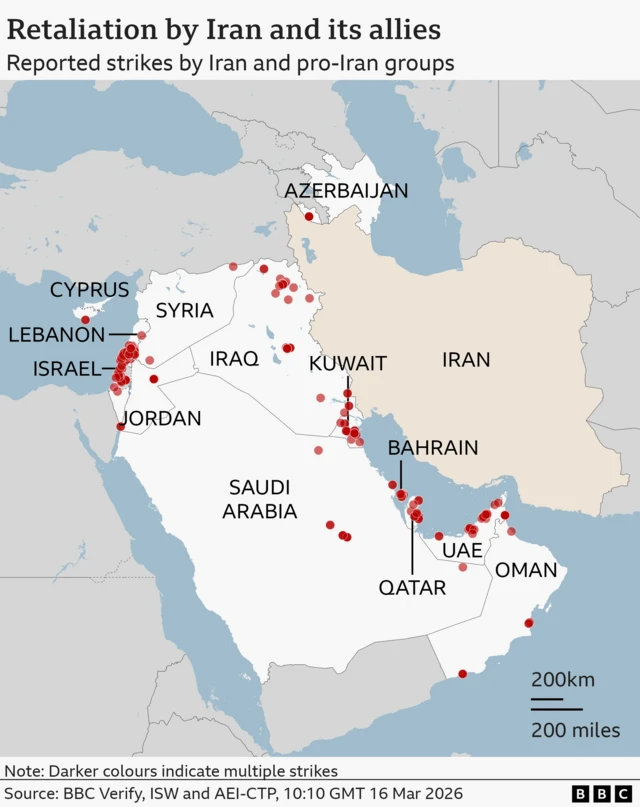
  5. Which countries in the region report being struck by Iran and its allies?published at 21:30 GMT 16 March

    A map of neighbouring countries who report being hit by retaliatory strikes from Iran and its allies.

    A regional map highlighting Iran in white with its name in black. Countries that have come under fire from Iran are labelled - Israel, Cyprus, Lebanon, Iraq, Kuwait, Jordan, Bahrain, Qatar, UAE, Oman, Saudi Arabia, Azerbaijan, Syria. Surrounding countries are grey.Image source, Getty Images
  6. Here's what Trump and Vance just said at the White Housepublished at 21:29 GMT 16 March

    We have just heard from President Trump and Vice President JD Vance at the White House where the president signed an executive order on domestic issues but took reporters' questions on Iran.

    Here is a round-up of their remarks:

    • Trump says Iran's missile supplies have largely been destroyed and are down to a fraction of what they were before the war
    • He reiterates his criticism of allies, such as the UK and Nato member countries, who have been reluctant to join the US during the war
    • But Trump says some countries are stepping up to help in a US plan to secure the Strait of Hormuz amid rising global oil prices. Trump does not identify the countries but says others, such as South Korea, Japan, and China, should be helping the US
    • He says the war will be ending soon - "it won't be long" - but says he has asked to delay for a month his upcoming trip to China, which was originally scheduled at the end of March
    • Vance, asked if he supports the war after US media reports that he had privately expressed misgivings, accuses the media of trying to "drive a wedge" between him and the president. He says he backs Trump's assertion that Iran was close to developing a nuclear war, hence necessitating the war.
  7. US markets have best day since war beganpublished at 21:12 GMT 16 March

    The US stock market has closed, with all three major indexes rising after weeks of losses.

    By Monday's market close, the Dow Jones had risen about 0.8%, the tech-heavy Nasdaq composite rose about 1.2% and the S&P 500 was up about 1%.

    Oil prices have also fallen, with brent crude at around $93 per barrel after a morning high of $102.

    It was the market's best day since the war in Iran began in late February.

  8. China trip may be postponed, Trump sayspublished at 21:06 GMT 16 March

    Trump is asked if a ground force will be needed in Iran to contain any nuclear material.

    "Why would I tell you?" Trump answers, saying questions like this are stupid. "If any president answered those questions, they shouldn't be president."

    Trump is then asked if he will still go to China. He says he's asked to delay that trip for a month because he wants to be in the US during the war.

    "We've got a war going on," he says.

  9. Iran down to limited missiles and drones, Trump sayspublished at 20:56 GMT 16 March

    Trump says Iran is down to about 8% of their missiles and a small amount of attack drones.

    He then says there are some countries that "greatly disappoint" him for not supporting the US in its war with Iran.

    He specifically mentions Nato countries, and brings up his conversation with British Prime Minister Keir Starmer, who he says hesitated when asked to help but later offered some assistance.

    He says: "I don't need your aircraft carriers after we have already won."

  10. Trump says it's unlikely war will end this weekpublished at 20:53 GMT 16 March

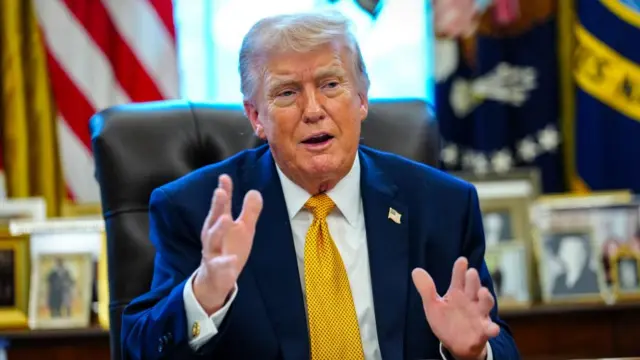
    Trump, in a blue suit and yellow tie, speaks from his chair in the Oval OfficeImage source, EPA

    Trump is asked if the war can end this week given what the president described as an "obliteration" of the Iran's military.

    "Yeah, sure," he says, but when asked if the war actually will end this week he says, "I don't think so, but it'll be soon. It won't be long."

    Trump says he had an "obligation to do this" and that we will have a "safer world" after the war is over.

  11. Trump again says that Iranian strikes on Gulf surprised himpublished at 20:49 GMT 16 March

    Bernd Debusmann Jr
    Reporting from Washington DC

    For the second time today, Trump has expressed surprise that Iran struck out at its Gulf neighbours once the US-Israeli strikes began.

    According to Trump, nobody briefed him on the possibility.

    Many observers, however, will find this difficult to believe. For decades, attempted Iranian strikes on US military facilities in the region has been considered Iran's most likely course of action in the event of a war, along with an attempt to close the Strait of Hormuz.

    In fact, Iran had attempted to strike US bases in the past, including Al Udeid air base in Qatar following Operation Midnight Hammer last year, and the US base at Al Asad in Iraq after the US killing of Qasem Soleimani in early 2020.

    Military analysts believe that Iran's strikes on Gulf states are aimed, partly, at prompting their governments to pressure the US to end hostilities.

    In practice, however, they have had the opposite effect and in some cases have turned local officials and public sentiment against Iran.

  12. Countries that get their oil through Strait 'should be helping us', says Trumppublished at 20:44 GMT 16 March

    Trump says world leaders like Japan, South Korea, and China - which get large percentages of their oil through the Strait of Hormuz - "should be thanking me".

    "And they should be not only thanking us, they should be helping us," he adds. "What does surprise me is that they're not eager."

  13. Trump criticises Iran for firing missiles at neighbouring countriespublished at 20:40 GMT 16 March

    Trump says Iran has been firing missiles at "every country within 1,000 miles of them".

    They're sending thousands of missiles into countries that didn't expect to be in the war, he adds.

    He adds that all the leadership in Iran is "gone" and he has "no idea" who he is currently dealing with.

    "They're all gone. My biggest problem is I have no idea who we're talking to," he said. "Nobody ever heard of any of these people, they're all dead."

    He had said earlier in the day that the US doesn't know if Mojtaba Khamenei, Iran's new supreme leader, is "dead or not"

  14. Trump admires B-2 bomber aircraft modelpublished at 20:35 GMT 16 March

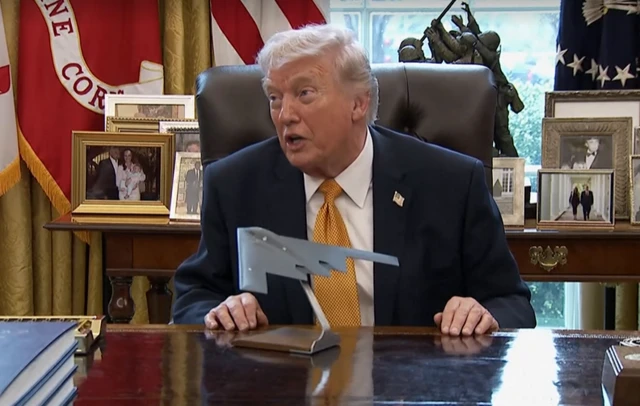
    A model of B-2 bomber on the Resolute Desk as Trump speaksImage source, Reuters

    Trump grabs a model of a B-2 bomber aircraft. He says if he hadn't ordered airstrikes on Iranian nuclear facilities last year, Tehran would have had a nuclear weapon by now. B-2 bombers were used in those strikes, which the US code named Midnight Hammer.

    He says had "we not done this" there would have been a "nuclear war, World War 3".

  15. Vance fields question on his enthusiasm for Iran warpublished at 20:32 GMT 16 March

    Bernd Debusmann Jr
    Reporting from Washington DC

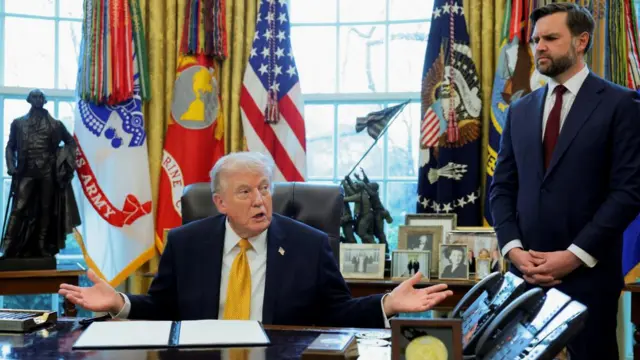
    President Donald Trump seated next to Vice-President JD Vance,  who is standing, speaks during an event in the Oval OfficeImage source, Reuters

    Trump is currently speaking in the Oval Office alongside Vice-President JD Vance, whom he has named to lead a task force aimed at fighting benefits fraud.

    Most of the questions have stayed on topic - but Vance was just asked whether he is "fully on-board" with Operation Epic Fury, given the fact that he has been previously critical of open-ended US military missions overseas.

    Various US media outlets have reported that Vance had counseled Trump against launching strikes in Iran.

    Vance responded - as he has in the past - by saying that he wants the operation to be as "successful as possible".

    The vice-president also responded to the question by attacking the media, accusing the reporter who asked of attempting to "drive a wedge" between him and Trump.

    We heard similar answers from Vance when he spoke to reporters at the end of last week.

    Trump is still talking about Iran, but most of his comments are repeats of what we heard earlier today and much of last week.

  16. Trump says he 'wants war less than anyone'published at 20:30 GMT 16 March

    President Donald Trump and Vice-President JD Vance are now speaking at the White House at an event unrelated to the war.

    But they are now taking questions on the war from reporters.

    Trump says he wants war "less than anyone", but that he has been watching Iran for years. If they had a nuclear weapon, they would use it, he says.

  17. Thousands of Iranian targets struck, US Central Command says in fresh updatepublished at 20:21 GMT 16 March

    Roughly 7,000 Iranian targets have been struck across the country since the conflict began, the US Central Command has said in its latest update.

    Military officials say over 100 Iranian vessels have been damaged or destroyed, while more than 6,500 combat flights have been carried out.

    Listing off some of the military assets use, the US Central Command says B-1 and B-2 Stealth bombers have been deployed in the operation as have various fighter jets.

    "CENTCOM forces are striking targets to dismantle the Iranian regime’s security apparatus, prioritising locations that pose an imminent threat," it adds in a statement.

  18. 'Deeply alarming' humanitarian situation in Lebanon, say western leaders in statementpublished at 20:12 GMT 16 March

    The leaders of the UK, Canada, France, Germany and Italy have just issued a joint statement expressing "grave concern" by the "escalating violence in Lebanon".

    All five have called on a "meaningful engagement by Israeli and Lebanese representatives to negotiate a sustainable political solution".

    "Hezbollah’s attacks on Israel and the targeting of civilians must cease and they must disarm," the statement adds. "We condemn Hezbollah’s decision to join Iran in hostilities, which further jeopardises regional peace and security.

    "We condemn attacks directed at civilians, civilian infrastructure, health workers and infrastructure, as well as the United Nations Interim Force in Lebanon. These actions are unacceptable, and we call on all parties to act in accordance with international humanitarian law.

    "A significant Israeli ground offensive would have devastating humanitarian consequences and could lead to a protracted conflict. It must be averted. The humanitarian situation in Lebanon, including ongoing mass displacement, is already deeply alarming."

  19. Iran launched attack at Qatar, defence ministry sayspublished at 20:02 GMT 16 March

    The Qatari Defence Ministry has said that it was attacked by Iranian missiles on Monday, though most of them were intercepted.

    The attack involved 14 ballistic missiles and several drones, the defence ministry said, noting that 13 of the ballistic missiles were intercepted, as were all of the drones.

    One missile landed in " an uninhabited area without causing any losses," the ministry said.

  20. Israeli action against Hezbollah continues in southern Lebanonpublished at 19:49 GMT 16 March

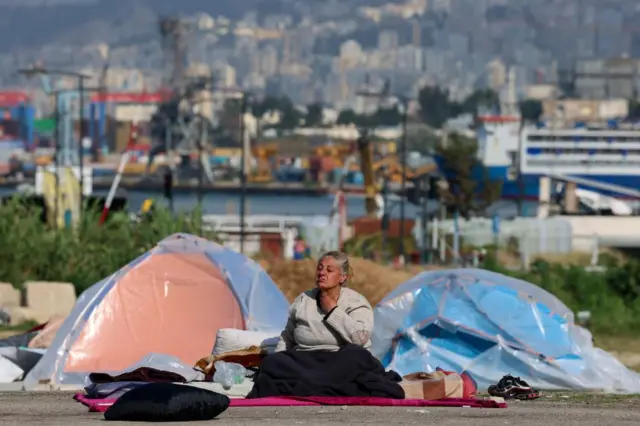
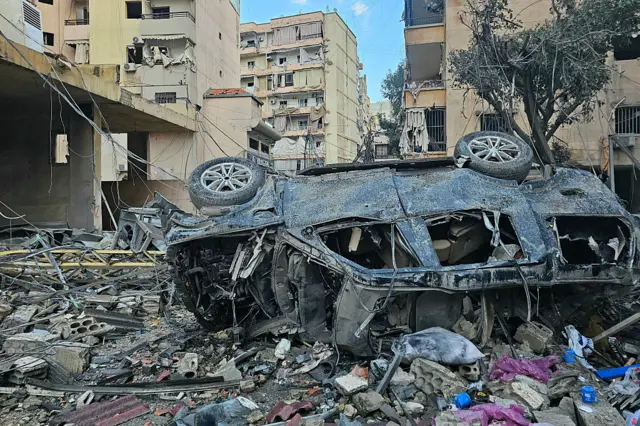
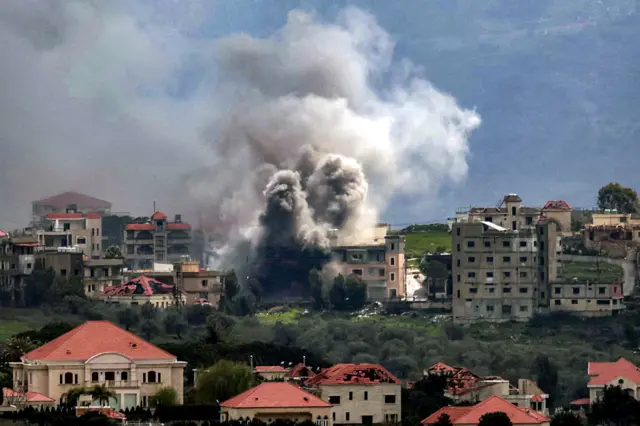
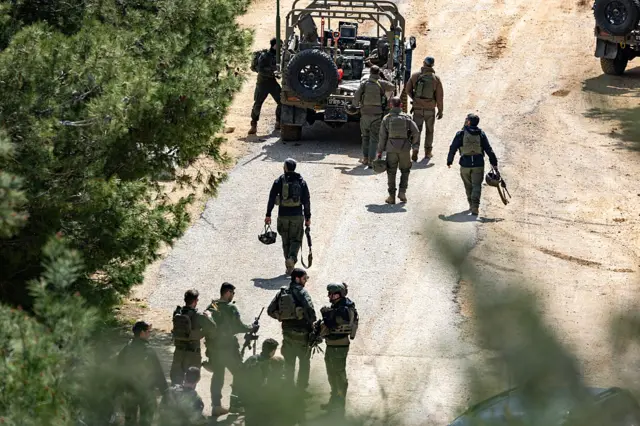
    Images show the destructive aftermath of Monday's "limited and targeted" operations against Hezbollah in southern Lebanon by the Israeli military.

    The fighting has destroyed southern parts of Beirut and left some residents stranded and displaced.

    A woman sits on a blanket on a street, tents are proped up behind her and the city scape of Beirut can be seen in the backgroundImage source, WAEL HAMZEH/EPA/Shutterstock
    Image caption,

    A woman displaced, living in a tent after fighting broke out in Beirut

    A destroyed car lays upside down and destroyed belongings and buildings can be seen, in the background some buildings remain standingImage source, AFP via Getty Images
    Image caption,

    The site of an overnight Israeli airstrike is pictured in the southern suburbs of Beirut

    Homes with red roofs and tan exteriors are seen in the foreground of the image as smoke plumes rise in the background and a building appears to be detroyedImage source, AFP via Getty Images
    Image caption,

    Smoke plumes rise following Israeli bombardment on the village of Khiam in southern Lebanon near the border with Israel

    Soldiers in uniform are seen walking along a dusty road, green trees are sprinkled on the sides of them. Some of the soldiers hold weapons and others hold their helmets in their hands.Image source, Odd ANDERSEN / AFP via Getty Images
    Image caption,

    Israeli army soldiers gather on the border with Lebanon in the Upper Galilee, northern Israel