Summary

  1. Sri Lanka declares Wednesdays public holidays to conserve fuelpublished at 05:23 GMT 17 March

    Kelly Ng
    Live reporter
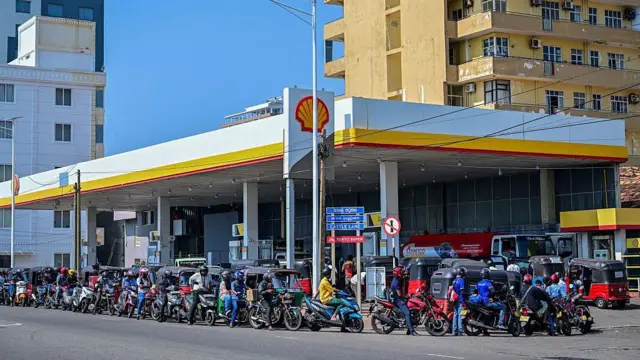
    Motorists wait in a queue to refuel their vehicles at a filling station in Wellawatte on the outskirts of Colombo.Image source, Getty Images
    Image caption,

    Snaking queues are seen around petrol stations in Sri Lanka as motorists scramble for fuel

    Asian countries are introducing a series of belt-tightening measures in an attempt to conserve fuel, as they grapple with possible shortages in the wake of the US and Israel's war with Iran.

    Nearly 90% of all the oil and gas flowing through the Strait of Hormuz last year was bound for Asia, which is the world's largest oil-importing region.

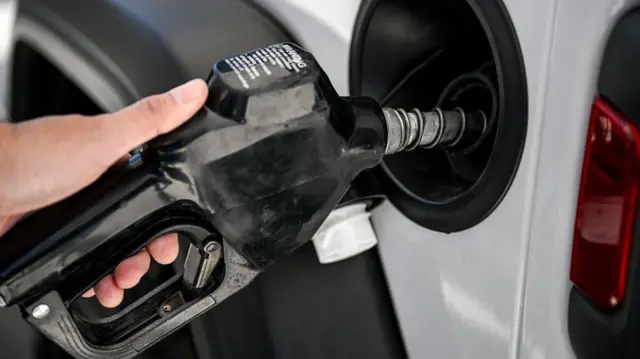
    • Sri Lanka has declared every Wednesday a public holiday to conserve fuel, and motorists are also now required to register for a National Fuel Pass which rations the amount of fuel that people can buy
    • In Myanmar, private vehicles are allowed only to operate on alternates days depending on their licence plate numbers
    • Bangladesh has brought forward Ramadan holidays in universities and introduced planned blackouts across the nation to conserve energy
    • In the Philippines, some government offices have mandated that staff work from home at least one day a week

  2. Iranian Football Federation wants to play World Cup matches in Mexicopublished at 04:55 GMT 17 March

    The Iranian Football Federation says it is in negotiations with FIFA about moving Iran's World Cup matches to Mexico due to safety reasons.

    Mehdi Taj, the President of the Iranian Football Federation said in a post on X, external: "When Trump has explicitly stated that he cannot ensure the security of the Iranian national team, we will certainly not travel to America."

    He added: "We are currently negotiating with FIFA to hold Iran's matches in the World Cup in Mexico."

    Last week, Iran's sports minister said it was not possible for Iranian players to participate in the tournament after the US launched airstrikes alongside Israel on Iran.

    US President Donald Trump has said that Iran would be "welcome to the World Cup" but that he did not believe it would be "appropriate that they be there, for their own life and safety".

    The Iranian team are scheduled to play two group matches in Los Angeles and one in Seattle.

    The gold and green FIFA world cup trophy on display in a glass cabinet in Monterrey, Mexico.Image source, Reuters
  3. How is commercial air travel impacted by strikes?published at 04:19 GMT 17 March

    As we reported earlier, the United Arab Emirates' aviation authority temporarily closed the country's airspace as "an exceptional precautionary measure" following incoming threats from Iran.

    It comes following the temporary closure of Dubai International Airport on Monday, after a drone attack on a nearby fuel tank. The airport is the world's busiest for international passengers.

    The UAE's airspace is critical for global aviation, serving as a corridor that connects Europe, Africa and Asia.

    According to aviation analysts quoted by the Times, more than 50% of British passengers heading east and 65% of Europe-bound Australians now transit through the three major international airports in the Middle East: Dubai International Airport and Zayed International Airport in the UAE, and Hamad International Airport in Doha, Qatar.

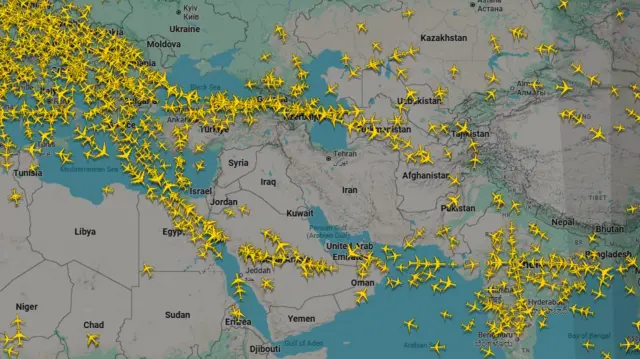
    Commercial air travel through the region has been severely impacted by the strikes, with nations like Egypt and Georgia receiving an influx of air traffic as flights are forced to divert around dangerous airspace.

    Air traffic reduced over IranImage source, FlightRadar24
  4. European leaders condemn escalating conflict between Israel and Hezbollahpublished at 03:48 GMT 17 March

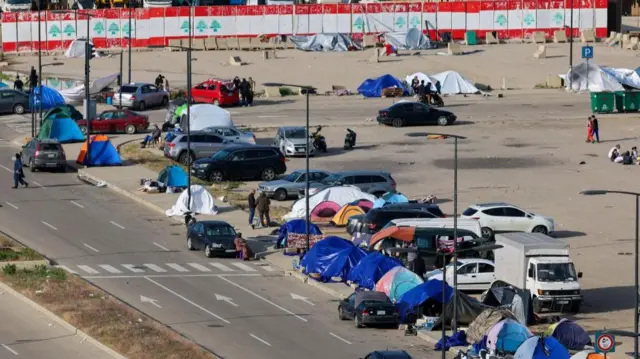
    Many tents along a road.Image source, EPA/Shutterstock
    Image caption,

    Displaced residents of southern Beirut following Israeli airstrikes on 16 March

    The leaders of Canada, France, Germany, Italy and the UK are urging Israel and Lebanon to begin negotiating a "sustainable political solution", following what they say is "deeply alarming" humanitarian situation in Lebanon.

    In a joint statement, they call on Lebanon's Hezbollah to disarm and cease attacks on Israel, condemning the group for the "decision to join Iran in hostilities".

    "We strongly support initiatives to facilitate talks and urge for immediate de-escalation," it says.

    It goes on: "A significant Israeli ground offensive would have devastating humanitarian consequences and could lead to a protracted conflict. It must be averted."

    The statement came during reports of Israeli air strikes across Beirut overnight, which Lebanon's National News Agency say were localised to southern neighbourhoods.

    On Monday, Israel's military said its troops had begun "limited and targeted ground operations" against Hezbollah in southern Lebanon.

    Hezbollah is a Shia Islamist political and military group backed by Iran, and has been designated a terrorist organisation by countries that include the UK and US.

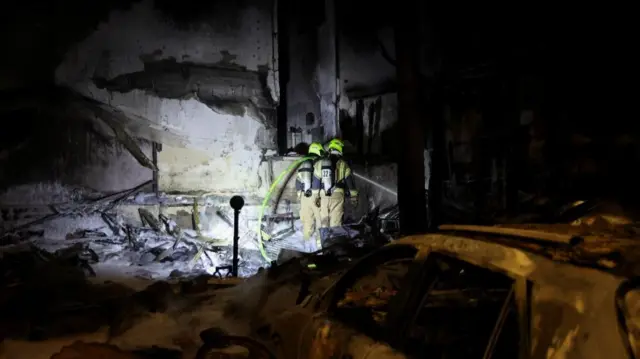
    Two emergency workers hold a hose over a heavily damaged structure.Image source, Reuters
    Image caption,

    Firefighters work at the scene of a Hezbollah rocket attack in Nahariya, northern Israel, on 16 March

  5. Strikes on Iraq continue into Tuesdaypublished at 03:10 GMT 17 March

    Iraq has been hit by a series of strikes this week, which have continued into early Tuesday morning.

    On Monday, a drone sparked a fire at a luxury hotel in Baghdad's heavily fortified Green Zone, which is home to government buildings and where foreign embassies are located.

    On Tuesday morning, the US embassy, which is located in the Green Zone, was targeted. A security official told AFP "three drones and four rockets attacked the embassy, with at least one drone crashing inside it".

    A witness told Reuters they saw at least three drones flying towards the US embassy. Two were shot down but a third struck inside the embassy compound, Reuters reports.

    Iraqi security sources told AFP it was "the most intense assault since the attacks began".

  6. Iran repeatedly strikes the UAEpublished at 02:55 GMT 17 March

    Since the war began, the Iranian military has launched more than 1,900 missiles and drones at the United Arab Emirates.

    Iran has been targeting the UAE's transport and oil infrastructure.

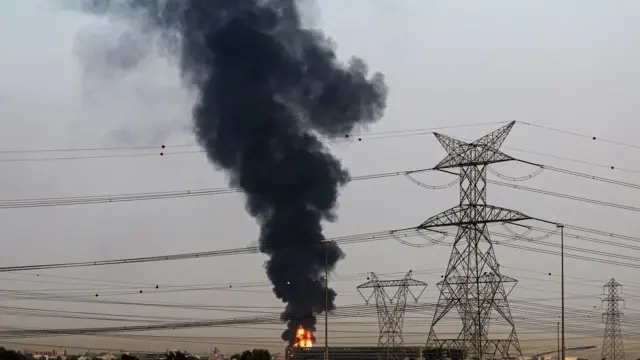
    Flights were temporarily suspended on Monday after a fire broke out near Dubai International Airport, the busiest hub for international travel, after a "drone-related incident". A drone attack also caused a fire at the strategically important port at Fujairah, one of the largest oil storage facilities in the region.

    And a rocket attack on a car killed a Palestinian national on the outskirts of the UAE capital, Abu Dhabi, the city's Media Office reported.

    Dubai International Airport has been under multiple attacks since Iran launched retaliation strikes, causing major delays and disruptions. A luxury hotel in Dubai was also hit in late February.

    The UAE "feels it has been unjustly pulled into this war", BBC correspondent Azadeh Moshiri told the BBC Global News podcast on Monday.

    "Iran may think this is the sort of pressure that makes leaders here put pressure on the United States to end the war but the fact is, is that officials here are furious," she said.

    Given how long it has taken the UAE to become "a safe and prosperous country", and the fact that "it's taking multiple blows", Moshiri said, "people are worried about the longterm impact".

    Smoke rises from an area near Dubai International Airport in Dubai, United Arab EmiratesImage source, EPA
    Image caption,

    Smoke rises near Dubai International Airport on Monday

  7. Air traffic resumes in UAE, state media sayspublished at 02:28 GMT 17 March

    Air traffic operations have returned to normal in the United Arab Emirates after a temporary closure earlier on Tuesday, state media is reporting, as cited by Reuters.

    Earlier on Tuesday, the General Civil Aviation Authority (GCAA) "announced a temporary closure of the country's airspace amid rapidly evolving regional security developments", Reuters reports.

    The GCAA has since said air navigation had returned to normal across the UAE’s airspace, state news agency WAM reports, external.

    GCCA emphasised "that continuous real-time monitoring remains in place to ensure the highest levels of safety of air navigation".

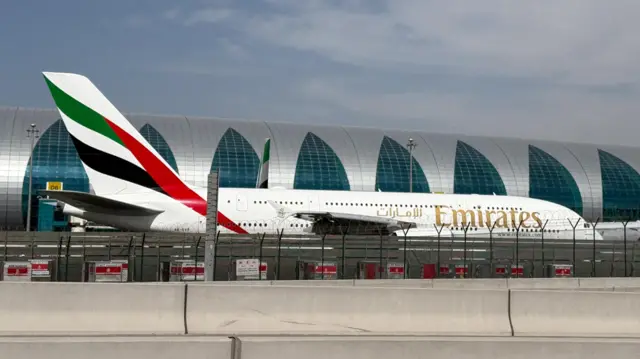
    An Emirates airplane at Dubai International Airport, amid the U.S.-Israeli conflict with Iran, in Dubai.Image source, Reuters
  8. Oil price jump during early Asia tradepublished at 01:41 GMT 17 March

    Osmond Chia
    Business reporter

    It's morning in Asia and Brent has jumped by 2.8% to $103.08 (£77.50) a barrel, while US-traded crude rose by nearly 3% to $96.25.

    Traders are still on watch for signs that oil shipments across the choked Strait of Hormuz trade waterway will continue, and signs of when tensions will calm.

    Oil prices eased slightly on Monday after reports that several ships have navigated safely through the channel, which has been targeted by Iran in retaliation to the US and Israeli attacks.

    Stock markets in Asia opened slightly higher on Tuesday, including indexes in Japan and South Korea which are reliant on Gulf oil.

    Japan's Nikkei 225 index gained by 0.25% while South Korea's Kospi exchange jumped by more than 2.5%.

    Technology stocks, which form a big chunk of the Kospi, were also given a lift after chip firm Nvidia announced a trillion-dollar forecast in 2027 sales and a slew of bumper deals with major companies.

    A man uses a black gas pump at a petrol stationImage source, Getty Images
  9. US embassy in Baghdad targeted by drone strikespublished at 01:15 GMT 17 March

    The US embassy in Baghdad has been targeted by a wave of drone and rocket attacks, according to reports from Reuters and Agence France-Presse (AFP).

    Iraqi security sources have told the latter that it was "the most intense assault since the attacks began".

    The embassy had issued a fresh security alert to US citizens in Iraq roughly six hours prior, where they warned that "Iran-aligned terrorist militias have repeatedly attacked the International Zone" in central Baghdad.

  10. UAE airspace closes hours after airport shutdownpublished at 01:07 GMT 17 March

    An Emirates airline plane mid-airImage source, AFP via Getty Images

    The closure of the UAE's airspace comes just hours after another airspace shutdown affecting commercial flights was lifted.

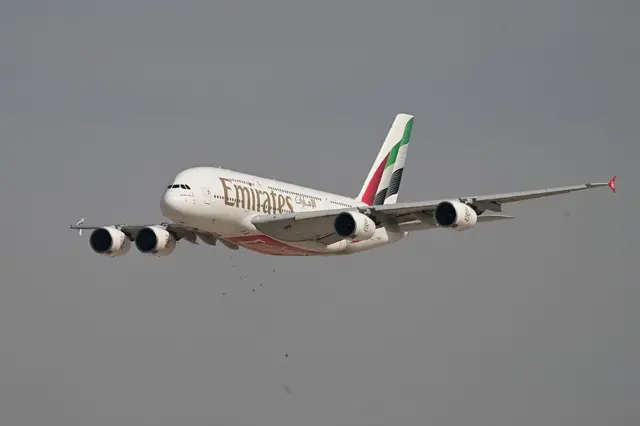
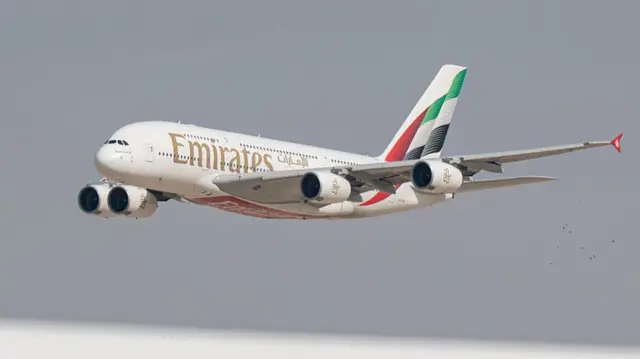
    Emirates airline, one of the country's national carriers, resumed "a reduced flight schedule" on Monday, after the Dubai Civil Aviation Authority temporary suspended flights at Dubai International Airport as "as a precautionary measure" following a fire.

    The nation's other flagship airline, Etihad Airways, has been operating "a limited commercial flight schedule" from Abu Dhabi.

    It said the decision "has been taken in coordination with relevant authorities following extensive safety and security assessments".

  11. Iran had warned US military action would trigger regional warpublished at 00:38 GMT 17 March

    Ghoncheh Habibiazad
    Senior reporter, BBC Persian

    Iran's late Supreme Leader Ayatollah Ali Khamenei had warned back in February that any US military action against Iran would trigger a wider regional war.

    Speaking at a ceremony marking the 47th anniversary of the 1979 Islamic Revolution on 1 February, Khamenei had said: "America should know that if it starts a war, this time it will be a regional war."

    Iranian officials had in the past issued several warnings about shipping and energy flows in the Strait of Hormuz.

    For example, Islamic Revolutionary Guard Corps (IRGC) naval commander Alireza Tangsiri wrote on X earlier this month that vessels attempting to cross the strait must obtain permission from Iran, claiming two ships had ignored warnings and "were trapped".

    Iran has also been regularly striking countries hosting US bases – Qatar, Bahrain, Jordan, the United Arab Emirates (UAE) and Kuwait – and US-allied Oman and Saudi Arabia.

    US President Donald Trump expressed surprise that Iran had attacked its Gulf neighbours.

    On Monday, Trump said that "nobody expected" Iran's leaders to fire missiles in retaliation for US-Israel strikes.

    "In the last two weeks, they weren't supposed to go after all these other countries in the Middle East," he said, BBC's US partner CBS reports.

    "Nobody expected that. We were shocked and they fought back. They could have yielded, but think of it if we weren't around. They had tremendous power."

  12. Australia releases fuel reserves as locals panic buypublished at 00:15 GMT 17 March

    Partial view of person holding a petrol pump about to put it into the tank in a carImage source, Getty Images

    Let's head to Australia for a moment, where the government recently announced a release of fuel reserves and officially approved the move last night, local time.

    That extra supply - 762 million litres of petrol and diesel - will start to flow through to consumers from today, and is expected to put some downward pressure on prices that have skyrocketed in recent weeks, mirroring similar scenes around the world.

    Petrol prices jumped almost 50 cents per litre across Australia’s five largest cities from 20 February to 11 March, with daily average prices around A$2.20 ($1.55; £1.17) per litre, according to the Australian Competition and Consumer Commission.

    In Australia's most populous state, New South Wales, authorities said 32 of its 3,000 petrol stations were running low or had run out of petrol.

    Long queues have been reported at petrol stations as locals stockpile fuel supplies, despite government calls to only buy what they need.

    "Get as much fuel as you need, but not less and not more because we're seeing a doubling of demand for fuel since the bombing of Iran," Energy Minister Chris Bowen told local media in recent days.

  13. UAE temporarily closes airspace amid missile and drone threats from Iranpublished at 23:51 GMT 16 March
    Breaking

    The United Arab Emirates' air defences are responding to incoming missile and drone threats from Iran, Reuters reports.

    The UAE's aviation authority has temporarily closed the country's airspace as "an exceptional precautionary measure", the state news agency reported on Tuesday, as cited by Reuters.

  14. Israel says Iran has fired a new wave of missilespublished at 23:33 GMT 16 March
    Breaking

    The Israeli military says missiles fired from Iran are heading towards the country and has urged people to head to shelters.

    "Defensive systems are operating to intercept the threat," the emergency alert posted on Telegram says.

  15. Fatalities reported across the region as war continuespublished at 23:17 GMT 16 March

    US military officials say the number of US service members who have been injured has climbed to about 200. At least 13 have died.

    In Iran more than 3,000 people have been killed since the US and Israel began the war with Iran on 28 February, according to one estimate by an Iranian group based outside the country.

    The Human Rights Activist News Agency (HRANA) says that includes 1,351 civilians and 1,126 military fatalities, with another 599 deaths which they could not precisely define as coming from the military or the civilian population.

    In Lebanon, 886 people have been killed, the country's health ministry reports, including 67 women and 111 children.

    Israel reports that 12 civilians have been killed.

    Other countries reporting war-related deaths include the United Arab Emirates, Kuwait, Saudi Arabia, Bahrain and Oman.

    Update 23 April 2026: This post has been updated to include the number of civilians killed in Israel up to the time it was originally published and also to add in the number of estimated deaths in Iran which could not be accurately assigned as civilian or military

  16. How is air travel being affected by the war in Iran?published at 23:00 GMT 16 March

    Emirates Airline - an A380 in the airImage source, Getty Images

    Air travel remains disrupted, with the US-Israel war in Iran forcing the closure of major transport hubs. Here's how some airlines have been impacted:

    Emirates: The UAE airline was gradually resuming flights to some destinations, authorities said, after a fire caused by a drone near the airport forced the temporary suspension of flights. However early on Tuesday morning, the UAE announced that it was temporarily closing its airspace as an "exceptional precautionary measure". How this will affect flights is currently unclear.

    Etihad Airways: The UAE carrier said it was operating a limited schedule of flights between Abu Dhabi and other destinations, however with the UAE's announcement of a temporary airspace closure, it is unclear how flights may be affected.

    Oman Air: Flights to and from certain destinations, including Dubai, Doha and Bahrain are cancelled until March 31.

    Qatar Airways: The airline announced that flights were still suspended due to the closure of Qatari airspace, but a revised limited number of flights will resume from 18-28 March.

    Turkish Airlines: Flights have been listed as cancelled from various destinations in the Middle East including Bahrain, Saudi Arabia, Iran, Iraq, Qatar and the United Arab Emirates.

    Meanwhile, a number of airlines including Air Canada, Delta, and Wizz Air have suspended flights to Tel Aviv until later in March.

    If you're due to travel, the advice is to check with your airline to make sure your flight hasn't been amended or cancelled.

  17. US allowing some Iranian ships to pass through Strait of Hormuzpublished at 22:48 GMT 16 March

    Scott BessentImage source, Reuters

    Earlier today, Treasury Secretary Scott Bessent said on CNBC that the US is allowing some Iranian oil tankers to navigate through the Strait of Hormuz.

    "The Iranian ships have been getting out already, and we’ve let that happen to supply the rest of the world. We've seen Indian ships go out now ... we believe some Chinese ships have gone out."

    Around 20% of the world's oil passes through the strait.

  18. BBC Verify

    Why did a Pakistani tanker take a longer route around the Strait of Hormuz?published at 22:32 GMT 16 March

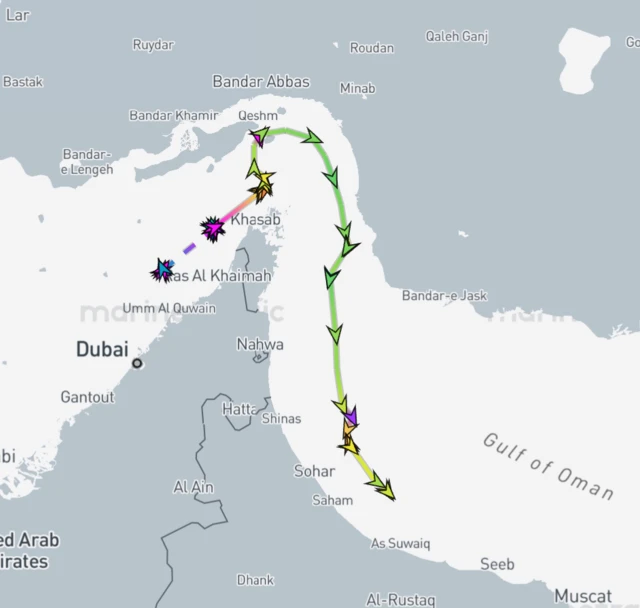
    A screengrab from tracking site MarineTraffic showing the course of tanker Pakistan as it headed north towards Iran before turning south into the Gulf of OmanImage source, MarineTraffic

    By Joshua Cheetham

    We’ve been tracking several vessels that appear to have passed through the Strait of Hormuz today.

    One of them is the Pakistan-flagged Karachi which is carrying a cargo of crude oil and is owned by the state-run Pakistan National Shipping Corporation.

    Looking at tracking data on MarineTraffic we can see it entered Iran’s Exclusive Economic Zone (EEZ), sailing between Qeshm and Larak islands, and close to the Iranian coast as it headed south.

    We asked former US Navy captain Bradley Martin why the ship may have taken such a long, unusual route through the area.

    Bradley, now a senior researcher at the US defence think tank Rand Corporation, says it may indicate the ship was “responding to some set of directions from Iran concerning passage”.

    He adds that its path could indicate the presence of mines, or it was chosen by Iran so it could be identified more easily among other traffic in the area.

    Jonathan Schroden, principle research scientist at the US-based Center for Naval Analyses, agrees the ship’s route could indicate there are mines in the area - or that Iran chose it because it wants to give the impression of mines as a deterrent.

  19. Who will help Trump in the Strait of Hormuz?published at 22:22 GMT 16 March

    President Donald Trump is criticising US allies for their reluctance to help break the Iranian blockade of the Strait of Hormuz - a vital waterway for oil and gas tankers.

    “I’m demanding that these countries come in," he said. "It’s the place from which they get their energy. And they should ... help us protect it”.

    No countries have yet committed to sending warships to the strait.

    In the latest edition of the Global News Podcast on YouTube, the BBC's diplomatic correspondent Paul Adams says that the wariness of Washington’s allies shows there is no quick fix to the Iran crisis.

    You can watch Adams as he provides context and analysis to the hesistance on the BBC's YouTube channel, external.

  20. Iran's foreign minister denies contact with US envoypublished at 22:05 GMT 16 March

    Iran's Foreign Minister Abbas Araghchi has denied US media reports that Washington has re-established communication with Tehran through Trump's special envoy Steve Witkoff.

    "My last contact with Mr. Witkoff was prior to his employer's decision to kill diplomacy with another illegal military attack on Iran," Araghchi says in a statement online.

    "Any claim to the contrary appears geared solely to mislead oil traders and the public."